


- 90% of enterprises are expected to run hybrid cloud architectures by 2027, yet most still lack a dedicated agility layer for operational workflows outside the SAP core (Aymax, 2026).
- Gartner projects 17,000 SAP ECC holdouts by 2027. Organizations need an extension strategy before migration is complete, not after.
- Mekari Officeless Marketplace provides 15 verified enterprise apps across procurement, HSE, DMS, and facility management, designed to sit alongside existing core systems without replacing them.
Most enterprises that run SAP built their ERP investment over years, sometimes decades. SAP handles their financials, procurement backbone, master data, and supply chain governance. It was never designed to handle everything.
The operational workflows that sit between business units and the SAP core, from HSE compliance to document management to facility operations, remain a persistent gap. And filling that gap by customizing SAP directly is precisely the approach SAP itself now discourages.
A SAP hybrid cloud strategy is the answer. Not as a path to tear out SAP and start over, but as a way to extend it, cleanly, without compromising the stability of the core.
What SAP hybrid cloud strategy actually means
In SAP, a hybrid cloud strategy is more than running workloads across on-premise and cloud infrastructure. It is an architectural approach built around the Clean Core principle: keeping the ERP core standardized and upgrade-safe while moving business-specific functionality to SAP BTP or other extension platforms.
Instead of embedding custom logic into SAP, organizations are encouraged to build extensions such as:
- Pricing engines
- Approval workflows
- Partner portals
- Industry-specific business processes
This approach reduces upgrade complexity while allowing greater flexibility. As adoption accelerates, industry analysts predict that 90% of organizations will use hybrid cloud by 2027, with the SAP market expected to grow from USD 46.18 billion in 2024 to USD 92.62 billion by 2033.
Why SAP alone cannot cover every business need
SAP excels at standard ERP functions such as finance, procurement, compliance, and master data management. However, operational processes often require capabilities beyond SAP’s standard scope, including:
- Procurement workflows
- HSE compliance
- Document management
- Facility operations
- Visitor management
Historically, these gaps were filled through custom “Z-code” embedded in SAP, making upgrades increasingly expensive and risky.
Under SAP’s Clean Core strategy, such customizations should instead be built as external applications connected via APIs. SAP’s extensibility model also recommends retiring Level D customizations that directly modify the core.
This shift is becoming increasingly urgent as mainstream SAP ECC support ends in 2027. With enterprise migrations typically taking 18–36 months, organizations that postpone their extension strategy risk rebuilding critical operational software after completing their S/4HANA migration.
The 3 layers of a practical SAP hybrid cloud architecture
A practical hybrid cloud architecture for SAP customers has three distinct layers:
- The stable core. SAP S/4HANA or ECC operating as the system of record for financials, procurement master data, compliance, and supply chain backbone. No modifications inside the core. This is what SAP calls Clean Core.
- The integration and platform layer. SAP BTP, APIs, and middleware that handle data flows, event triggers, and identity federation between the core and external applications. In this architecture, SAP S/4HANA functions as the system of record, while SAP BTP becomes the system of innovation, enabling agility without compromising stability.
- The agility layer. Purpose-built business software for the operational workflows that sit outside what the SAP core should absorb: procurement workflows, HSE compliance, document management, facility operations, visitor management. These applications connect to SAP via API and deliver speed and specificity that the core cannot.
What happens when enterprises try to solve this inside SAP
Companies are under pressure to digitalize and automate processes quickly while integrating them cleanly into SAP. In practice, the transformation does not have to take the form of a radical cloud migration. Hybrid architectures and low-code platforms are establishing themselves as a pragmatic way of combining modernization and stability.
But many enterprises still default to building inside SAP when new operational requirements arise. The consequences compound over time:
- Upgrades become expensive and risky. Every piece of custom code inside S/4HANA must be re-tested and often rebuilt with each new SAP release. The more Z-code accumulates, the higher the upgrade cost.
- AI adoption is blocked. SAP’s Joule and emerging autonomous agents require clean, standardized data. Custom code and data silos embedded in the core undermine the data foundation that AI needs to function.
- Delivery timelines stretch. Getting a new procurement workflow or HSE compliance module built inside a heavily customized SAP environment can take months. Business units wait. Agility suffers.
More customers now look beyond their SAP core when planning transformation programs. In 2026, there is significantly more interest in moving or consolidating non-SAP applications such as EAM and HR systems into SAP landscapes through integration rather than into the SAP core itself.
The pattern is clear: the best SAP customers are extending outward, not customizing inward.
Mekari Officeless as the SAP extension layer
Mekari Officeless is not an ERP replacement. It is the agility layer: a marketplace of pre-built, enterprise-grade business software designed to sit alongside SAP and deliver the operational capabilities that a clean SAP core cannot absorb.
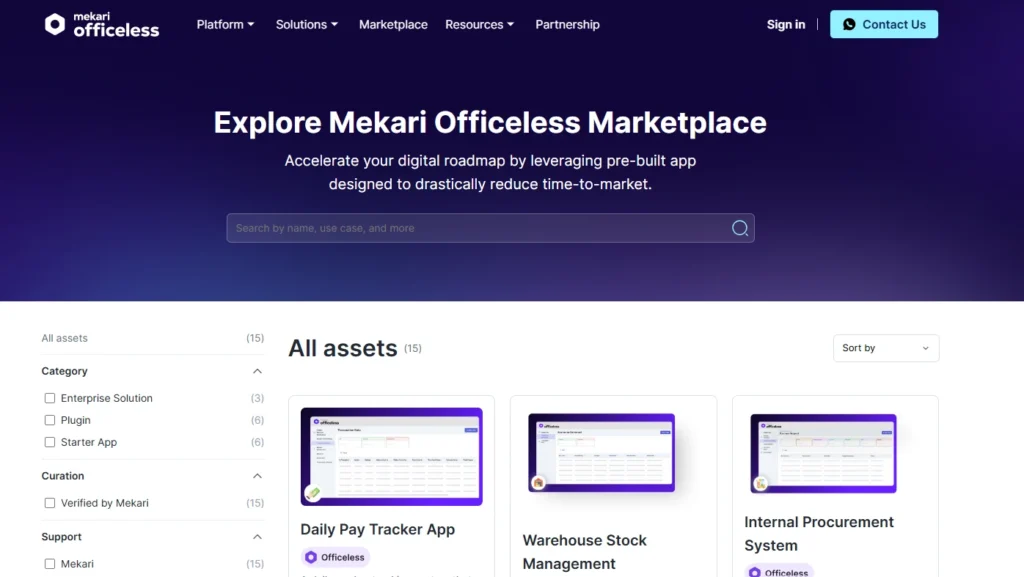
The Mekari Officeless Marketplace provides 15 verified enterprise applications across:
- eProcurement and Source-to-Pay: End-to-end procurement workflows including vendor management, RFQ, bidding, contract management, and purchase-to-pay automation.
- Document Management System: Centralized, customizable document database and workflows with multi-level approvals, audit trails, and version control.
- HSE (Health, Safety, and Environment): Compliance management, incident reporting, and safety workflows built for regulated industries.
- Workplace Management: Tools to connect distributed teams and manage the modern office environment.
- Facility Management: Asset maintenance, daily operations, and building management workflows.
- Visitor Management: Front-desk check-in digitalization and secure site access control.
All applications are verified by Mekari, built on the Officeless platform, and designed for enterprise deployment. The platform supports custom workflows, multi-level approval structures, API integration with existing core systems, real-time reporting, and analytics.
For enterprises on SAP, the integration path is straightforward. SAP remains the system of record for master data and financial controls. Officeless handles the operational layer, connecting via API without touching the SAP core. No Z-code. No upgrade risk. No multi-month implementation project.
Who needs this: enterprises on SAP in Indonesia and Southeast Asia
This architecture is particularly relevant for:
- Enterprises on SAP ECC planning the 2027 migration. The migration window is closing. Defining which operational workflows should live outside the SAP core, and deploying them now, reduces the scope of what needs to be rebuilt post-migration. Navigating the right ECC support path requires clarity on strategy, risk, and commercial implications before any commitment is made. The extension architecture is part of that strategy.
- Enterprises already on S/4HANA pursuing Clean Core. If your organization has committed to keeping S/4HANA as close to standard as possible, you already know that operational software for procurement workflows, HSE, and document management should not live inside the core. Officeless is the ready-made answer.
- IT leaders and CFOs under delivery pressure. Business units need operational software delivered in weeks. Building inside SAP takes months and accumulates technical debt. The Officeless Marketplace provides pre-built apps that can be deployed rapidly, integrated via API, and governed through the same platform.
- Indonesian conglomerates with multi-entity operations. The Officeless platform is built for scale across entities, with configurable approval structures, multi-language support, and regional compliance requirements for the Indonesian market.
How to get started
Extending SAP with Mekari Officeless does not require replacing what you already have. The starting point is identifying the operational gaps: the workflows your business units need that should not live inside the SAP core.
A practical approach:
- Identify the operational workflows currently being handled through email, spreadsheets, or legacy tools that your SAP core does not cleanly cover (procurement approvals, HSE incident tracking, document sign-off workflows, facility requests).
- Browse the Mekari Officeless Marketplace to find pre-built apps that match those needs. Every app is enterprise-verified and ready to deploy.
- Connect Officeless to your SAP environment via API. Your SAP core remains untouched. Your Clean Core strategy stays intact.
- Deploy in weeks, not months. Avoid Z-code. Stay upgrade-ready for your S/4HANA migration or your next ECC extended maintenance cycle.
Your SAP investment handles the backbone. Mekari Officeless handles the rest.
Explore the Mekari Officeless Marketplace.
References and methodology
Methodology
Methodology
Articles published by Mekari Officeless are developed using trusted sources, including official data, company reports, academic research, and insights from industry practitioners. Whenever possible, we refer directly to primary sources before drawing conclusions. Our editorial team reviews and verifies the information to ensure accuracy and relevance. All references are listed so readers can trace each piece of information back to its original source.
Our editorial standards
Our editorial standards
- Primary source first: We consult official product documentation and pricing pages directly, not secondhand summaries or aggregator sites.
- Fact-checking: All product features, pricing, and claims are cross-verified against each platform’s official website at the time of writing.
- No paid placement: Tools are selected based on relevance and fit for Indonesian businesses, not commercial arrangements. Mekari Officeless is included as a first-party product and is transparently labeled as such.
- Regular review: Articles are periodically updated to reflect product changes or shifts in market relevance.
References
References
SNP Group. ”Key SAP Transformation Trends in 2026”
SAPinsider. ”SAP Cloud Strategy Benchmark 2026”
Crowe Indonesia. ”SAP ECC Support Ends in 2027”