



- Only 50% of SAP implementation projects meet initial expectations, making iterative agile delivery a critical risk mitigation strategy.
- SAP Activate’s agile-aligned approach can shorten implementation timelines by 20-30% compared to traditional waterfall methods.
- Mekari Officeless Marketplace offers 15 pre-built, Mekari-verified apps that extend SAP infrastructure without triggering a new implementation cycle.
SAP investments are significant, but business requirements move faster than waterfall implementation cycles can absorb. The result: cost overruns, scope mismatches, and systems that are technically live but operationally inadequate.
SAP agile methodology was designed to close that gap. By applying iterative, sprint-based delivery to SAP environments, organizations can course-correct continuously rather than discovering misalignment at go-live.
This guide covers what SAP agile methodology is, its phases, its real challenges, and how decision-makers can extend their SAP infrastructure without another full redevelopment cycle.
What is SAP agile methodology
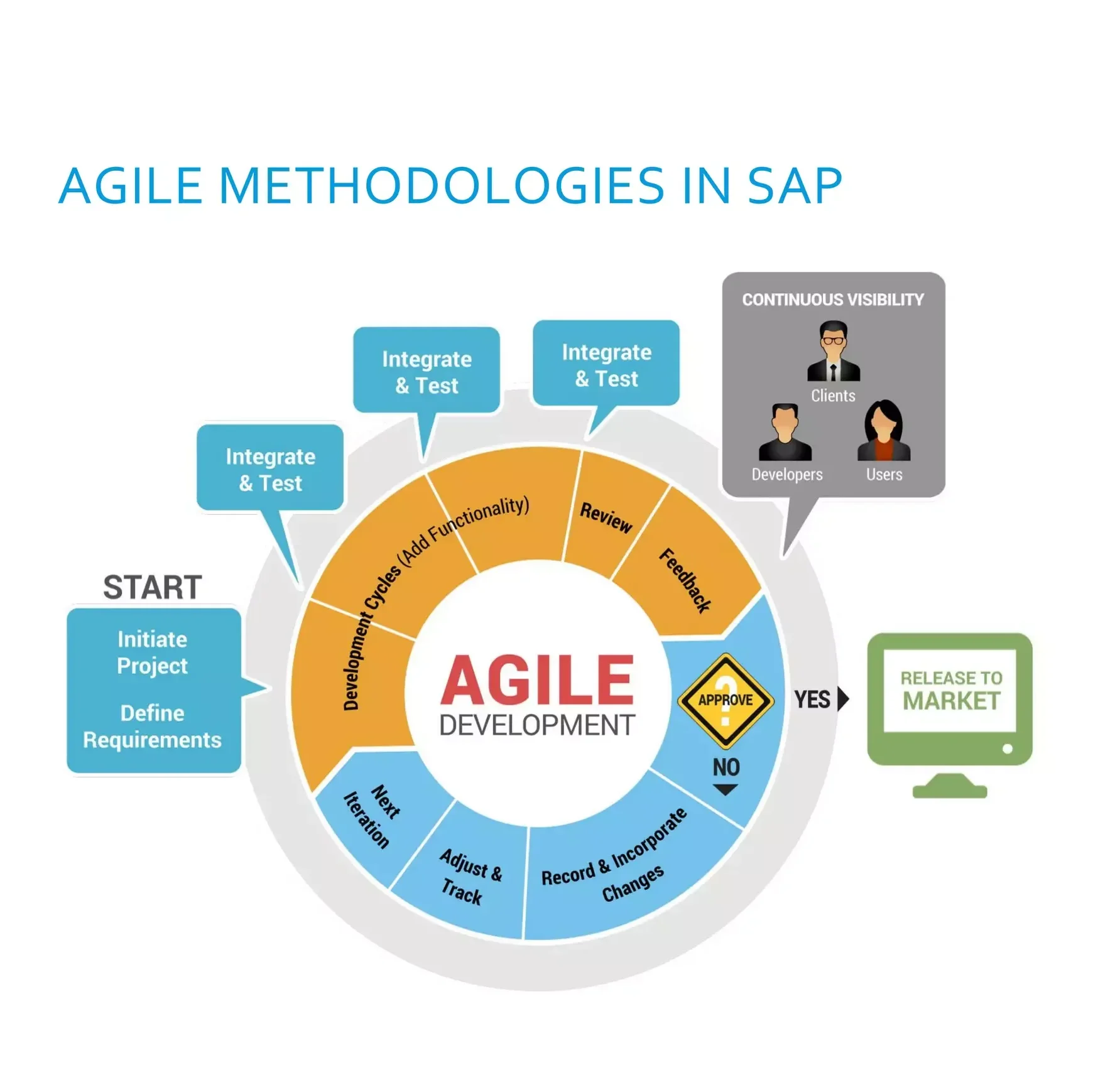
SAP agile methodology adapts agile principles to SAP implementation and development projects, breaking work into shorter sprints that each deliver testable, working functionality instead of one long sequential rollout. It centers on a few core principles:
- Incremental delivery
- Continuous stakeholder feedback
- Cross-functional team collaboration
- Adaptability to changing requirements
Because SAP’s tightly integrated modules, strict data governance, and enterprise compliance needs add complexity, sprints typically run 4–5 weeks instead of the standard 2-week cycle. Three roles anchor SAP agile teams:
- Product Owner – manages the backlog and prioritizes by business value
- Scrum Master – coaches the team and removes blockers
- Development Team – SAP consultants, functional analysts, testers, and developers working as one cross-functional unit rather than separate silos
The driver behind adopting this approach is simple — only 50% of SAP implementations meet initial expectations, and agile gives teams a way to catch misalignment early, before it turns into a sunk cost.
SAP Activate: the official agile framework
SAP Activate is SAP’s modern implementation methodology and the official framework for delivering SAP agile projects, built to replace the older waterfall-based ASAP approach for S/4HANA and cloud deployments. It rests on three pillars:
- Methodology – roadmap, roles, and governance structure
- Best Practices – pre-configured, industry-aligned process content
- Guided Configuration – step-by-step tooling for system setup
The biggest shift from ASAP is how requirements are handled. ASAP required a fully approved business blueprint before any configuration could start, assuming requirements were stable upfront.
SAP Activate instead uses fit-to-standard workshops, comparing business processes directly against SAP’s best-practice configurations to spot gaps rather than documenting everything from scratch.
The payoff is measurable: SAP Activate can cut implementation timelines by 20–30% compared to waterfall, while still preserving the phase-gate governance enterprise projects need.
SAP agile methodology phases
SAP Activate organizes delivery into six phases. Each builds on the previous, with the Realize phase serving as the agile execution core where sprint cycles happen.
- Discover. The initial phase focuses on scoping and justification. Teams develop the business case, assess organizational readiness (technical, process, and people dimensions), and define the implementation scenario. A trial system in the cloud is often used to give stakeholders early exposure to the solution before commitment.
- Prepare. The project officially starts here. Governance is established, the project team is onboarded and assigned roles, infrastructure is provisioned, and high-level plans are finalized including go-live milestones. Preparatory work in this phase directly determines the efficiency of every sprint that follows.
- Explore. This is the fit-to-standard phase. Functional workshops compare current business processes against SAP best practice configurations to identify where standard functionality is sufficient and where delta requirements (custom configurations or developments) are needed. The output is a prioritized delta list that becomes the sprint backlog for the Realize phase.
- Realize. The agile core of the project. The team works in iterative sprints to configure the SAP system based on Explore findings, develop any required extensions (RICEFW objects), run unit testing, and progressively integrate components. Each sprint is prioritized by the Product Owner based on business value. Stakeholder demos at the end of each sprint confirm alignment before the team proceeds.
- Deploy. This phase transitions the system to production readiness. Activities include user acceptance testing using pre-delivered SAP test scripts, final data migration, end-user training, and resolution of UAT issues. The system is fully validated before go-live authorization.
- Run. Post-go-live, the focus shifts to ongoing support and continuous improvement. Incidents are resolved, enhancements are planned and delivered in new sprints, and the system is kept aligned with evolving business needs and SAP release updates.
Key benefits of SAP agile development
The business case for SAP agile methodology rests on five outcomes that matter to decision-makers.
- Faster time-to-value. Working functionality is delivered in incremental sprints rather than in a single release at the end of a multi-year waterfall project. Business units gain access to operational improvements sooner.
- Reduced rework costs. Continuous stakeholder involvement in sprint reviews surfaces misalignments early, when correcting them is relatively cheap. In waterfall projects, misalignments surface at testing or go-live, when rework is expensive and schedule-breaking.
- Better change adaptability. Requirements can evolve between sprints without destabilizing the overall project. The agile framework is built to absorb change rather than resist it.
- Improved cross-functional collaboration. Agile SAP delivery integrates consultants, developers, testers, and business analysts into cohesive teams. This eliminates the handoff delays that characterize siloed SAP workstreams.
- Balanced governance. Shared dashboards, sprint velocity tracking, and phase-gate approvals maintain the visibility and control that enterprise governance requires, without sacrificing agile speed.
Common challenges of SAP agile implementation
Understanding the benefits without acknowledging the constraints is insufficient for decision-makers evaluating SAP agile methodology.
- Change management across integrated modules. SAP’s tightly coupled architecture means a change in one module often creates downstream impacts in others. Managing these dependencies within short sprint cycles requires disciplined backlog governance and experienced technical oversight.
- Parallel development friction. Teams running concurrent sprints on different modules risk destabilizing the functioning baseline system. This is one reason SAP agile projects run longer sprint cycles than standard software projects.
- Data governance pressure. Agile’s emphasis on speed can conflict with SAP’s strict data integrity and compliance requirements. Organizations need explicit governance controls to ensure rapid iteration does not introduce data quality or regulatory risk.
- Stakeholder availability. Fit-to-standard workshops in the Explore phase, and sprint reviews in the Realize phase, require consistent participation from business-side decision-makers. Their unavailability is one of the most common causes of sprint delays.
- Sprint length mismatch. Standard agile frameworks assume 2-week sprints. SAP’s integration complexity typically requires 4 to 5-week sprint cycles. Teams unfamiliar with SAP-specific agile adaptations often underestimate this and plan unrealistically.
Why SAP agile alone is not enough for enterprise operations
SAP Activate is a powerful implementation framework, but it is not a complete solution for extending SAP’s operational coverage across every enterprise workflow. After go-live, organizations often encounter the same challenge: SAP best practices do not cover every industry-specific or locally mandated process. Common gaps include:
- Health, safety, and environment (HSE) compliance
- Facility operations
- Visitor access management
- Custom procurement approval workflows
Addressing these requirements within SAP typically requires costly custom ABAP development, additional SAP licensing, dedicated development resources, and the overhead of another implementation cycle.
For organizations that have already invested heavily in SAP infrastructure, this creates a significant barrier to innovation. The challenge is no longer whether SAP should be extended, but how to do so without repeating the cost, complexity, and lengthy timeline of the original implementation.
How Mekari Officeless Marketplace extends your SAP infrastructure
Mekari Officeless Marketplace is a curated library of pre-built, Mekari-verified enterprise applications built for exactly this challenge: extending operational infrastructure without full-scale redevelopment.
The Marketplace currently offers 15 verified applications across three solution categories:
- Enterprise Solutions for complex, organization-wide operational needs
- Plugins that add targeted functionality to existing workflows
- Starter Apps that provide deployment-ready foundations for common business processes
These applications support both cross-industry operations and sector-specific requirements across Construction & Real Estate, Distribution & Rental, and Hospitality & Consumer Services. Every solution is verified by Mekari, ensuring consistent quality, documentation, and long-term support.
Rather than serving as a generic app store, the Marketplace acts as a governed extension layer for enterprises that need to fill operational gaps quickly.
For organizations running SAP environments, it complements SAP Activate by enabling faster deployment of operational workflows without the cost, complexity, and risk of custom development.
Ready to maximize your existing infrastructure? Explore the full application library at Mekari Officeless Marketplace.
References and methodology
Methodology
Methodology
Articles published by Mekari Officeless are developed using trusted sources, including official data, company reports, academic research, and insights from industry practitioners. Whenever possible, we refer directly to primary sources before drawing conclusions. Our editorial team reviews and verifies the information to ensure accuracy and relevance. All references are listed so readers can trace each piece of information back to its original source.
Our editorial standards
Our editorial standards
- Primary source first: We consult official product documentation and pricing pages directly, not secondhand summaries or aggregator sites.
- Fact-checking: All product features, pricing, and claims are cross-verified against each platform’s official website at the time of writing.
- No paid placement: Tools are selected based on relevance and fit for Indonesian businesses, not commercial arrangements. Mekari Officeless is included as a first-party product and is transparently labeled as such.
- Regular review: Articles are periodically updated to reflect product changes or shifts in market relevance.
References
References
Surety Systems. ”Using SAP Agile Methodology to Streamline Software Development”