


Fixed assets can represent 30–50% of a company’s total balance sheet. Yet most organizations still rely on disconnected spreadsheets, manual registers, and reactive maintenance, leaving billions in asset value unmanaged and billions more in compliance risk unaddressed. Asset lifecycle management changes that.
This guide covers what asset lifecycle management is, its five stages, the business benefits, common pitfalls, and how a custom digital solution built for Indonesian enterprise processes can deliver the full value of ALM.
What is Asset Lifecycle Management (ALM)?
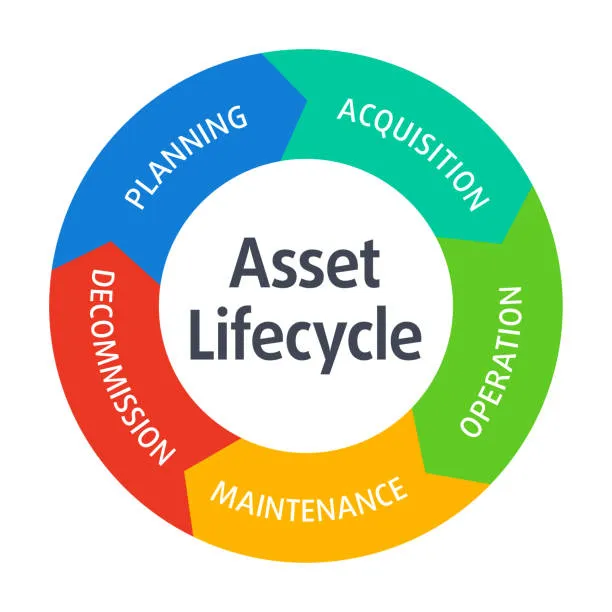
Asset Lifecycle Management (ALM) is the end-to-end process of managing assets—from planning and acquisition to operation, maintenance, and disposal—to maximize value while minimizing total ownership costs.
Key points:
- More than asset tracking: Tracking shows where an asset is; ALM evaluates whether it is delivering optimal value, performance, and compliance at the right cost and risk level.
- Based on ISO 55000: Asset management is defined as coordinated activities that balance cost, risk, opportunity, and performance throughout an asset’s lifecycle.
- Applies to all asset types: Including machinery, equipment, buildings, vehicles, IT hardware and software, cloud infrastructure, and facility assets such as HVAC and electrical systems.
- Supports regulatory compliance: In Indonesia, ALM helps organizations comply with PSAK 16 requirements for fixed assets and align depreciation practices with applicable tax regulations, including PMK No. 72 of 2023.
The five stages of the asset lifecycle
Every asset passes through five distinct stages. Understanding what happens, what decisions are required, and what can go wrong at each stage is the foundation of effective ALM.
Stage 1: Planning
The planning phase determines what assets the organization actually needs, aligned with business objectives. Key activities include needs assessment, inventory audit of existing assets (to avoid duplicating capacity already on hand), budget allocation, and definition of vendor evaluation criteria.
Failure to plan properly leads to over-purchasing, premature CAPEX commitments, and assets that underperform against organizational needs. Digital twin technology is increasingly used at this stage to simulate asset performance before a purchase decision is made.
Stage 2: Acquisition
Once requirements are defined, the organization moves to procurement: vendor selection, contract negotiation, delivery, installation, and commissioning. Under PSAK 16, the acquisition cost recorded must include the purchase price plus all costs directly attributable to bringing the asset to its intended location and condition, including freight, installation, and testing.
Without a structured ALM system, asset costs are frequently recorded incompletely, and assets enter operations before being registered in the fixed asset register, creating immediate compliance exposure.
Stage 3: Operation and deployment
After commissioning, the asset enters productive use. This stage involves tracking location, assigned user or department, utilization rate, and operational condition. Baseline performance benchmarks are established against which future condition assessments are measured.
A critical failure at this stage is the emergence of “ghost assets”: items recorded as active in the fixed asset register that are physically missing, broken, or idle. Ghost assets inflate depreciation charges and distort balance sheet values, directly undermining the accuracy of PSAK 16 disclosures.
Stage 4: Maintenance
Maintenance is where the most significant cost and risk decisions occur. A well-managed ALM program shifts maintenance from reactive (responding to failures after they occur) to preventive (addressing potential issues before they escalate).
The 2026 Brightly Asset Lifecycle Report confirms this shift is accelerating: in 2024, 52% of organizations reported that one-quarter to one-half of their annual work orders were reactive. By 2025, that number dropped to 22%, with 35% of organizations now reporting less than one-tenth of maintenance is reactive.
Stage 5: Disposal or replacement
The final stage involves deciding whether to repair, replace, repurpose, or retire the asset. This decision should be data-driven: comparing the remaining book value against the projected cost of continued maintenance and the performance trajectory of the asset.
For tangible fixed assets, PSAK 16 requires proper derecognition from the balance sheet upon disposal, with any gain or loss recognized in profit or loss. For IT assets, disposal requires certified data wiping. For physical assets, compliant disposal must account for environmental regulations.
Manual vs. automated ALM: a direct comparison
| Activity | Manual approach | Automated ALM |
| Asset registration | Spreadsheet entry, error-prone | Auto-registered with barcode or QR at acquisition |
| Depreciation calculation | Manual per asset | Automated per PSAK 16 and PMK schedules |
| Maintenance scheduling | Ad hoc or calendar-based | Rule-triggered preventive maintenance alerts |
| Disposal decision | Based on age or assumption | Data-driven: cost vs. performance analytics |
| Compliance reporting | Manual consolidation | Real-time dashboard with full audit trail |
Why asset lifecycle management matters: key business benefits
A structured Asset Lifecycle Management (ALM) approach helps organizations improve asset performance, control costs, and maintain compliance throughout the asset lifecycle.
Key benefits include:
- Lower maintenance costs through planned maintenance, asset performance monitoring, and optimized replacement strategies.
- Higher asset utilization by ensuring assets are used efficiently and operate at peak performance.
- Reduced unplanned downtime with proactive maintenance and early identification of potential failures.
- Extended asset lifespan through data-driven maintenance, repair, and renewal decisions.
- Better capital planning by providing visibility into asset condition, replacement schedules, and future investment requirements.
- Stronger compliance and audit readiness by maintaining accurate records for asset valuation, depreciation, revaluation, and disposal in line with PSAK 16 and other regulatory requirements.
- Improved decision-making through centralized asset data, analytics, and lifecycle insights that support cost, risk, and performance optimization.
Manufacturing facilities using comprehensive lifecycle management report 22% higher overall equipment effectiveness (OEE), while infrastructure organizations achieve up to 35% longer asset service lives through optimized maintenance and replacement strategies. (PreventiveHQ, 2025)
Common challenges in managing asset lifecycles
Even organizations that recognize the value of ALM frequently struggle with implementation. Here are the most common challenges.
- Fragmented data. Asset records are spread across ERP modules, maintenance systems, spreadsheets, and paper files, with no unified source of truth. Finance tracks depreciation in one system; operations manages maintenance in another; procurement handles acquisition in a third.
- Ghost assets. Assets that appear active in records but are physically missing, broken, or decommissioned inflate both the fixed asset register and ongoing depreciation charges, directly affecting PSAK 16 accuracy.
- Reactive maintenance culture. Despite the proven cost advantages of preventive approaches, many organizations still default to responding to failures rather than preventing them, largely because they lack the data infrastructure to schedule proactive interventions.
- Compliance exposure. Without complete lifecycle records, companies cannot meet PSAK 16 disclosure requirements, including reconciliation of asset carrying amounts, depreciation basis, and disposal details.
- Poor capital allocation. When decisions about replacement or repair are based on asset age rather than actual condition and performance data, organizations either replace assets prematurely (wasted capital) or retain them too long (rising maintenance costs and increasing failure risk).
- Generic software misfit. Off-the-shelf ALM tools are pre-configured for generic workflows. Enterprises with complex approval hierarchies, multi-site structures, or industry-specific asset profiles often find they spend more time working around the software than working with it. The tool dictates the process rather than the process dictating the tool.
How Mekari Officeless delivers custom asset lifecycle management
Mekari Officeless is a platform to democratize business app creation, workflow automation, and analytics across Indonesia by empowering teams to build and supporting organizations to scale by generating innovative idea solutions.
For asset-intensive organizations, this means building an end-to-end ALM system that reflects the company’s own processes rather than adapting to a vendor’s default configuration.
Here is what a custom Mekari Officeless ALM implementation includes:
- Custom asset registry: A centralized, searchable asset database configured to the company’s own categories, fields, location hierarchy, and classification structure. No generic templates.
- Lifecycle workflow automation: Every stage of the asset lifecycle, from acquisition request and approval routing through maintenance scheduling, condition assessment, and disposal authorization, runs through configured automated workflows.
- Multi-level approval flows: Asset procurement, maintenance work orders, and disposal approvals route automatically through the right stakeholders, matching the company’s exact internal hierarchy.
- Preventive maintenance scheduling: Rules-based maintenance triggers set by time interval, usage hours, or condition threshold, with automatic task assignment and completion tracking.
- Depreciation and financial integration: Depreciation calculations configured to align with PSAK 16 and PMK No. 72/2023, connected to Mekari Jurnal for seamless financial reporting.
- Real-time dashboards and reporting: Unified visibility across asset utilization, maintenance status, upcoming replacement windows, and compliance readiness.
- Mekari ecosystem integration: Connect with Mekari Jurnal for accounting, Mekari Expense for operational cost control, Mekari Sign for digitizing asset transfer and disposal documents, and Mekari Pay for vendor payment management.
As a reference, PT Asuransi Takaful Keluarga achieved 100% paperless operations and reduced approval cycles by 50% after centralizing their operational management and spend control through the Mekari Officeless platform.
Ready to stop managing your assets across disconnected spreadsheets and generic tools? Mekari Officeless builds a custom asset lifecycle management system tailored exactly to your processes, workflows, and compliance requirements.
Build Your Custom ALM System with Mekari Officeless.
References and methodology
Methodology
Methodology
Articles published by Mekari Officeless are developed using trusted sources, including official data, company reports, academic research, and insights from industry practitioners. Whenever possible, we refer directly to primary sources before drawing conclusions. Our editorial team reviews and verifies the information to ensure accuracy and relevance. All references are listed so readers can trace each piece of information back to its original source.
Our editorial standards
Our editorial standards
- Primary source first: We consult official product documentation and pricing pages directly, not secondhand summaries or aggregator sites.
- Fact-checking: All product features, pricing, and claims are cross-verified against each platform’s official website at the time of writing.
- No paid placement: Tools are selected based on relevance and fit for Indonesian businesses, not commercial arrangements. Mekari Officeless is included as a first-party product and is transparently labeled as such.
- Regular review: Articles are periodically updated to reflect product changes or shifts in market relevance.