


- SAP B1 implementation typically takes 3–6 months and costs IDR 50M+ just for initial setup, before customization or consulting fees.
- The native HR and payroll module is rated “basic” by independent reviewers and requires add-ons for most real-world use cases.
- Mekari Officeless deploys in days or weeks alongside SAP B1, closing procurement, HSE, and document workflow gaps without replacing your ERP core.
SAP Business One is one of the most recognized ERP systems for small and midsize businesses worldwide. It consolidates finance, inventory, purchasing, CRM, and reporting into a single platform.
But every ERP has trade-offs, and SAP B1 is no exception. Before committing to an implementation, procurement teams and business leaders need to understand both what it delivers and where it falls short.
This guide breaks down the real pros and cons of SAP Business One, including Indonesia-specific cost context, and explains how companies can fill the gaps faster with a surrounding platform like Mekari Officeless.
What is SAP Business One?
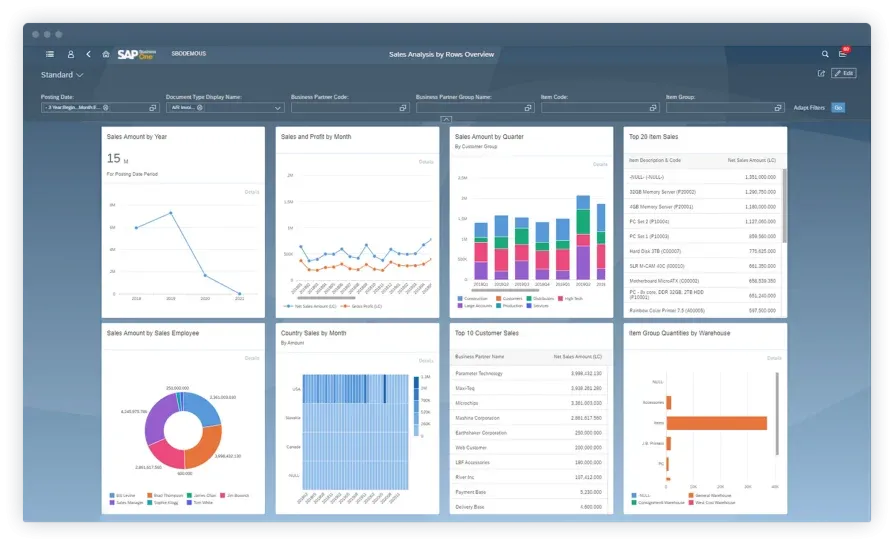
SAP Business One (SAP B1) is an ERP solution designed for small and midsize businesses, helping organizations manage core operations from a single platform. Unlike SAP’s enterprise-focused products such as S/4HANA or SAP ECC, SAP B1 is purpose-built for growing companies and includes:
- Accounting and financial management for budgeting, invoicing, and financial reporting
- Sales and customer relationship management (CRM) to manage leads, quotations, orders, and customer interactions
- Purchasing and procurement to streamline supplier management and purchasing workflows
- Inventory and warehouse management with real-time stock visibility across locations
- Production planning to support manufacturing operations and resource planning
- Reporting and analytics, including integration with SAP HANA for faster in-memory reporting and business insights
SAP Business One is available as either an on-premise deployment or a private cloud subscription, giving businesses flexibility in how they manage their infrastructure.
It is widely used across manufacturing, distribution, retail, and professional services, with its biggest strength being the ability to centralize data across departments. For example, a sales order can automatically update inventory levels, trigger purchasing activities, and provide real-time visibility into business performance.
SAP Business One pros
Integrated, centralized business data
SAP Business One connects data across sales, inventory, logistics, and finance in real time, eliminating duplicate data entry and reducing errors caused by disconnected systems. For businesses managing multiple warehouses or product lines, this creates a single source of truth, while features like the Relationship Map provide end-to-end visibility from purchase order through payment.
Strong financial management and reporting
Financial management is one of SAP B1’s strongest capabilities, covering accounts payable and receivable, multi-currency transactions, tax compliance, bank reconciliation, and financial reporting. Interactive dashboards, customizable KPIs, and built-in reports help finance teams close books faster, while transaction transparency supports internal audits.
Flexible customization and add-on ecosystem
Beyond its core ERP features, SAP B1 is highly customizable. Users can modify layouts, build reports, and configure workflow alerts without coding, while businesses with more complex requirements can extend the platform using hundreds of industry-specific add-ons and integrations.
Scalable for growing SMBs
SAP B1 is designed to grow alongside the business. Companies can add users, modules, and branches without replacing the system, while localization support and multi-entity capabilities make it suitable for regional expansion.
Multiple deployment options
Businesses can deploy SAP B1 on-premise for greater control over infrastructure and data or choose a private cloud subscription to reduce IT management and move to a predictable operating expense model. Hybrid deployments are also supported.
Real-time inventory and supply chain visibility
SAP B1 provides real-time inventory tracking across multiple warehouses, with support for batch and FIFO management, automated goods receipts, and supply chain reporting. This improves purchasing decisions while reducing stock shortages and excess inventory.
SAP Business One cons
High total cost of ownership
SAP B1 requires a significant upfront investment beyond licensing. Businesses also need to budget for implementation, consulting, training, maintenance, data migration, and add-ons, making the total cost difficult to justify for smaller organizations without a clear ROI.
| Cost Component | Typical Range (Indonesia) |
| Perpetual license per user | IDR 50M – IDR 150M (one-time) |
| Implementation and consulting | IDR 100M+ (varies by complexity) |
| Annual maintenance | 15–20% of total license value per year |
| Add-ons and customizations | +10–30% of total |
| Implementation timeline | 3–6 months (standard) |
Complex, time-consuming implementation
A typical implementation takes 3–6 months, while larger or heavily customized projects can take much longer. Successful deployments require dedicated internal resources, experienced implementation partners, and strong executive sponsorship.
Steep learning curve
Although feature-rich, SAP B1’s interface can feel dated and less intuitive than modern cloud software. Most organizations need structured user training, and advanced configuration often requires support from certified SAP partners.
Limited native HR and payroll capabilities
SAP B1 includes basic employee management but does not process payroll natively. Businesses typically need third-party payroll solutions or add-ons to handle statutory requirements and local compliance, including Indonesia-specific payroll regulations.
Advanced procurement requires add-ons
The built-in purchasing module covers standard procurement processes, but advanced capabilities such as e-sourcing, supplier evaluations, multi-level approvals, and sourcing analytics generally require customization or third-party extensions.
Mobile access limitations
While SAP B1 provides web and mobile access, the experience is more limited than many cloud-native ERP platforms. This can be restrictive for field teams, sales representatives, and managers who frequently approve transactions on the go.
Dependence on certified SAP partners
Most advanced customizations, integrations, and ongoing system enhancements require certified SAP consultants or implementation partners. While this ensures quality, it also increases long-term support costs and creates greater vendor dependency.
SAP Business One pricing in Indonesia
Understanding cost in the Indonesian market requires looking beyond the license sticker price. Here is a realistic breakdown:
- Licensing costs: Perpetual licenses are the most common model in Indonesia. Costs vary by license type (professional, limited, or starter) and are priced per user. Authorized SAP resellers in Indonesia typically offer flexibility on payment terms, including multi-year discounts and periodic payment options.
- Implementation and consulting: Initial installation and configuration in Indonesia starts at IDR 100 million for simpler setups. Business process consulting, which covers requirements gathering and solution design, adds further cost depending on the complexity of the project and the number of custom modules.
- Annual maintenance: After go-live, companies pay an annual support and maintenance fee of around 15–20% of the total license value. This covers software updates, bug fixes, and technical support access.
- Hidden costs to plan for: Add-ons for payroll, advanced procurement, HR, or e-commerce; integration fees for connecting SAP B1 to existing systems; additional storage as data volumes grow; and training sessions for new users or after organizational changes.
For SMEs in Indonesia, a realistic total cost of ownership for the first three years often runs significantly above the initial license quote. Careful TCO analysis before signing is essential.
Who should and should not use SAP Business One
SAP B1 is a strong fit if:
- Your business is an SMB in manufacturing, distribution, or professional services with complex inventory and financial management needs
- You have a dedicated IT resource or budget for a certified SAP implementation partner
- You are making a long-term ERP investment and can absorb a 3–6 month implementation period
- You need deep financial reporting, multi-entity management, or multi-warehouse inventory control
- You require localization support for tax and accounting compliance across multiple countries
SAP B1 may not be the right fit if:
- You need to deploy operational workflows (procurement, HSE, facility management) in weeks, not months
- Your team lacks internal SAP expertise and budget for ongoing partner support
- You need native HR and payroll without additional integration projects
- Your procurement needs go beyond basic purchasing and into structured sourcing, competitive bidding, or vendor lifecycle management
- Your primary operational gaps are outside finance and inventory
How Mekari Officeless extends SAP Business One without replacing it
SAP Business One is a strong foundation for finance and inventory management. But for businesses that also need structured procurement workflows, HSE compliance, document management, or operational visibility across facilities and workplace management, the gaps are real and filling them through SAP’s add-on ecosystem often means more time, more cost, and more consultant hours.
Mekari Officeless is a platform to democratize business app creation, workflow automation, and analytics across Indonesia by empowering teams to build and supporting organizations to scale by generating innovative idea solutions.
Mekari Officeless is designed to work alongside SAP B1, not replace it. It is an enterprise platform that covers the operational workflows SAP B1 does not prioritize natively, and it deploys in days or weeks rather than months.
Where SAP B1 excels at the financial and inventory core, Mekari Officeless extends the stack across:
- Source-to-Pay (S2P): End-to-end procurement from vendor sourcing and competitive bidding through to payment, with pre-built workflows that do not require custom development from scratch
- Document Management System (DMS): Centralized, structured document workflows with audit trails and approval flows
- HSE (Health, Safety, and Environment): Build secure environments, manage compliance checklists, and streamline regulatory reporting
- Workplace and Facility Management: Connect teams, manage assets, and keep building operations running smoothly
- Visitor Management: Modernize access control and front-desk operations with structured digital check-ins
For companies already running SAP B1 for core ERP functions, Mekari Officeless fills the gaps that would otherwise require months of SAP customization or expensive add-on licensing. It is more affordable to deploy, faster to get live, and purpose-built for the Indonesian market.
Ready to extend what your SAP Business One investment can do? Mekari Officeless gives you the surrounding operational layer you need, deployed faster and at a lower cost than adding it through SAP alone.