


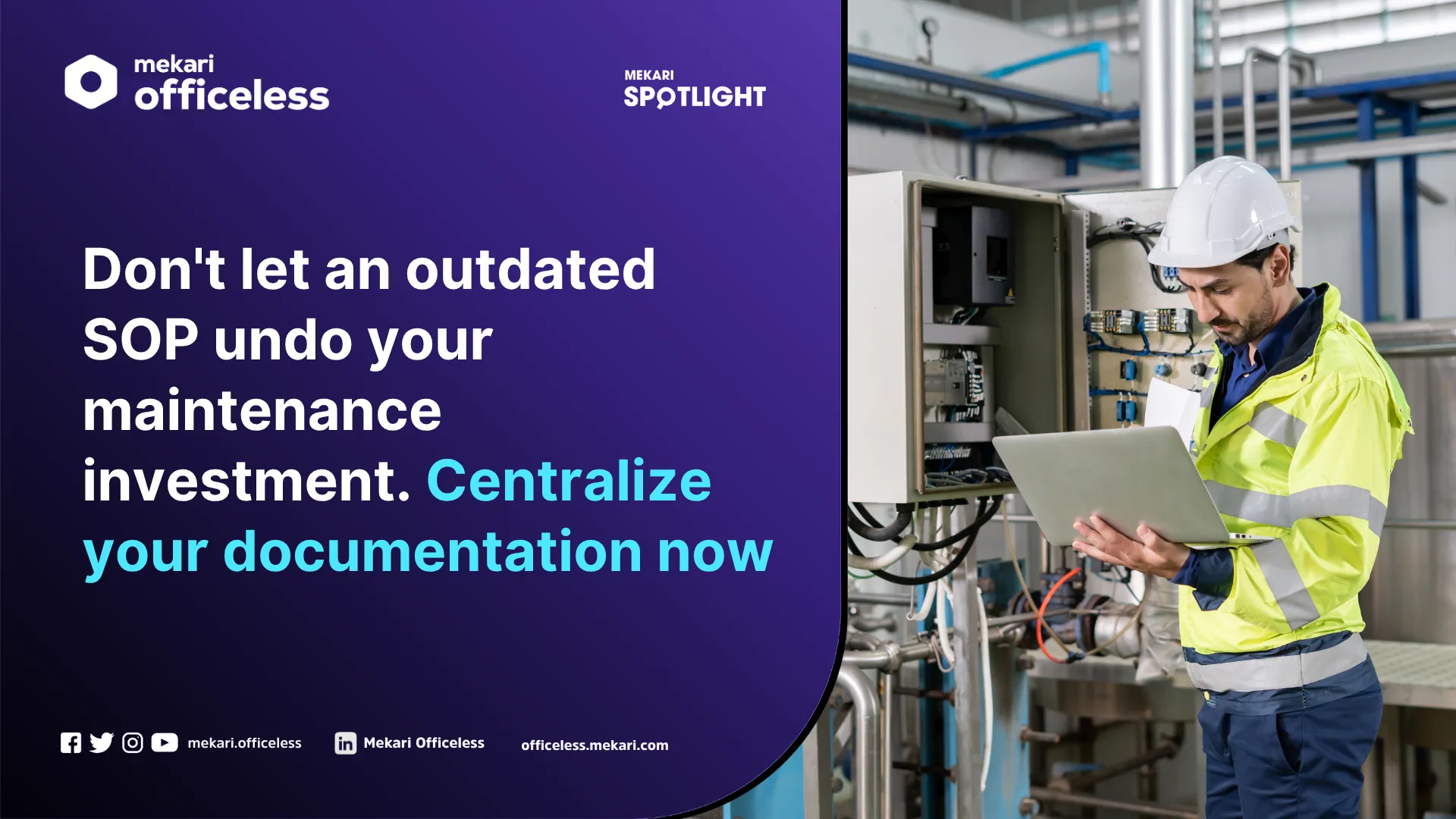
- Predictive maintenance cuts costs up to 25%, lifts uptime 10 to 20%
- Only 32% of teams have deployed AI-driven maintenance at scale
- Mekari Officeless DMS centralizes SOPs, manuals, and audit trails for technicians
Predictive maintenance is scaling fast across Asia Pacific, and Indonesia is named among the industrializing markets driving that growth. Yet most programs stall not on sensors, but on the paperwork behind them.
This guide explains what predictive maintenance integration actually means, why the documentation layer decides whether it scales, and how Mekari Officeless DMS closes that gap.
What is predictive maintenance integration?
Predictive maintenance integration is the process of connecting IoT sensors, condition-monitoring data, an analytics or machine learning layer, and the CMMS or work order system into one closed loop.
When a sensor detects an anomaly, that signal should automatically trigger a work order rather than sit unread in a dashboard.
The technology alone only detects a problem. Integration is what turns that detection into an actioned, documented, and auditable maintenance event. The pattern that works is to standardize sensor data, integrate it with the CMMS, and close the loop from alert to work order, and facilities that achieve this end-to-end integration are the ones unlocking predictive maintenance at scale.
The predictive maintenance market is projected to grow from USD 13.89 billion in 2026 to USD 23.79 billion by 2031, at a CAGR of 11.4%. Asia Pacific is the fastest growing region, with Indonesia among the markets driving that growth.
Why predictive maintenance integration matters for asset-heavy businesses
The financial case is direct.
Predictive maintenance can reduce maintenance costs up to 25% and increase uptime by 10% to 20%, according to Deloitte.
For manufacturers running dozens of production lines, that margin compounds quickly.
Local data reinforces the point. A textile factory in Surabaya that adopted predictive maintenance reported roughly 25% lower maintenance costs in its first year of implementation, a relevant benchmark as Indonesian manufacturers face rising labor and raw material costs.
Despite the upside, adoption remains at an early stage. Less than one-third of maintenance and operations teams, 32%, have fully or partially implemented AI in their maintenance programs, even as 65% say they plan to use AI by the end of 2026.
Companies that close the documentation gap now gain a real head start over competitors still stuck at the pilot stage.
Core components of a predictive maintenance integration stack
A working predictive maintenance integration typically connects four layers:
- Condition monitoring sensors: vibration, temperature, and pressure sensors that generate raw equipment health data.
- Analytics or machine learning layer: software that converts sensor signals into fault predictions and remaining useful life estimates.
- CMMS or work order system: the system that turns a prediction into a scheduled, assigned maintenance action.
- Documentation and governance layer: SOPs, equipment manuals, calibration records, and compliance files that guide the technician once a work order is triggered.
Effective predictive maintenance workflows embed troubleshooting steps and standard operating procedures directly into work orders based on the specific fault detected, reducing guesswork and improving first-time fix rates. That embedding only works if the underlying SOPs are current, findable, and correctly versioned, which is exactly where most predictive maintenance programs break down.
The documentation gap that undermines predictive maintenance integration
Here is the common failure mode: a sensor correctly flags an early bearing fault, a work order fires, but the technician cannot quickly find the right calibration certificate or the latest revision of the repair SOP. The fix gets delayed, done from memory, or done off an outdated procedure.
This is not a rare edge case. Studies identify the lack of standardized integration protocols between predictive analytics platforms and CMMS, along with inconsistent or incomplete data capture, as major obstacles to PdM-CMMS integration, alongside workforce skill gaps and organizational resistance to change.
Treating this as a pure technology problem misses the point. Without a centralized, version-controlled system for the documents that guide maintenance action, a predictive maintenance program cannot scale reliably past a single pilot line, no matter how accurate the sensors are.
Common challenges in predictive maintenance integration
Beyond sensors and algorithms, most predictive maintenance rollouts run into the same operational friction:
- Fragmented SOPs and manuals scattered across shared drives, email threads, and paper binders, with no single source of truth.
- Version confusion, where technicians act on outdated procedures because old revisions are never formally retired.
- Weak audit trails, with no verifiable record of who approved a procedure change or when a manual was last updated.
- Slow approval chains, where documentation updates stall in manual, email-based review loops.
- Limited role-based access, leaving sensitive calibration or compliance records open to anyone with a shared folder link.
Each of these is a governance gap, not a sensor gap, and each one is solvable with the right document infrastructure.
How Mekari Officeless DMS supports predictive maintenance integration
Mekari Officeless DMS sits alongside a company’s sensors, analytics tools, and CMMS as the documentation and governance layer, not as a replacement for the predictive maintenance technology itself.
Capabilities relevant to predictive maintenance integration include:
- Centralized knowledge base: SOPs, manuals, and calibration records searchable in one place.
- Automated version control: Outdated revisions are deprecated automatically, so technicians always act on the current version.
- Structured approval workflows: Procedure updates move through defined review chains instead of email.
- Role-based access control: Calibration and compliance files stay restricted to authorized roles.
- Immutable audit trail: Every approval and access event is logged for ISO audits and inspections.
- Manufacturing-ready structure: Unified revision control for SOPs and quality manuals, with full audit trails across plants.
Mekari Officeless is an enterprise app development platform that helps Business Managers and IT teams build custom applications, automate workflows, and eliminate operational gaps by integrating fragmented systems to accelerate enterprise growth.
As part of the Mekari unified software ecosystem, Mekari Officeless is also integrated with various other Mekari solutions such as Mekari Talenta, Mekari Flex, Mekari Jurnal, Mekari Expense, Mekari Qontak, Mekari Klikpajak, Mekari Sign, Mekari Desty, Mekari POS, and Mekari Airene to support end-to-end business operational automation.
Ready to close the documentation gap in your predictive maintenance program? Explore Mekari Officeless DMS or see the full feature set on the Officeless Marketplace.
References and methodology
Methodology
Methodology
Articles published by Mekari Officeless are developed using trusted sources, including official data, company reports, academic research, and insights from industry practitioners. Whenever possible, we refer directly to primary sources before drawing conclusions. Our editorial team reviews and verifies the information to ensure accuracy and relevance. All references are listed so readers can trace each piece of information back to its original source.
Our editorial standards
Our editorial standards
- Primary source first: We consult official product documentation and pricing pages directly, not secondhand summaries or aggregator sites.
- Fact-checking: All product features, pricing, and claims are cross-verified against each platform’s official website at the time of writing.
- No paid placement: Tools are selected based on relevance and fit for Indonesian businesses, not commercial arrangements. Mekari Officeless is included as a first-party product and is transparently labeled as such.
- Regular review: Articles are periodically updated to reflect product changes or shifts in market relevance.
References
References
Get Maintain X. “25 maintenance stats you need for 2026: Predictive maintenance statistics, AI trends, and more”
International Journal of Scientific and Research Publications. “Predictive Maintenance Integration with CMMS: Advancing Preventive Maintenance Approaches in Facilities Management”