


- SAP Ariba implementations typically cost $150,000–$400,000 and take 3–6 months to go live.
- Digitized source-to-pay processes can cut procurement costs by 15–20% and speed up cycle times by 30–50%.
- For companies that need S2P capability without an SAP-scale budget or timeline, Mekari Officeless offers a ready-made Source-to-Pay app built for faster deployment.
For many growing enterprises, SAP procurement — most commonly delivered through SAP Ariba — represents the gold standard of spend management. But that standard comes with a price: full-suite SAP Ariba implementations can run between $150,000 and $400,000, and implementation timelines typically range between three and six months.
For companies that don’t already run on SAP ERP, or that need procurement digitization sooner rather than later, those numbers raise a fair question: is there a SAP procurement alternative that delivers similar source-to-pay coverage without the enterprise-scale commitment?
This guide breaks down what SAP procurement covers, why companies evaluate alternatives, what to look for in a source-to-pay platform, and how Mekari Officeless positions itself as a ready-made alternative built for faster implementation.
What is SAP procurement (SAP Ariba)?
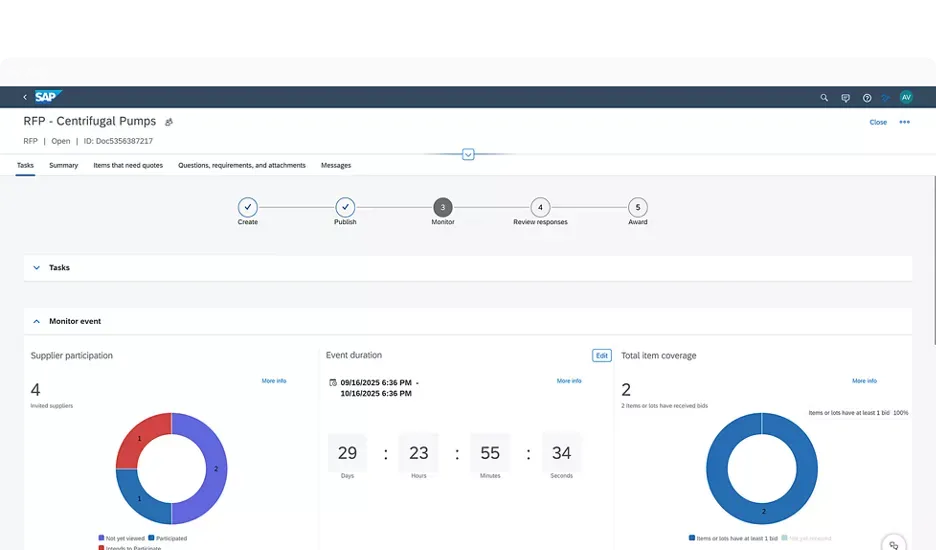
When people refer to “SAP procurement,” they’re usually talking about SAP Ariba — a cloud-based spend management suite that helps businesses streamline and automate procurement processes, including sourcing, contracting, purchasing, invoicing, and supplier management.
SAP Ariba is focused entirely on procurement and supply chain management, offering tools to manage purchasing, supplier relationships, contract negotiations, and payments in one platform. It’s designed to work tightly with the rest of the SAP ecosystem — SAP Ariba integrates with ERP platforms like SAP S/4HANA, enabling seamless procurement and financial data synchronization.
That tight integration is exactly why SAP Ariba is so powerful for organizations already running SAP S/4HANA — and why it’s such a heavy lift for companies that aren’t.
Why companies look for a SAP procurement alternative
SAP Ariba’s capability isn’t in question. What pushes companies to evaluate alternatives is usually cost, timeline, and complexity relative to their actual scale.
- High and unpredictable cost. SAP Ariba follows a subscription-based model typically ranging from $50,000 to $250,000 per year, depending on company size, transaction volume, and customization needs. On top of that subscription, full-suite implementations can run $150,000 to $400,000 — and that figure can grow further if the project requires international tax compliance or custom connectors to non-SAP systems.
- Long implementation timelines. Implementation timelines for SAP Ariba typically range between three and six months depending on enterprise size and complexity. For a procurement team that needs to digitize now, half a year is a long runway.
- Complexity that requires dedicated expertise. SAP Ariba spans both strategic and operational procurement with a wide range of features, and that complexity can pose real challenges for teams without prior spend-management experience. Best-practice guidance warns against over-customizing every detail of old processes or building overly complex approval flows — but avoiding that trap requires experienced implementation partners, which adds further cost.
- Built around an SAP-centric ecosystem. Because SAP Ariba’s deepest integration is with SAP S/4HANA, companies running on other ERPs or finance stacks often need middleware and additional integration work to get the same seamless experience.
None of this makes SAP Ariba a bad product — it’s simply built for organizations that already have SAP-scale budgets, IT teams, and ERP investments. For everyone else, it’s worth understanding what a source-to-pay alternative actually needs to deliver.
What is source-to-pay (S2P) and why it matters
Source-to-pay describes the complete procurement journey — not just the transactional purchase-to-payment steps, but everything upstream as well. Procure-to-pay (P2P) focuses on the transactional steps that begin with a purchase requisition and end with paying an invoice, while source-to-pay (S2P) includes those activities plus the upstream work of identifying and selecting suppliers.
In practice, that means S2P covers supplier identification, sourcing and bidding, contract negotiation, purchase requisitions and approvals, vendor management, and final payment — all in one connected workflow.
The payoff for connecting these stages is significant. Organizations commonly see double-digit procurement cost reductions, often in the 15–20% range, alongside 30–50% faster cycle times when sourcing, purchasing, and payment run through one automated workflow.
For companies still managing sourcing in spreadsheets, approvals over email, and payments in a separate finance tool, S2P automation is where the real efficiency gain sits — regardless of which platform delivers it.
Key criteria when evaluating a SAP procurement alternative
Before comparing specific platforms, it helps to define what “good enough” looks like for a SAP procurement alternative. The criteria that matter most:
- Implementation speed — can the platform go live in weeks rather than months?
- Total cost of ownership — does pricing scale with company size, or does it assume enterprise-level spend from day one?
- Ease of adoption — can procurement teams use it productively without months of training or a dedicated SAP-certified consultant?
- Local compliance and support — for businesses operating in Indonesia, does the vendor understand local procurement regulations and offer local-language support?
- Integration with existing finance tools — does it connect cleanly with the accounting, expense, and payment systems the company already uses?
- Scalability without heavy customization — can the platform grow with the business without re-engineering the core workflow each time?
These criteria are exactly where ready-made platforms can compete with — and in some cases outperform — a traditional SAP procurement deployment.
Mekari Officeless as a source-to-pay alternative to SAP
Mekari Officeless positions its Source-to-Pay solution as a ready-made app that helps manage the full sourcing-and-procurement lifecycle in one structured workflow. The platform is explicitly built around three principles: no build-from-scratch system required, structured and pre-made workflows included, and faster deployment than fully custom development.
That “ready-made” framing is the core differentiator versus SAP Ariba. Where SAP Ariba implementations involve months of configuration, workshops, and (often) third-party consultants, Mekari Officeless Source-to-Pay starts from a working procurement workflow that companies can adapt to their own approval hierarchies and vendor processes — rather than building one from zero.
SAP Ariba vs Mekari Officeless: at a glance
| Aspect | SAP Ariba | Mekari Officeless Source-to-Pay |
| Implementation time | 3–6 months for full deployment | Ready-made workflows, faster go-live than custom builds |
| Cost structure | $50K–$250K/year subscription, plus $150K–$400K implementation | Scales to mid-size and enterprise needs without SAP-level setup cost |
| Customization approach | Highly configurable but complex; risk of over-customization | Pre-made workflows, customizable approval flows without rebuilding the system |
| Best fit | Large enterprises already on SAP S/4HANA | Companies needing full S2P coverage without an existing SAP ERP investment |
| Ecosystem integration | Deepest with SAP S/4HANA, SAP Business Network, SAP Fieldglass | Integrates with Mekari Jurnal, Mekari Expense, Mekari Pay, Mekari Sign |
| Local (Indonesia) support | Via SAP partner network | Indonesia-based platform and support |
Note: SAP Ariba figures are based on third-party implementation guides and may vary by scope, region, and vendor.
Why choose a source-to-pay platform other than SAP Ariba
SAP Ariba earns its reputation in environments where the scale justifies the investment — large enterprises with complex, multi-geography supplier networks and an existing SAP S/4HANA backbone. SAP Ariba integrates natively with SAP systems, which lowers integration complexity for companies already in that ecosystem.
But for the much larger group of companies that don’t fit that profile, the same strengths become friction. A few honest reasons to look beyond SAP Ariba:
- Your ERP isn’t SAP. If procurement isn’t sitting on top of S/4HANA, much of SAP Ariba’s “seamless” integration advantage doesn’t apply — and third-party integrations to systems like NetSuite or custom ERPs often require middleware costing $25,000–$100,000.
- You need to go live this quarter, not next year. A 3–6 month implementation is a reasonable trade-off for a global enterprise rollout, but it’s a hard sell for a procurement team that’s currently running on email and spreadsheets and losing visibility every day.
- You don’t have (or want) a dedicated SAP procurement team. SAP Ariba’s complexity, driven by its breadth of features and functions, requires aligning implementation with organizational goals — work typically done by specialized consultants.
- You want predictable, scoped cost. Annual subscription fees plus a six-figure implementation budget is a different financial commitment than a ready-made app that’s already built and configured to a working baseline.
A ready-made source-to-pay platform like Mekari Officeless doesn’t try to out-feature SAP Ariba. Instead, it covers the same core lifecycle — sourcing, vendor management, approvals, contracts, and payment integration — through pre-built workflows that can be live in a fraction of the time.
How Mekari Officeless Source-to-Pay works
Mekari Officeless Source-to-Pay brings together the core stages of the procurement lifecycle in one platform:
- Sourcing and vendor bidding — run competitive, collaborative bidding processes with vendors in a single system.
- Vendor management — maintain a centralized vendor database with qualification and performance tracking.
- Contract and quotation management — manage contracts and quotations through a structured, documented workflow.
- Customizable approval flows — adapt approval structures and form layouts to match company policy, without rebuilding the platform.
- Real-time reporting and analytics — monitor procurement activity with dashboards and reports tailored to the business.
- Ecosystem integration — connect with Mekari Jurnal (finance), Mekari Expense (spend control), Mekari Pay (vendor payments), and Mekari Sign (contract authorization) for end-to-end automation across sourcing, approvals, and payment.
For companies evaluating a SAP procurement alternative, this combination — full lifecycle coverage, pre-made workflows, and an integrated ecosystem — is designed to deliver the outcomes companies look for in source-to-pay digitization, without the SAP-scale implementation project.
Ready to see how a ready-made source-to-pay platform compares to your current procurement setup? Explore Mekari Officeless Source-to-Pay and see how the full sourcing-to-payment lifecycle can run in one connected workflow.
References and methodology
Methodology
Methodology
Articles published by Mekari Officeless are developed using trusted sources, including official data, company reports, academic research, and insights from industry practitioners. Whenever possible, we refer directly to primary sources before drawing conclusions. Our editorial team reviews and verifies the information to ensure accuracy and relevance. All references are listed so readers can trace each piece of information back to its original source.
Our editorial standards
Our editorial standards
- Primary source first: We consult official product documentation and pricing pages directly, not secondhand summaries or aggregator sites.
- Fact-checking: All product features, pricing, and claims are cross-verified against each platform’s official website at the time of writing.
- No paid placement: Tools are selected based on relevance and fit for Indonesian businesses, not commercial arrangements. Mekari Officeless is included as a first-party product and is transparently labeled as such.
- Regular review: Articles are periodically updated to reflect product changes or shifts in market relevance.