PlatformOfficeless platform

Mekari Officeless is the solution to customize unique business & operational needsWhy Mekari Officeless fits for Enterprises
A ready-made app that helps you to manage the full Sourcing & Procurement lifecycle in one structured workflow.
A centralized platform for managing vendor qualification, sourcing, contracts, purchasing, receiving, invoice reconciliation, and spend analysis.
Instead of building each procurement module separately, Officeless Ready-made App provides a ready-to-rollout Sourcing & Procurement flow for vendor onboarding, sourcing, contracts, purchase orders, goods receipt, invoices, and analytics.
Explore how Officeless S2P Platform works and achieve full sourcing and procurement capability.
Vendors register, submit documents, and complete profiles. The system applies required forms, approvals, and risk checks before activation.

Sourcing requests move through approval and RFx workflows. The system supports invitations, submissions, scoring, and vendor comparison.

Awarded vendors move into contracts, catalogues, and purchase orders. The system applies approved terms, pricing, and order controls.

Goods, services, and invoices are tracked in one flow. The system supports receipt tracking, invoice matching, reconciliation, and spend analysis.

Read more on how our ready-made Sourcing & Procurement system helps enterprise businesses manage vendors, sourcing, and purchasing in one controlled workflow.
With over a million packages moving daily, JNE needed to close the gap between warehouse logistics and field couriers. By centralizing dispatch and tracking on Officeless, JNE reduced delivery disputes by 40% and streamlined nationwide operations.

We needed to move beyond a legacy system restricted and outdated browsers. With Officeless, we eliminated the need for manual system and streamlined our exports, achieving a 70% increase in speed and a much smoother user experience.

The Sourcing & Procurement Platform is engineered to support procurement, finance, logistics, and vendor teams with the same structured workflow, governance control, and operational visibility.
BY ROLE
Procurement teams can manage sourcing projects, RFx events, vendor evaluation, contracts, performance reviews, and spend analytics in one customizable workflow.
Sourcing requests, RFx events, vendor shortlists, awarded bids, contracts, and spend analysis are handled across disconnected files and discussions. Procurement operations struggle to compare vendors objectively and monitor maverick spend.

Finance teams can review invoices against PO and GRN references, flag mismatches, approve or reject invoices, track reconciliation status, and close transactions once matching and payment terms are satisfied.
Invoice review depends on manual checking against purchase orders, goods receipt notes, and supporting documents. Discrepancies in quantity, price, or total amount can be missed before payment is processed.

Business users can browse approved catalogues, create purchase requests, or submit sourcing requests for non-catalogue needs. Managers can review, approve, reject, or request revisions before procurement proceeds.
Employees request goods or services through informal channels, while managers lack a consistent way to validate needs, control budgets, or route purchases through approved workflows.

Logistics teams can monitor incoming deliveries, record received quantities and item conditions, generate GRNs, track partial deliveries, initiate returns linked to PO and GRN records, and update service completion milestones.
Incoming goods, partial receipts, defective items, service completion, and returns are documented manually, making fulfillment progress and quality issues difficult to track.

Legal and procurement teams can use approved clauses, review contracts together, store them centrally, and turn approved terms into purchasing catalogues.
Contract terms are drafted and negotiated separately from procurement operations, creating gaps between legal approval, negotiated line items, and purchasing execution.

Supplier Risk teams can configure risk matrices, conduct vendor risk assessments, maintain risk profiles, review the risk registry, create mitigation strategies, and support blacklisting or whitelisting decisions when needed.
Vendor risk assessments are difficult to standardize, high-risk suppliers can be missed, and risk mitigation decisions are separated from onboarding and vendor governance.

Vendors can register, maintain profiles, join RFx events, submit proposals and pricing, review and sign contracts, acknowledge POs, view and download GRNs, submit invoices, and access performance evaluation results or warning letters.
Vendors submit documents, proposals, PO acknowledgements, delivery confirmations, invoices, and corrective action plans through separate channels with limited visibility into status.

A comparative analysis of Sourcing & Procurement operating models across key enterprise procurement workflows.

 End-to-end lifecycle
Registration, risk, blacklist
Scoring, comparison, award
Terms linked to catalogues
Approval, release, changes
GRN, services, RTV
PO, GRN, invoice linked
End-to-end lifecycle
Registration, risk, blacklist
Scoring, comparison, award
Terms linked to catalogues
Approval, release, changes
GRN, services, RTV
PO, GRN, invoice linked  Spend & vendor insights
Vendor self-service access
Spend & vendor insights
Vendor self-service access  Built module by module
  Rules built separately
Custom scoring logic
Custom handoff needed
Logic must be built
Separate flow design
Matching logic required
Dashboard build needed
Extra portal build
Disconnected steps
Hard to control
Manual comparison
Rules built separately
Custom scoring logic
Custom handoff needed
Logic must be built
Separate flow design
Matching logic required
Dashboard build needed
Extra portal build
Disconnected steps
Hard to control
Manual comparison  Terms stay separate
Hard to trace
Manually reconciled
Manual invoice checks
Delayed / incomplete insights
No vendor portal
Terms stay separate
Hard to trace
Manually reconciled
Manual invoice checks
Delayed / incomplete insights
No vendor portal Our ready-made app covers the full Sourcing & Procurement lifecycle, from vendor qualification, onboarding, sourcing request, RFx events, contract management, catalogue management, purchase requisition, purchase order, goods or service receipt, invoice processing, reconciliation, vendor performance evaluation, and spend analytics.
The system supports vendor self-service registration, dynamic profile forms based on vendor type, registration approvals, profile updates, risk matrix configuration, vendor risk assessments, risk registry monitoring, activation requests, warning letters, blacklisting, and whitelisting.
Yes. Sourcing & Procurement supports sourcing requests and sourcing projects, including RFx events such as RFI, RFS, RFQual, RFP, and RFQ. Procurement teams can configure whether events are public or invite-only, collect vendor submissions, evaluate responses, and select awarded vendors.
Awarded sourcing events can move into contract drafting, review, signing, and repository management. Approved contract terms and line items can then be converted into purchasing catalogues so procurement execution stays aligned with agreed terms.
Business users can browse buyer catalogues, add items to a purchase request, and submit the request for approval. Procurement officers can create Purchase Orders from approved purchase requests or completed sourcing projects, submit them for review, issue them to vendors, and manage PO changes when revisions are needed.
For physical goods, logistics teams can monitor delivery schedules, receive incoming shipments, create and post Goods Receipt entries, and generate GRNs. For services, users can record service completion milestones. If goods are defective or rejected, the system supports Return to Vendor processes linked to the relevant records.
Vendors can submit invoices against Purchase Orders. Finance teams can review invoice details alongside PO and GRN references, identify mismatches in quantity, price, or total amount, approve or reject invoices, track payment status, and manage purchase reconciliation.
Yes. Vendors can register and maintain profiles, participate in sourcing events, submit proposals and pricing, review and sign contracts, view issued Purchase Orders, acknowledge or reject orders, download GRNs, submit invoices, view returned goods, and access performance evaluation results or issued warning letters.
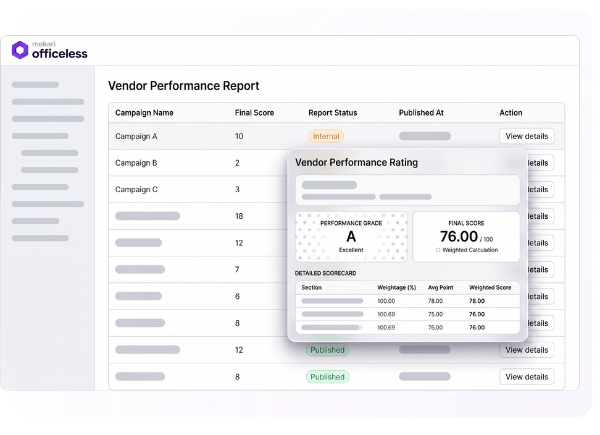
Procurement leaders can use spend analytics to review organizational spend, identify preferred vendors, analyze category trends, and monitor budget adherence. The system also supports vendor performance scorecards and evaluation reports based on dynamic metrics such as delivery speed and defects.
Start and speed up your digital solution adoption with Mekari Officeless, or discuss with our team for further assistance.
 WhatsApp sales