


- Between 55-75% of ERP projects fail to meet their objectives (Gartner, Panorama Consulting) yet enterprises keep investing in customization. ERP ecosystem extensions offer a fundamentally lower-risk path to closing operational gaps.
- Gartner projects 70%+ of new enterprise apps will be built via low-code or no-code: the market has already shifted toward extension-first thinking for operational application development.
- Mekari Officeless Marketplace gives enterprises a verified catalog of prebuilt Starter Apps, Plugins, and Enterprise Solutions to extend any ERP; with deployment measured in days, not months.
Your ERP is the backbone of your business. But ask any operations manager, procurement lead, or HSE officer whether SAP, Oracle, Odoo, or Microsoft Dynamics handles everything their teams need and the answer is the same across every industry and company size: it does not.
There is a better approach. It is called ERP ecosystem extension: building purpose-built applications that run alongside your ERP, fill operational gaps, and connect to your core system without ever touching its source code.
The gap no ERP can fully close
SAP S/4HANA. Oracle Fusion Cloud. Microsoft Dynamics 365. Odoo. These are among the most powerful enterprise systems ever built and every one of them leaves operational gaps.
This is not a product failure. It is a design reality. Major ERP platforms are engineered for core enterprise functions: financial management, HR, supply chain transactions, and compliance at scale. They do this exceptionally well.
But the operational reality of running a business extends far beyond core transactions. Consider what happens in practice:
- The HSE team needs a permit-to-work system and incident tracking, but the ERP has no module for it.
- Procurement needs a vendor portal for onboarding, bidding, and purchase requests that external suppliers can actually use; not just internal ERP screens.
- Facilities needs room booking, visitor registration, and maintenance ticketing. The ERP has no concept of a meeting room.
- Operations needs a checklist management system and a real-time dashboard that pulls data from three different systems. IT builds a spreadsheet.
Gartner projects that 70% of organizations will lack AI-ready ERP data by 2027 — not because ERPs are failing, but because the operational data enterprises need sits outside ERP scope, scattered across manual workarounds and disconnected tools.
Even ERP vendors acknowledge this reality. SAP offers SAP BTP for extension development. Oracle offers APEX for custom application building. Microsoft offers Power Apps. Each vendor’s own extension platform is the clearest possible signal that the core ERP was never designed to handle everything.
Why ERP customization makes the problem worse
When a gap is identified, the conventional response is to raise a customization request. And this is where things go wrong.
ERP customization projects are slow. They require certified specialists — SAP developers, Oracle consultants — whose time is expensive and limited. Every team’s request enters the same IT backlog and competes with everyone else’s priority.
They are costly. Research from Gartner and Panorama Consulting consistently shows that 55-75% of ERP projects fail to meet their objectives, and cost overruns of 50% or more above the original budget are common. Real-world examples make the numbers concrete: a major Oracle Fusion implementation that started at a £19 million budget reached approximately £90 million by 2024, with projections extending further.
They are fragile. Custom ERP code must be maintained across every vendor upgrade. A customization that works today may break when the ERP vendor releases a new version — and the cycle of maintenance begins again.
And fundamentally, they misapply the ERP’s role. The ERP is the system of record, not the application development platform. Treating it as such creates compounding cost, risk, and delay.
As research published at the 2025 Americas Conference on Information Systems confirms: ERP systems are critical for business process integration but often lack the flexibility needed for rapid adaptation. Low-code platforms have emerged specifically to fill this gap.
What is an ERP ecosystem extension?
An ERP ecosystem extension is a purpose-built application that runs independently of the core ERP and connects to it via API. It reads and writes data to the ERP where needed, but it operates on its own infrastructure — meaning changes, upgrades, or replacements of the extension never put the core ERP at risk.
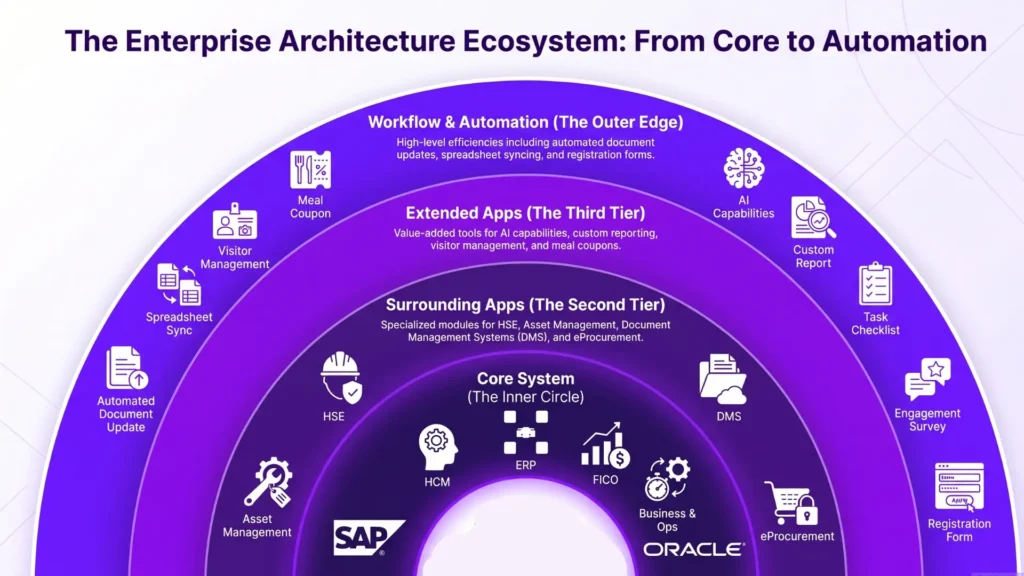
Think of the enterprise application stack in three layers:
- Core Systems are SAP, Oracle, Odoo, and Dynamics. They handle structured transactional data, financial records, and compliance-critical processes at scale. This layer should be protected, not customized unnecessarily.
- Surrounding Apps are the large-scale operational systems that supplement core ERP capabilities. eProcurement portals, HSE management systems, document management, workplace management, and asset management all live in this layer. These are high-impact, cross-functional applications that every enterprise needs but most ERPs do not natively support.
- Extended Apps are department-level tools for specific use cases. Visitor management, custom analytics dashboards, task checklists, and operational automation. These are lighter-weight, faster to deploy, and typically owned by business teams rather than IT.
The business case for this architecture is straightforward. Extensions deploy faster, cost less to maintain, fail safely when they need to be changed, and can be built by a broader range of people — not just ERP-certified specialists.
By 2025, Gartner projects that more than 70% of new enterprise applications will be built using low-code or no-code technologies. The market has already moved toward extension-first thinking for operational application development.
Where Mekari Officeless fits in your ERP ecosystem
Mekari Officeless is an enterprise app development platform that helps Business Managers and IT teams build custom applications, automate workflows, and eliminate operational gaps by integrating fragmented systems to accelerate enterprise growth. It does this by occupying the surrounding apps and extended apps layers of the enterprise application stack.
This means Mekari Officeless does not compete with your ERP. It works with it.
Surrounding Apps that Officeless delivers:
- eProcurement / Source-to-Pay: End-to-end vendor management, sourcing, purchase requests, and procure-to-pay — with a vendor portal your suppliers can actually use.
- HSE management: Health, safety, and environmental compliance workflows, incident tracking, and permit-to-work systems designed for operations-heavy industries.
- Workplace management: Room booking, scheduling, and integrated workspace tools that connect your teams and support a modern office environment.
- Facility management: Asset tracking, maintenance workflows, and building operations management.
- Document management system (DMS): Centralized, customizable document database with structured lifecycle workflows.
Extended Apps that Officeless delivers:
- Visitor management: Modernized guest check-in, security registration, and site access control.
- Operational dashboards and custom reports: Department-specific analytics configured by business users, without IT involvement.
- Task checklists and workflow automation: Standardized operational processes with real-time execution tracking.
The Officeless Marketplace: deploy your ERP extension faster
The fastest path to closing an ERP gap is not writing a customization request. It is deploying a solution that already exists, has already been tested, and is already verified for enterprise use.
The Officeless Marketplace is exactly that: a growing catalog of prebuilt Starter Apps, Plugins, and Enterprise Solutions — all verified by Mekari — that enterprises can browse, select, and deploy against their operational gaps.
All 15 assets in the Marketplace are verified by Mekari and span industries including Manufacturing, Logistics and Supply Chain, Oil and Gas, Mining and Metals, Construction and Real Estate, and Hospitality — as well as cross-industry operational domains.
Your ERP handles the core. Mekari Officeless handles everything it can’t. Explore the Officeless Marketplace and deploy your first ERP extension today.