


- Oracle confirmed in October 2023 that Agile PLM version 9.3.6 is its final release. All support ends December 31, 2027, leaving organizations with no patches, no security fixes, and no technical support.
- Most existing Agile users have declined Oracle Fusion Cloud PLM, as its entirely different architecture requires core processes and integrations to be rebuilt from scratch.
- Organizations that delay migration face a shrinking window and growing competition for qualified implementation partners as the 2027 deadline approaches.
Oracle Agile PLM’s era is ending. Oracle removed version 9.3.7 from its roadmap in October 2023, making 9.3.6 the final release. All premier support ends December 31, 2027, with no security patches, bug fixes, or technical support to follow.
For enterprises in regulated industries, this is a risk management decision with a hard deadline. This guide covers what the end of life means, the real risks of staying on the platform, and an honest comparison of the top alternatives.
What is Oracle Agile PLM?
Oracle Agile PLM is an enterprise platform for managing the full product lifecycle, including BOMs, parts, engineering changes, new product introduction (NPI), quality, portfolio management, and supplier collaboration.
It became widely adopted across manufacturing industries as a centralized source of product data, connecting engineering, operations, quality, and suppliers.
However, the platform’s legacy architecture became increasingly difficult to support, with limitations such as:
- Aging technology stack that is hard to maintain and scale
- No cloud-native architecture or modern API support
- Outdated user interface and user experience
- Growing integration challenges with modern ERP, CAD, and MES systems
These structural limitations ultimately led Oracle to end support for Agile PLM.
Oracle Agile PLM end of life: what exactly is happening?
Oracle officially ended the Agile PLM roadmap in October 2023. Version 9.3.6 is the platform’s final release, with premier support ending on December 31, 2027. After that, customers will no longer receive:
- New releases or feature updates
- Security patches and bug fixes
- Technical support from Oracle
Rather than modernizing Agile, Oracle shifted investment to Fusion Cloud PLM. However, it is not a direct upgrade but an entirely new platform with a different architecture and data model. As a result, organizations often need to:
- Rebuild change management, quality, and governance workflows
- Redesign integrations with ERP, CAD, MES, and supplier systems
- Re-test and validate existing business processes
Because of these migration challenges—including functionality gaps, complex integrations, an incomplete digital thread, and SaaS-only deployment—many existing Agile PLM customers have chosen not to migrate to Oracle Fusion Cloud PLM.
Risks of staying on Oracle Agile PLM past 2027
Staying on Agile PLM after December 2027 is technically possible. It is strategically inadvisable. The risks compound over time.
- Security vulnerabilities. Without regular updates and patches, Agile PLM systems will be vulnerable to security breaches and cyber-attacks. Software that has reached its end of life no longer satisfies the requirements of the current digital product development environment. Every month past 2027 without a patch widens the attack surface.
- Compliance failures. Industries including medical equipment, automotive, and aerospace face compliance challenges due to constantly changing regulatory frameworks. The likelihood of non-compliance increases significantly with unsupported systems. Auditors increasingly require evidence of active software support.
- Rising maintenance costs. Over time, the cost of maintaining legacy systems tends to rise, particularly when there is a shortage of experienced labor to support Agile development. As the consultant pool shrinks, rates increase.
- Integration breakdowns. Without ongoing support and updates, Agile PLM may lead to compatibility issues with newer enterprise systems and disrupt critical workflows.
- Innovation bottlenecks. Firms not keeping up to date will experience difficulties adopting AI-based design, IoT integration, and digital twin capabilities. Competitors on modern PLM platforms will accelerate ahead.
The window to plan and execute a clean transition is open now. It will not stay that way.
Top Oracle Agile PLM alternatives
There is no single right answer. The best alternative depends on industry, product complexity, existing ERP stack, deployment preferences, and organizational readiness. Below is an honest assessment of the leading options.
| Alternative | Best For | Deployment | Key Strength |
| PTC Windchill | Large manufacturers, high-tech, regulated industries | On-prem, hybrid, SaaS | Comprehensive digital thread, AI capabilities |
| Siemens Teamcenter | Complex, multi-tier global enterprises | On-prem, hybrid | Deep BOM, ERP, CAD integration |
| Aras Innovator | Organizations needing flexibility and lower TCO | On-prem, cloud, hybrid | Open platform, customizable |
| Arena PLM (PTC) | Mid-market, hardware startups | Cloud-native (SaaS) | Fast implementation, ease of use |
| Oracle Fusion Cloud PLM | Existing Oracle ERP users | SaaS only | Native Oracle ERP integration |
| Mekari Officeless | Asia-Pacific enterprises, operational and document workflows | Cloud | Pre-built apps, rapid deployment, local compliance |
1. PTC Windchill
PTC Windchill is widely regarded as the most direct and capable enterprise alternative to Oracle Agile PLM. According to ABI Research’s PLM benchmark, PTC ranks well ahead of Oracle in both innovation and implementation. Windchill supports on-premises, hybrid, and SaaS deployments, making it a flexible option for enterprises not yet ready for a full cloud transition.
- End-to-end digital thread connecting engineering, manufacturing, and service
- AI-powered quality and change management
- Strong compliance support for regulated industries
- Flexible deployment: on-prem, hybrid, and SaaS
- Deep integration with CAD tools and major ERP systems
2. Siemens Teamcenter
Siemens Teamcenter is built for large, global enterprises managing complex products and multi-tier supply chains. Its strength lies in advanced product data management and deep integration across engineering, manufacturing, and enterprise systems.
- Robust engineering, manufacturing, and service BOM management
- Advanced product configuration and variant management
- Comprehensive document and release management
- Strong compliance capabilities
- Native integration with major CAD and ERP platforms
- Support for global, multi-site deployments
3. Aras Innovator
Aras Innovator takes a different approach by providing an open, low-code PLM platform that organizations can configure to fit their own processes. This flexibility helps reduce total cost of ownership while making it easier to adapt the system as business needs evolve.
- Open platform with subscription-based licensing
- Highly configurable with minimal custom code
- Full PLM coverage, including BOM, quality, and change management
- Flexible deployment: on-prem, cloud, or hybrid
- Upgrades that preserve customizations
- Strong partner and community ecosystem
4. Arena PLM (PTC)
Arena PLM is a cloud-native solution designed for mid-market manufacturers, hardware startups, and electronics companies that need enterprise PLM capabilities without lengthy implementations. Its ease of use and SaaS delivery make it one of the fastest PLM systems to deploy.
- True cloud-native SaaS platform
- Fast implementation
- User-friendly interface for cross-functional teams
- Strong BOM and change management
- Built-in supplier collaboration
- Compliance support for regulated industries
- Integrated quality management workflows
5. Oracle Fusion Cloud PLM
Oracle Fusion Cloud PLM is Oracle’s recommended migration path for Agile PLM customers already invested in Oracle Cloud ERP. However, it should be evaluated as a new implementation rather than a direct upgrade, as it requires rebuilding processes on a completely different architecture.
- Native Oracle Cloud ERP integration
- Unified Oracle data model
- Cloud-first architecture with managed infrastructure
- Product portfolio and innovation management
- Compliance and quality management
- Continuous cloud feature updates
6. Mekari Officeless
Mekari Officeless addresses the operational and document workflow gaps that traditional PLM platforms often leave behind, particularly for enterprises in Indonesia and the Asia-Pacific region.
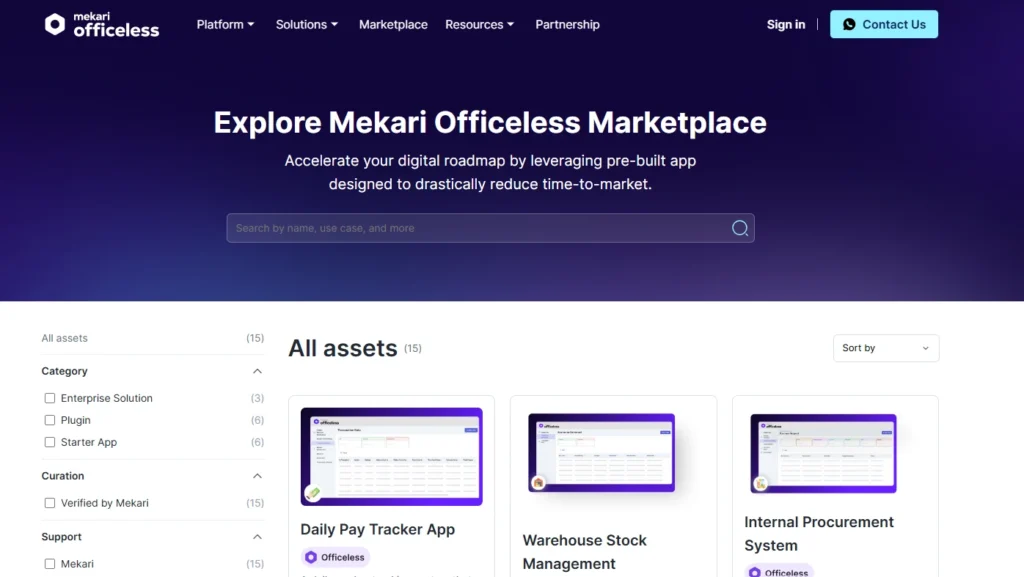
As an enterprise marketplace of pre-built software, it enables organizations to modernize operational processes quickly without waiting for a full PLM replacement, making it a practical complement during and after Agile PLM migration.
Key capabilities include:
- Document Management System (DMS): Centralized document management with customizable workflows, version control, and access controls.
- Source-to-Pay Management: End-to-end vendor onboarding, procurement, purchase orders, approvals, and payments.
- Customizable approval workflows: Multi-level approval routing without custom development.
- Integrated Mekari ecosystem: Native integration with Mekari Jurnal, Mekari Expense, Mekari Sign, and Mekari Pay.
- Enterprise-grade security and local compliance: Built for Indonesia and Asia-Pacific regulatory requirements.
- Rapid deployment: Pre-built applications that can be implemented much faster than traditional enterprise software.
Rather than replacing core engineering PLM, Mekari Officeless helps organizations close operational gaps with ready-made applications while their long-term PLM migration progresses.
How to choose the right alternative for your organization
The organizations that navigate this transition well share one approach: they lead with requirements, not familiarity.
Instead of asking how closely a system resembles Agile, leaders ask how well it will support the next decade of product development: Can this platform manage increasing product complexity? Will it support global collaboration? Does it enable faster decision cycles?
Practical steps for evaluation:
- Audit your current integrations first. Map every system connected to Agile today: ECAD, MCAD, ERP, MES, supplier portals. Your next platform must support these natively or provide a clear, documented integration path.
- Match deployment preferences to organizational readiness. Not every enterprise is prepared to move entirely to SaaS. Windchill, Teamcenter, and Aras all offer hybrid and on-premises options alongside cloud.
- Budget for organizational change management. Solution adoption and organizational change management (OCM) is vital for a successful transition from Oracle Agile PLM to a new PLM system. Re-training staff and redesigning workflows require investment as significant as the software itself.
- Start now. Although 2027 may seem distant, the process of switching from Agile PLM is not an overnight event. It takes time to align stakeholders and then execute. Competition will increase for qualified consultants as the deadline approaches. Organizations that wait until 2026 will find the market for experienced migration partners already congested.
Why Mekari Officeless is a strong solution for Asia-Pacific enterprises
For many organizations migrating away from Oracle Agile PLM, the immediate challenge is not just replacing PLM core features. It is managing the operational and document workflows that lived alongside or adjacent to Agile: product documentation management, procurement approvals, vendor qualification workflows, multi-level sign-offs, and cross-team collaboration.
This is where Mekari Officeless provides targeted, practical value.
Mekari Officeless is an enterprise marketplace of pre-built software designed to accelerate digital roadmaps by dramatically reducing time-to-market. Rather than committing to a multi-year PLM platform rebuild, enterprises can deploy ready-made applications covering the operational workflow gaps that arise during and after migration.
Key capabilities for post-Agile operational workflows:
- Document Management System (DMS): Centralized, structured handling of product and operational documents with customizable workflows and access controls. Replaces the document-management functions many organizations ran through Agile.
- Source-to-Pay Management: End-to-end vendor and procurement management, from vendor onboarding and qualification through purchase orders and payment. Covers the procurement collaboration workflows that Agile PLM users managed through its supplier modules.
- Customizable approval flows: Multi-level approval routing adaptable to any organizational hierarchy or policy, without custom development.
- Ecosystem integration: Native connection with Mekari Jurnal (financial management and supply chain), Mekari Expense (spend control), Mekari Sign (contract authorization), and Mekari Pay (vendor payment) for unified operational coverage.
- Enterprise-grade security and compliance: Built for the operational and regulatory environment of Indonesia and Asia-Pacific enterprises.
Mekari Officeless provides a prebuilt software marketplace which help organizations without need to choose between a monolithic PLM rebuild and doing nothing. Pre-built, verified applications can be deployed selectively to address specific operational gaps while the broader PLM transition is planned and executed.
Ready to modernize your operational and document workflows without the complexity of a full enterprise PLM implementation? Explore the Mekari Officeless Marketplace and see which pre-built solutions fit your transition needs today.
Explore Mekari Officeless Marketplace.
References and methodology
Methodology
Methodology
Articles published by Mekari Officeless are developed using trusted sources, including official data, company reports, academic research, and insights from industry practitioners. Whenever possible, we refer directly to primary sources before drawing conclusions. Our editorial team reviews and verifies the information to ensure accuracy and relevance. All references are listed so readers can trace each piece of information back to its original source.
Our editorial standards
Our editorial standards
- Primary source first: We consult official product documentation and pricing pages directly, not secondhand summaries or aggregator sites.
- Fact-checking: All product features, pricing, and claims are cross-verified against each platform’s official website at the time of writing.
- No paid placement: Tools are selected based on relevance and fit for Indonesian businesses, not commercial arrangements. Mekari Officeless is included as a first-party product and is transparently labeled as such.
- Regular review: Articles are periodically updated to reflect product changes or shifts in market relevance.
References
References
PTC. ”Oracle Agile Is Going Away: Electronics and High-Tech Guide”
Trissential. ”End of Oracle Agile PLM”