


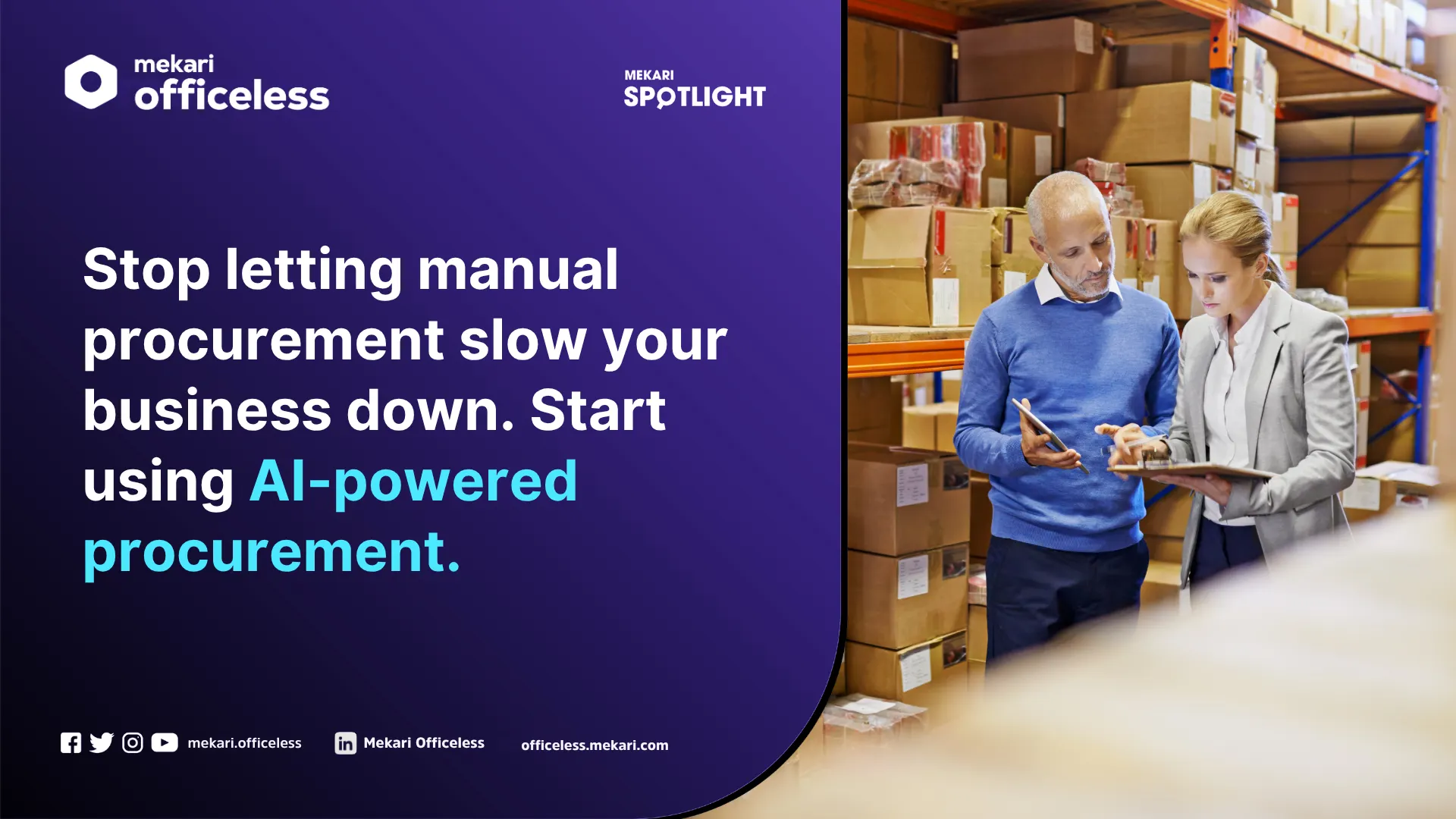
- Procurement workloads are growing faster than budgets, creating a widening efficiency gap.
- AI automates manual tasks such as spend classification, contract review, and invoice matching, freeing teams to focus on strategy and supplier relationships.
- 43% of organizations are already actively deploying AI, highlighting the rapid pace of adoption.
- For Indonesian enterprises, Mekari Officeless Source to Pay combines e-sourcing, vendor management, P2P automation, and real-time analytics in a single ISO 27001-certified platform.
Procurement workloads are rising 10% while budgets grow just 1%. A 9% efficiency gap only AI can close (Hackett Group). Yet while 43% of organizations are now actively deploying AI-enabled procurement, only 4% have reached scale.
The gap between intention and execution is where most transformations stall. This guide covers what AI in procurement means, its stage-by-stage use cases, quantified benefits, real implementation challenges, and a practical roadmap.
What Is AI in Procurement?
Artificial intelligence in procurement refers to the use of intelligent technologies to automate, analyze, and enhance procurement processes from strategic sourcing and supplier selection through to purchase orders, invoice processing, and payments.
Rather than following fixed rules, AI systems learn from data, recognize patterns, and make recommendations or take actions that previously required human judgment.
In practice, “AI in procurement” isn’t a single technology. It’s a family of related capabilities, each suited to different parts of the procurement workflow:
- Machine Learning (ML) analyzes historical purchasing data, supplier performance records, and market signals to identify patterns and make predictions — such as forecasting demand, flagging supplier risk, or classifying spend categories with high accuracy.
- Natural Language Processing (NLP) enables systems to understand and generate human language. In procurement, NLP powers contract analysis (extracting key terms and obligations), RFP generation, and supplier communication tools.
- Robotic Process Automation (RPA) uses bots to handle repetitive, rule-based tasks: routing purchase orders for approval, matching invoices to POs, onboarding new suppliers into vendor databases.
- Generative AI (GenAI) creates new content from prompts. Procurement teams are using it to draft RFPs from scratch, summarize complex contracts in plain language, generate category intelligence reports, and produce supplier outreach messages at scale.
- Agentic AI is the emerging frontier — AI systems that don’t just respond to prompts but set goals, create plans, and execute multi-step tasks autonomously. Platforms are beginning to embed agentic capabilities for procurement orchestration across sourcing events, contract reviews, and supplier negotiations.
Together, these technologies are reshaping procurement from a reactive, administrative function into a proactive, data-driven strategic capability.
Why Procurement Teams Are Turning to AI in 2026
Procurement teams are under growing pressure to reduce costs, manage supplier risk, support sustainability goals, and contribute more strategically to the business—all while handling increasing workloads with limited resources.
At the same time, procurement data remains fragmented across ERP systems, emails, contracts, and spreadsheets, making it difficult to gain timely insights.
AI helps close this gap by connecting and analyzing data in real time, enabling faster decisions, greater visibility, and more proactive procurement operations.
- 94% of procurement executives use generative AI at least weekly, up 44 percentage points from 2023. (Art of Procurement)
- 90% of procurement leaders are implementing or planning to implement AI agents within the next 12 months. (Icertis)
- 54% of organizations are not yet fully prepared for AI adoption, primarily due to data, integration, and change management challenges. (PR Newswire)
Key Benefits of AI in Procurement
The business case for AI in procurement is no longer theoretical. Here’s what the evidence shows.
- Cost savings. AI helps reduce procurement costs by improving supplier selection, identifying spend inefficiencies, optimizing negotiations, and minimizing ordering and invoicing errors. Some organizations report cost reductions of up to 20%.
- Greater efficiency. AI automates repetitive procurement tasks, reducing manual workloads and enabling teams to focus on higher-value strategic activities. Organizations commonly achieve efficiency gains of 15–30%.
- Proactive risk management. AI continuously monitors supplier, financial, and compliance data to identify potential risks early, helping organizations respond before disruptions occur.
- Improved compliance. AI enforces procurement policies, flags exceptions, and maintains audit-ready records, strengthening governance and reducing regulatory risk.
- Stronger supplier relationships. By providing data-driven performance insights and more consistent communication, AI supports better supplier collaboration and more informed negotiations.
AI in Procurement Use Cases: Stage by Stage
AI adds value at every stage of the procurement cycle. Here’s where the impact is most tangible:
- Strategic Sourcing & RFP Generation. AI analyzes purchasing history, market trends, and supplier capabilities to recommend sourcing strategies and auto-draft RFPs and RFQs — cutting preparation time from days to hours.
- Spend Analysis & Classification. Algorithms parse thousands of line items, assign spend categories, and surface cost reduction opportunities. One water treatment company improved classification accuracy by over 90% with AI.
- Supplier Discovery & Risk Scoring. AI evaluates supplier databases, financial health, ESG compliance, and performance history at scale — with risk scores updated continuously, not annually.
- Contract Lifecycle Management. NLP extracts key terms, flags deviations from approved templates, and alerts teams to renewal deadlines. GenAI drafts first versions and produces plain-language summaries for faster stakeholder review.
- Purchase Order Automation. AI sorts, validates, and processes POs automatically — shrinking approval cycles from days to hours and reducing supplier friction from manual errors.
- Invoice Matching & AP Automation. AI handles three-way matching (PO, invoice, receipt), catches discrepancies in real time, and routes exceptions for human review — accelerating payments and reducing fraud risk.
- Payments Optimization. AI identifies early payment discount windows, optimizes cash flow timing, and flags anomalies that may indicate duplicate or fraudulent transactions.
Generative AI vs. Traditional AI in Procurement
Not all “AI” in procurement is the same. The table below clarifies the distinctions:
| Capability | What It Does | Procurement Example |
| Rule-Based Automation | Executes predefined logic | Routing a PO over $10K to a specific approver |
| Machine Learning | Learns patterns from data, makes predictions | Predicting supplier delivery delays based on past performance |
| Natural Language Processing | Reads and generates human language | Extracting payment terms from a 50-page contract |
| Generative AI | Creates new content from context | Drafting a supplier RFP from a brief description of requirements |
| Agentic AI | Sets goals, plans and executes multi-step tasks autonomously | Running a full sourcing event: research, shortlisting, RFP, scoring, recommendation |
The 2025 Ardent Partners survey of nearly 400 procurement leaders found 62% believe AI’s impact on procurement over the next two to three years will be “Transformational” or “Significant.”
Platforms are now competing on the depth of their agentic AI capabilities — how much of the procurement workflow can be orchestrated autonomously, with human-in-the-loop oversight for strategic decisions.
How to Choose the Right AI Procurement Software
Selecting the right platform is a foundational decision. The following criteria should guide your evaluation:
- Data security and compliance. Procurement systems hold sensitive commercial data. Look for ISO 27001 certification, role-based access controls, and clear data residency policies that comply with applicable regulations.
- Deep integration with your ERP and business systems. The AI in your procurement platform is only as powerful as the data it can access. A platform that integrates natively with your finance, HR, and supplier management systems eliminates the data silos that undermine AI performance.
- Breadth of AI capabilities across the procurement cycle. Evaluate whether the platform supports AI across sourcing, contract management, vendor management, PO processing, invoice matching, and payments — not just one or two stages.
- Customizability for your workflows. Enterprise procurement processes vary significantly by industry, company size, and geography. The right platform should allow you to configure approval workflows, vendor evaluation criteria, and reporting dashboards to match your specific requirements.
- Scalability. Your procurement volume will grow. Your AI platform needs to scale with it — handling increased transaction volumes, expanding supplier networks, and more complex spend categories without performance degradation.
- Proven enterprise-grade implementation support. A powerful platform poorly implemented produces poor results. Evaluate the vendor’s implementation methodology, onboarding support, and track record with organizations of similar complexity to yours.
How Mekari Officeless Powers AI-Driven Procurement End-to-End
For businesses in Indonesia, moving from manual procurement to AI-powered operations requires more than a generic global platform. It requires a solution built for the specific compliance requirements, supplier ecosystem, and enterprise workflows of Indonesian organizations.
Mekari Officeless is an enterprise app development platform that enables businesses to build custom applications, automate workflows, and connect fragmented systems to improve operational efficiency.
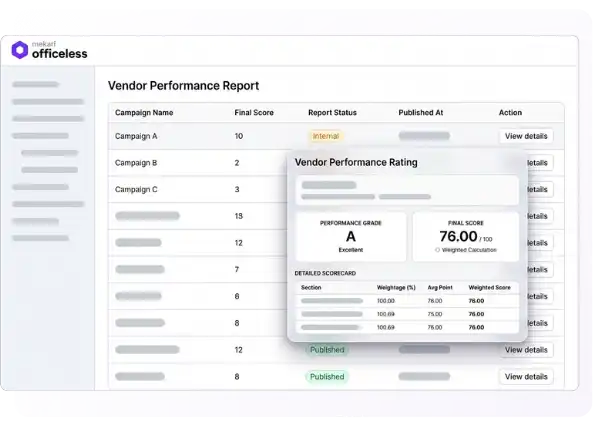
Offering an enterprise-grade eProcurement solution, Mekari Officeless also helps organizations manage the entire procurement lifecycle—from sourcing to payment—within a single integrated platform.
Core capabilities for sourcing teams:
- Vendor lifecycle and risk management. Centralize vendor registration, qualification, document collection, approvals, and risk assessments before supplier activation.
- Sourcing and vendor selection. Manage sourcing requests, RFx processes, supplier submissions, evaluations, scoring, and vendor comparisons in one system.
- Contract, catalogue, and purchase management. Convert awarded suppliers into active contracts, catalogs, and purchase orders while maintaining approved pricing and purchasing controls.
- Receiving, reconciliation, and spend visibility. Track goods receipts, invoice matching, reconciliation, and spending data through a single workflow for better financial control.
- Mekari ecosystem integration. Mekari Officeless connects natively with Mekari Jurnal (finance and supply chain), Mekari Expense (spend control and reimbursement), Mekari Pay (vendor payment execution), and Mekari Sign (digital contract authorization)—creating a fully automated procurement-to-payment loop.
Ready to move procurement from manual to intelligent? Explore how Mekari Officeless can help your team reduce costs, strengthen vendor relationships, and operate with the speed and transparency modern procurement demands.
References and methodology
Methodology
Methodology
Articles published by Mekari Officeless are developed using trusted sources, including official data, company reports, academic research, and insights from industry practitioners. Whenever possible, we refer directly to primary sources before drawing conclusions. Our editorial team reviews and verifies the information to ensure accuracy and relevance. All references are listed so readers can trace each piece of information back to its original source.
Our editorial standards
Our editorial standards
- Primary source first: We consult official product documentation and pricing pages directly, not secondhand summaries or aggregator sites.
- Fact-checking: All product features, pricing, and claims are cross-verified against each platform’s official website at the time of writing.
- No paid placement: Tools are selected based on relevance and fit for Indonesian businesses, not commercial arrangements. Mekari Officeless is included as a first-party product and is transparently labeled as such.
- Regular review: Articles are periodically updated to reflect product changes or shifts in market relevance.
References
References
Ivalua. ‘’The Role of AI in Sourcing and Procurement’’