


Most businesses still manage suppliers reactively: chasing invoices, renegotiating under pressure, scrambling when a vendor fails. That’s vendor management by crisis, not by strategy.
McKinsey reports that supply chain disruptions lasting longer than a month now occur every 3.7 years on average, and can cost businesses up to 45% of a year’s profit over the course of a decade.
A structured Supplier Relationship Management (SRM) program changes that transforming supplier interactions from transactional to strategic, and unlocking cost savings, innovation, and resilience when powered by the right technology.
What Is Supplier Relationship Management (SRM)?
Supplier Relationship Management (SRM) is the strategic process of managing supplier relationships to maximize value for both parties. It involves evaluating supplier performance, capabilities, and business importance, then tailoring engagement based on each supplier’s role in the organization.
Unlike traditional vendor management, which focuses on contracts and compliance, SRM emphasizes long-term collaboration, innovation, resilience, and shared growth.
| Dimension | Vendor Management | Supplier Management | SRM |
| Focus | Contracts, invoices, compliance | Operational performance | Strategic value and mutual growth |
| Time Horizon | Transactional | Short-to-medium term | Long term |
| Engagement | Administrative | Performance tracking | Collaborative partnership |
| Applies To | All vendors | Active suppliers | Strategic suppliers |
| Goal | Risk mitigation | Efficiency | Competitive advantage and innovation |
SRM builds on vendor and supplier management by transforming key supplier relationships into drivers of business value.
Why SRM Matters More Than Ever in 2026
Trade volatility, geopolitical uncertainty, and rising ESG requirements have made supplier resilience a strategic priority. Organizations with mature SRM programs, supported by supplier segmentation, performance monitoring, and risk management, are better positioned to reduce disruptions, strengthen supply continuity, and create long-term competitive advantage.
The Business Case for SRM: Why It Pays
Strong SRM programs deliver measurable business value:
- Lower costs and higher efficiency: Strategic collaboration helps reduce total cost of ownership, shorten lead times, minimize waste, and improve purchasing terms.
- Reduced supplier risk: Continuous monitoring of supplier performance, financial health, and compliance helps identify issues before they disrupt operations.
- Greater access to innovation: Trusted suppliers are more likely to share new ideas, technologies, and process improvements.
- Stronger supply chain resilience: Better visibility into supplier capabilities, capacity, and risks enables faster responses to disruptions and changing market conditions.
When asked about strategies expected to deliver the most value in 2025, CPOs highlighted increasing levels of supplier collaboration (38%) as a top three priority, alongside digital transformation (41%) and renegotiating with existing suppliers (41%) (Deloitte)
The 7-Step SRM Framework
A robust SRM program isn’t built overnight, it follows a deliberate lifecycle. Here is a proven seven-step framework that procurement teams can adapt to their organization’s scale and complexity.
Step 1: Supplier Identification and Onboarding
Define criteria for selecting and onboarding new suppliers. This includes capability assessments, financial health checks, compliance verification, and alignment with your organization’s values (sustainability, labor standards, data security). A structured onboarding process establishes expectations from day one and captures critical supplier data in a centralized system.
Step 2: Supplier Segmentation
Not all suppliers deserve — or require — the same level of engagement. Segment your supplier base into tiers based on strategic importance, spend volume, risk exposure, and partnership potential. The three-tier model is the most widely adopted starting point (detailed in the next section).
Step 3: Performance Measurement and KPI Tracking
Define clear, objective metrics for each supplier tier. Establish scorecards and review cadences. Performance data should be captured systematically — not manually compiled before a quarterly meeting — to provide a reliable, continuous view of supplier health.
Step 4: Risk Assessment and Monitoring
Conduct structured risk assessments covering financial stability, operational capacity, regulatory compliance, and geopolitical exposure. For strategic suppliers, this should be an ongoing process, not an annual checkmark. In 2026, this also increasingly includes ESG and carbon footprint tracking.
Step 5: Collaboration and Supplier Development
For strategic and preferred suppliers, proactive engagement goes beyond performance reviews. Joint business planning sessions, co-innovation initiatives, training programs, and early supplier involvement in product development create deeper partnerships that yield shared competitive advantages.
Step 6: Contract and Compliance Management
Ensure all supplier relationships are governed by current, clearly structured contracts with well-defined SLAs, performance incentives, and compliance obligations. Digital contract management tools make renewal tracking, amendment logging, and compliance auditing significantly more efficient.
Step 7: Continuous Improvement and Review Cycles
SRM is not a set-and-forget program. Establish regular review cycles — monthly operational reviews for strategic suppliers, quarterly performance reviews for preferred suppliers, and annual assessments for transactional suppliers. Review segmentation tiers and adjust resource allocation as business priorities evolve.
Supplier Segmentation: The Foundation of Smart SRM
Trying to manage all suppliers with the same intensity is one of the most common and costly SRM mistakes. Segmentation allows procurement teams to focus their most valuable resource — time and expertise — where it generates the highest return.
The Three-Tier Segmentation Model
- Strategic Suppliers (Tier 1)
These are the small number of suppliers — typically 5–10% of your supplier base — who provide goods or services critical to your core business, represent significant spend, or offer unique capabilities no other vendor can replicate. Investment here: dedicated relationship managers, joint business planning, executive-level engagement, comprehensive scorecards.
- Preferred Suppliers (Tier 2)
Consistent, reliable suppliers who meet performance standards and represent meaningful spend, but aren’t yet strategic partners. Investment here: regular performance reviews, contract optimization, and development conversations to identify potential for deeper collaboration.
- Transactional Suppliers (Tier 3)
High-volume, lower-criticality suppliers managed primarily for efficiency and compliance. Investment here: standardized onboarding, automated ordering, periodic compliance checks, minimal high-touch engagement.
Best Practice: Review and re-tier your supplier base at least quarterly. A supplier that was transactional two years ago may have become strategic as your business has grown — and an outdated segmentation model means misallocated resources.
SRM KPIs: What to Measure and Why
Effective SRM requires objective measurement. The right KPIs create shared accountability, enable data-driven conversations with suppliers, and surface improvement opportunities before they become problems.
| KPI Category | Key Metric | Why It Matters | Typical Target |
| Delivery | On-Time Delivery Rate | Measures supplier reliability and supply continuity. | ≥ 95% |
| Quality | Supplier Quality Score | Tracks overall quality performance across deliveries. | ≥ 85/100 |
| Cost & Value | Year-over-Year Savings | Quantifies cost improvements delivered by suppliers. | ≥ 3–5% annually |
| Risk & Compliance | Regulatory Compliance Rate | Ensures adherence to contractual, legal, and ESG requirements. | 100% |
| Risk & Compliance | Supplier Risk Score | Assesses financial, operational, and geopolitical risk exposure. | Low risk |
| Relationship Health | Issue Resolution Time | Measures how quickly supplier issues are addressed and closed. | Continuous improvement |
| Relationship Health | Supplier Responsiveness Score | Evaluates communication speed and collaboration effectiveness. | ≥ 4/5 |
| Innovation | Supplier-Initiated Improvements | Tracks supplier contributions to process, product, or cost innovation. | Increasing trend |
The right KPI mix should align with your segmentation strategy. Strategic suppliers warrant comprehensive scorecards across all dimensions. Transactional suppliers can be evaluated on core delivery and compliance metrics alone.
Common SRM Mistakes and How to Avoid Them
Even organizations with good intentions struggle with SRM. These are the most frequently observed failure points:
- Treating all suppliers the same
Applying the same management approach to every supplier leads to inefficient resource allocation. Segment suppliers based on strategic importance and tailor engagement accordingly. - Lack of formal onboarding and performance measurement
Incomplete supplier data and inconsistent performance reviews make it difficult to manage relationships effectively. Establish standardized onboarding processes and supplier scorecards. - Siloed supplier data
When procurement, finance, operations, and legal teams maintain separate records, visibility suffers. Centralize supplier information in a single system to improve decision-making and risk management. - Reactive risk management
Assessing supplier risk only after issues arise increases disruption exposure. Implement continuous monitoring of financial, operational, compliance, and geopolitical risks. - Limited supplier development
Organizations that focus solely on monitoring suppliers miss opportunities for improvement. Regular feedback, joint planning, and capability-building initiatives help suppliers deliver greater value over time.
How Technology Transforms SRM From Spreadsheets to Supply Chain Intelligence
The gap between a SRM program that exists on paper and one that actually drives business outcomes almost always comes down to technology.
Manual SRM — built on shared spreadsheets, email chains, and periodic reviews — has a hard ceiling. It doesn’t scale, it can’t deliver real-time visibility, and it’s prone to the kind of data gaps that let risks go undetected.
Modern eProcurement platforms change this by digitizing and integrating every stage of the supplier lifecycle:
- Centralized vendor data: All supplier profiles, qualifications, certifications, contracts, and performance history in one searchable system
- Automated performance scorecards: Real-time tracking against agreed KPIs, with automated alerts when thresholds are missed
- E-sourcing and vendor evaluation: Structured RFI, RFP, and RFQ processes with built-in scoring, eliminating manual bid comparison
- Contract and compliance management: Digital contracts with automated renewal alerts, amendment tracking, and audit logs
- Spend analytics: Real-time dashboards showing supplier spend, budget utilization, savings realized, and maverick purchasing
- Supplier collaboration portal: A single point of communication for document sharing, performance feedback, and purchase order management
87% of companies now utilize eProcurement tools to enhance their supplier sourcing processes. (Core X)
Mekari Officeless eProcurement SRM Built for Enterprise Scale
Mekari Officeless is an enterprise application development platform that enables businesses to build custom applications, automate workflows, and connect fragmented systems across operations.
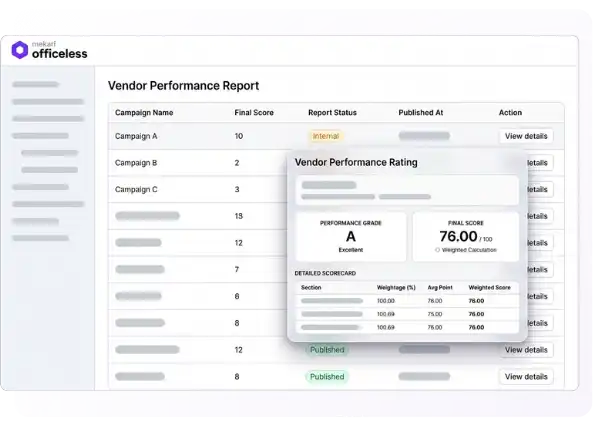
Through Mekari Officeless enterprise-grade eProcurement capabilities, organizations can manage sourcing, supplier onboarding, purchasing, contract management, invoice processing, and payment activities within a single integrated platform.
Key SRM capabilities within Mekari Officeless include:
- Vendor Management System (VMS): Centralize vendor databases, qualifications, and performance data for full transparency across your supplier base
- E-Sourcing: Streamline RFI, RFP, and RFQ workflows with structured bid management and automated supplier evaluation scoring
- Contract Management: Manage and automate supplier agreements with digital signature integration (Mekari Sign) and compliance tracking
- Spend Analytics & Reporting: Real-time dashboards for supplier spend, performance trends, and savings opportunities — accessible from any device
- Procure-to-Pay (P2P) Automation: Connect purchase requisitions through to supplier payment in a fully digital, approval-controlled workflow
- Multi-vendor and multi-location support: Ideal for enterprises managing complex, distributed procurement operations
Strengthen supplier collaboration, improve performance, and drive long-term value with an eProcurement from Mekari Officeless.
References and methodology
Methodology
Methodology
Articles published by Mekari Officeless are developed using trusted sources, including official data, company reports, academic research, and insights from industry practitioners. Whenever possible, we refer directly to primary sources before drawing conclusions. Our editorial team reviews and verifies the information to ensure accuracy and relevance. All references are listed so readers can trace each piece of information back to its original source.
Our editorial standards
Our editorial standards
- Primary source first: We consult official product documentation and pricing pages directly, not secondhand summaries or aggregator sites.
- Fact-checking: All product features, pricing, and claims are cross-verified against each platform’s official website at the time of writing.
- No paid placement: Tools are selected based on relevance and fit for Indonesian businesses, not commercial arrangements. Mekari Officeless is included as a first-party product and is transparently labeled as such.
- Regular review: Articles are periodically updated to reflect product changes or shifts in market relevance.
References
References
Focal Point. ‘’Supplier Relationship Management Best Practices for Success’’