


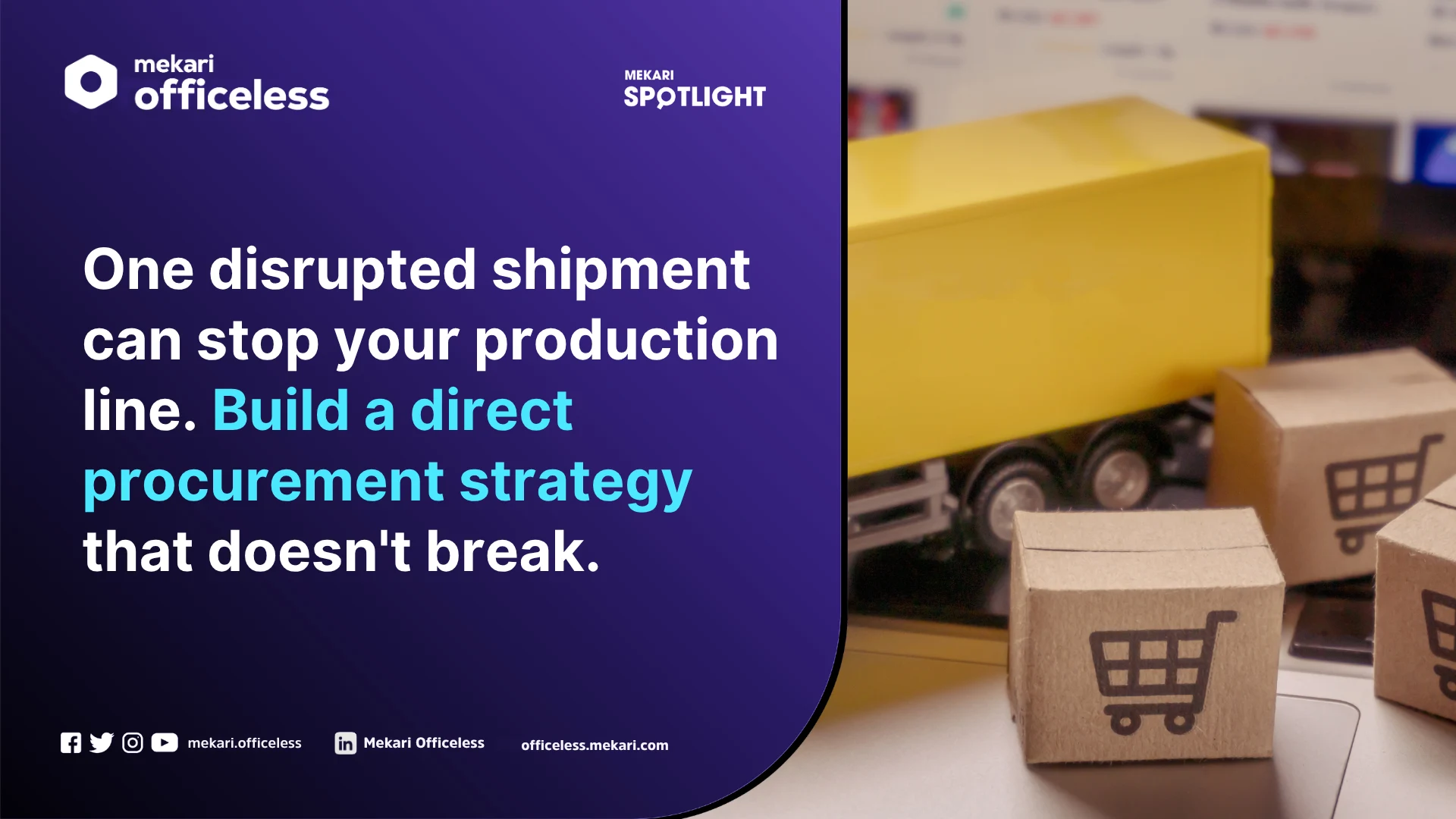
For most manufacturers and distributors, direct spend is the single largest cost category, and it’s also the most fragile. A disrupted raw-material shipment doesn’t just raise costs; it can stop the production line entirely.
Yet many procurement teams still manage direct spend through spreadsheets, email approvals, and reactive sourcing, only gaining visibility after a stockout or price spike hits.
This guide breaks down what direct procurement is, how it differs from indirect procurement, the end-to-end process, seven proven strategies for a high-performing program, common manual challenges, and how a source-to-pay platform like Mekari Officeless brings it all together.
What is direct procurement
Direct procurement is the acquisition of raw materials, components, and goods that go directly into a company’s finished product or core service. Examples include steel for car manufacturers, cotton for clothing companies, and wood for furniture makers.
Unlike indirect spend, direct procurement is treated as a strategic capability rather than a back-office function. For most companies that produce or sell physical goods, direct spend is the largest single expenditure category, so when a company talks about procurement cost savings, it’s often direct spend where the real dollars are.
Direct vs indirect procurement, key differences
| Aspect | Direct Procurement | Indirect Procurement |
| What’s purchased | Raw materials, components, production goods | Office supplies, software, MRO, services |
| Business impact | Forms the end product; drives COGS | Supports operations; drives overhead |
| Sourcing approach | Strategic sourcing, TCO-based, long-term contracts | Catalog buying, policy-driven |
| Disruption risk | Can halt production entirely | Costly but rarely stops the business |
| Typical owner | Category managers, supply chain teams | Procurement operations/admin teams |
A disruption in direct procurement, such as a key supplier going out of business, a geopolitical event cutting off a raw materials source, or a quality problem forcing a recall, can halt production entirely. Indirect disruptions are painful, but direct disruptions can be existential.
Why a strong direct procurement strategy matters
The numbers make the case for treating direct procurement as a strategic priority, not an operational afterthought.
According to Deloitte, nearly 60% of supply chain leaders say poor visibility in direct procurement leads to higher costs and production delays. Separately, a 2026 study of 133 senior direct procurement leaders found that supply disruptions cost an average of $16M annually, identifying infrastructure as the defining challenge for the year. (PR Newswire)
The takeaway: visibility and structured infrastructure aren’t nice-to-haves, they’re the difference between absorbing a supply shock and shutting down a line.
How to manage direct procurement process
A mature direct procurement function typically follows this flow:
- Demand planning & forecasting, align purchasing volumes with production schedules and MRP data.
- Supplier identification & qualification, research and assess suppliers on quality, pricing, reliability, and sustainability.
- Sourcing & negotiation, run RFQs/RFPs and negotiate pricing, lead times, and contract terms.
- Contracting & price agreements, formalize terms, including volume commitments and pricing tiers.
- Purchase order issuance & collaboration, issue POs and collaborate with suppliers at the line-item level on confirmations and changes.
- Goods receipt & quality inspection, receive, inspect, and update inventory.
- Invoice matching & payment, perform 3-way matching (PO, GRN, invoice) before payment.
- Supplier performance review, track KPIs and feed results back into future sourcing decisions.
7 proven direct procurement strategies
A high-performing direct procurement function isn’t built on one big initiative, it’s built on a set of interlocking strategies. Here are seven that consistently separate leaders from laggards.
1. Forecast demand with production data, not guesswork
Connect procurement planning directly to production schedules and MRP systems so purchase volumes match real demand. This reduces both costly stockouts and excess inventory tied up in working capital, especially important for materials with seasonal demand swings or long lead times.
2. Diversify your supplier base for critical materials
Relying on a single supplier for a critical input is one of the biggest risk exposures in direct procurement. McKinsey’s research found that half of single-source spending could be redirected to multiple sources through strategic supplier development. Qualify at least one backup supplier, ideally in a different region, for every high-risk category.
3. Source on total cost of ownership, not unit price
Strategic sourcing in direct procurement isn’t just about finding the lowest unit price. It’s about understanding total cost of ownership, including logistics, quality risk, lead times, currency exposure, and the cost of a supplier failure. A cheaper supplier with longer lead times or higher defect rates can cost more overall.
4. Build collaborative, not transactional, supplier relationships
Move beyond arm’s-length PO issuance toward active collaboration. Line-item PO confirmations and shared visibility let suppliers flag delays or shortages before they cascade into production problems, turning suppliers into an early-warning system rather than a black box.
5. Centralize sourcing-to-payment on one digital platform
Spreadsheets and email threads can’t scale with multi-supplier, multi-category direct spend. A single source-to-pay (S2P) platform, covering RFQs, POs, goods receipt, and invoice matching, gives every stakeholder the same real-time data and eliminates version-control chaos.
6. Set up multi-level approval and compliance workflows
Price variances, contract amendments, and large POs should route through structured, role-based approval chains. This prevents maverick spend, keeps procurement aligned with company policy, and creates the audit trail needed for compliance reviews.
7. Track KPIs and act on real-time data
Monitor metrics like cost-per-unit, supplier lead time, PO compliance rate, and on-time delivery on a live dashboard. Benchmark performance metrics like cost-per-unit and lead times against industry benchmarks to identify areas for improvement, and act on the gaps before they become budget overruns.
Common challenges when managing direct procurement manually
Before adopting these strategies, most teams run into the same operational roadblocks:
- Fragmented data: Supplier contracts, POs, and quality records scattered across spreadsheets, email, and paper.
- Poor real-time visibility: No single view of supplier status, inventory levels, or in-transit shipments.
- Slow approval chains: Price changes and contract amendments stuck in email threads for days.
- Weak benchmarking: Without consolidated data, it’s hard to know if current supplier pricing is competitive.
- High disruption exposure: Single-source dependencies go unnoticed until a supplier fails.
These gaps are exactly why direct spend infrastructure has become the top priority for procurement leaders heading into 2026.
How Mekari Officeless streamlines direct procurement with source-to-pay
Mekari Officeless is a platform to democratize business app creation, workflow automation, and analytics across Indonesia by empowering teams to build and supporting organizations to scale by generating innovative idea solutions.
Offering enterprise-grade Source to Pay, Indonesian businesses can manage complex procurement operations — with the governance infrastructure responsible sourcing requires.
Key capabilities for responsible sourcing:
- Vendor Management System: Maintain a qualified vendor database with performance scoring, certification tracking, and qualification status — ensuring you only transact with vetted, compliant suppliers.
- E-Sourcing and Vendor Bidding: Run structured, documented sourcing events that create a clear record of how suppliers were evaluated and selected.
- Customizable Approval Workflows: Configure multi-level approval flows that reflect your internal governance policy — including responsible sourcing checkpoints for new vendor onboarding.
- Contract and Quotation Management: Embed supplier code of conduct requirements and ESG criteria directly into contract structures.
- Real-Time Reporting and Analytics: Monitor procurement activity, supplier performance, and spending patterns with dashboards built for compliance and governance.
- Mekari Ecosystem Integration: Connect with Mekari Jurnal for financial reporting, Mekari Expense for spend control, and Mekari Sign for contract authorization — creating end-to-end procurement governance in one ecosystem.
Ready to build a procurement program your auditors, investors, and stakeholders can trust? Explore Mekari Officeless eProcurement.
References and methodology
Methodology
Methodology
Articles published by Mekari Officeless are developed using trusted sources, including official data, company reports, academic research, and insights from industry practitioners. Whenever possible, we refer directly to primary sources before drawing conclusions. Our editorial team reviews and verifies the information to ensure accuracy and relevance. All references are listed so readers can trace each piece of information back to its original source.
Our editorial standards
Our editorial standards
- Primary source first: We consult official product documentation and pricing pages directly, not secondhand summaries or aggregator sites.
- Fact-checking: All product features, pricing, and claims are cross-verified against each platform’s official website at the time of writing.
- No paid placement: Tools are selected based on relevance and fit for Indonesian businesses, not commercial arrangements. Mekari Officeless is included as a first-party product and is transparently labeled as such.
- Regular review: Articles are periodically updated to reflect product changes or shifts in market relevance.