


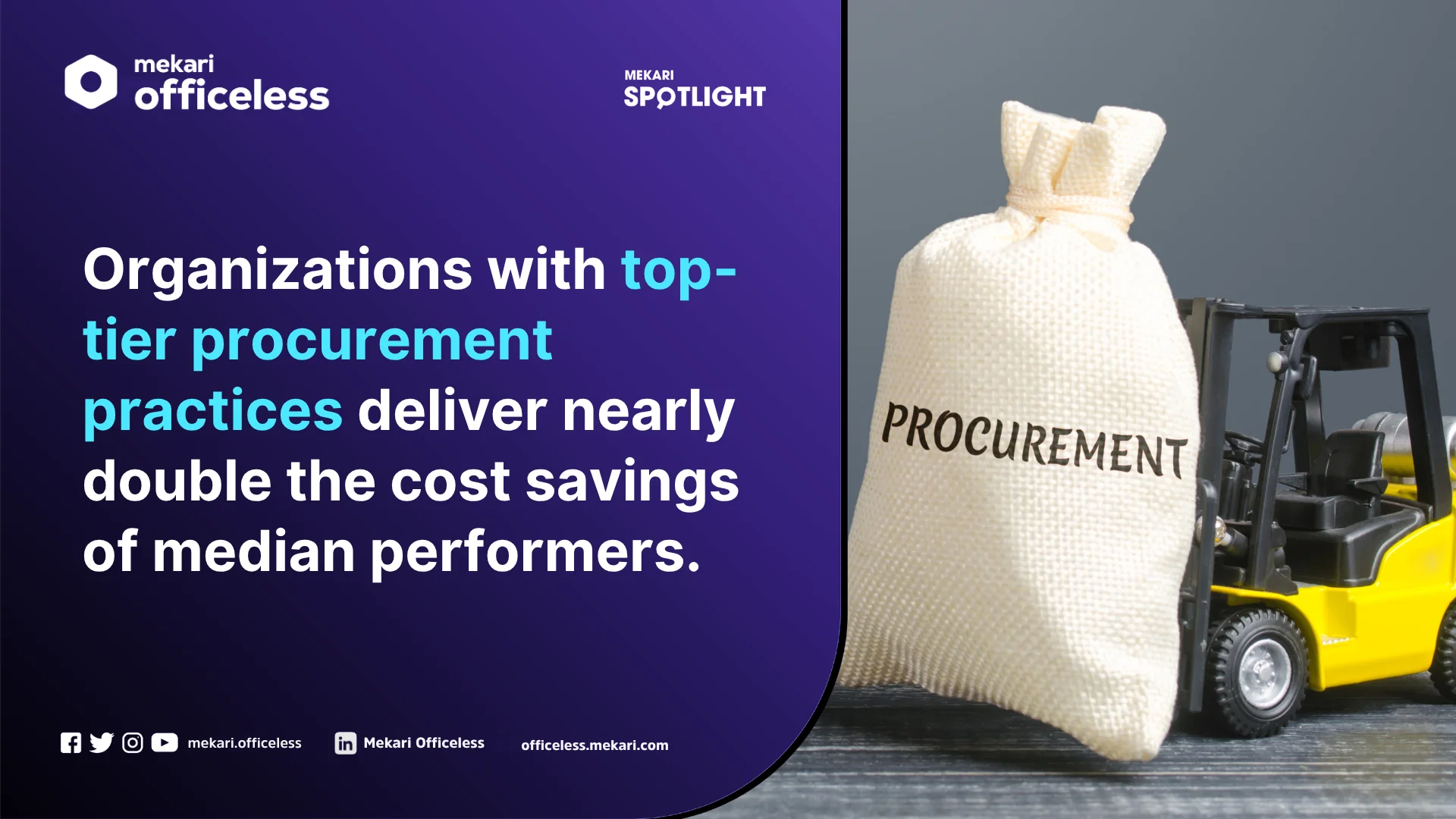
- Top-tier procurement teams deliver 2× cost savings vs. median performers (Ardent Partners).
- Best-in-class organizations manage 90%+ of total spend through structured channels (Gartner).
- Most teams still use fragmented tools — a unified S2P platform like Mekari Officeless closes the gap.
Most procurement problems don’t start at the negotiating table. They start upstream — in a missing approval, an unvetted vendor, or a contract buried in someone’s inbox. According to McKinsey, organizations with mature procurement practices achieve up to 15% cost savings through strategic metric usage alone, while best-in-class companies actively manage over 90% of their total spend. The average team? Just 44% of addressable spend goes through competitively-priced channels.
This guide covers 12 actionable procurement best practices — structured around the full source-to-pay lifecycle — so your team can reduce costs, eliminate waste, and build a procurement function that actually scales.
The 12 Procurement Best Practices
Strong procurement performance does not happen by chance. It requires clear processes, reliable data, effective supplier management, and the right technology to support decision-making.
The following best practices can help organizations strengthen procurement operations, improve compliance, and unlock greater value from their spending.
1. Centralize Spend Visibility with a Unified Platform
Effective procurement starts with visibility. Before organizations can control costs, identify savings opportunities, or improve decision-making, they need a clear view of where money is being spent. However, many companies still manage procurement data across multiple systems, making it difficult to gain accurate insights.
Best practice: Consolidate all procurement activity including requisitions, purchase orders, contracts, invoices, and vendor data into a single system of record. This enables real-time spend visibility, accurate forecasting, and faster identification of savings opportunities.
According to a Concord survey, 100% of respondents cited the lack of real-time visibility into procurement and contract data as a major pain point.
2. Standardize the Requisition-to-PO Workflow
Once spend data is centralized, the next step is ensuring that purchases follow a consistent process. Without standardized workflows, employees may bypass procurement controls, leading to unauthorized spending, compliance issues, and reduced visibility.
Best practice: Define a clear, enforced workflow from purchase request to approval, purchase order creation, and goods receipt. Every purchase above a defined threshold should require a PO. Use digital intake forms that route requests automatically based on category, value, and department.
The simpler the intake process, the higher the compliance rate. Complex processes often encourage employees to find workarounds.
3. Practice Strategic Sourcing Every Cycle
A standardized purchasing process creates better control, but organizations also need to ensure they are consistently obtaining the best value from suppliers. Markets change, supplier capabilities evolve, and pricing fluctuates, making regular sourcing reviews essential.
Best practice: Run competitive bidding processes at defined intervals, annually for high-value categories and at each renewal for medium-value ones. Issue RFQs or RFPs through a structured sourcing process and document the rationale behind every supplier selection decision.
World-class companies source 60% of their addressable spend through competitive channels, while the average team sources just 44%. (Esker)
4. Build and Maintain a Verified Supplier Database
Strategic sourcing depends on reliable supplier information. If vendor records are incomplete, outdated, or inaccurate, procurement teams face greater risks during sourcing, contracting, and ongoing supplier management.
Best practice: Maintain a centralized, continuously updated vendor master with qualification checkpoints that include legal documents, financial health indicators, compliance certifications, and performance history. Segment vendors by spend tier and business criticality. Self-service supplier portals can further improve data quality while reducing administrative work.
5. Implement Multi-Level Approval Workflows
As supplier and purchasing data becomes more structured, organizations must ensure that spending decisions are reviewed appropriately. Approval processes provide oversight and help prevent unauthorized purchases, but manual approval methods often create delays and compliance gaps.
Best practice: Build rule-based approval workflows that automatically route requests based on spend amount, category, cost center, or vendor type. Approval requirements should scale according to risk and value, ensuring appropriate oversight without slowing down routine purchases.
6. Enforce Contract Lifecycle Management
Approvals help organizations control spending before commitments are made, but procurement value must also be protected after agreements are signed. Without ongoing contract oversight, organizations risk missing savings opportunities, compliance requirements, and important obligations.
Best practice: Manage every contract from drafting and execution through renewal within a dedicated contract management system. Set automated alerts for expiration dates, renewal windows, and key milestones. Monitor contract compliance alongside supplier performance to ensure accountability.
7. Run Supplier Performance Reviews on a Cadence
Managing contracts effectively is only part of supplier management. Organizations also need to measure how suppliers perform against expectations over time. Regular reviews help identify issues early and support stronger supplier relationships.
Best practice: Establish a formal Supplier Performance Management process with quarterly or semi-annual scorecards. Measure suppliers against key performance indicators such as on-time delivery, quality performance, invoice accuracy, and responsiveness. Use these insights to guide sourcing decisions and contract renewals.
8. Eliminate Maverick Spend with Policy Guardrails
Supplier performance management helps ensure value after suppliers are selected, but organizations must also ensure employees purchase through approved channels. Uncontrolled spending can quickly undermine negotiated savings and procurement policies.
Best practice: Enforce purchasing policies through system controls rather than relying solely on employee compliance. Approved supplier catalogs, negotiated pricing agreements, and category-specific purchasing channels help prevent off-contract spending before it occurs.
9. Connect Procurement to Finance Through AP Automation
Controlling spend at the purchasing stage is important, but procurement processes do not end when an order is placed. Procurement and finance teams must work together to ensure invoices, payments, and records remain accurate throughout the transaction lifecycle.
Best practice: Integrate procurement systems with accounts payable and finance platforms. Automate three-way matching between purchase orders, goods receipts, and invoices. Route only exceptions for manual review to reduce processing time and improve accuracy.
10. Use Real-Time Analytics and Spend Dashboards
When procurement and finance systems are connected, organizations gain access to richer and more reliable data. The next step is turning that data into actionable insights that support better decision-making.
Best practice: Deploy real-time dashboards that track committed spend, actual spend, and remaining budgets across categories, departments, suppliers, and cost centers. Use predictive analytics to identify anomalies and potential budget overruns before they become significant issues.
64% of decision-makers and 73% of senior leaders consider data and AI-powered analytics essential to growth and resilience, yet many organizations still lack the tools needed to act on those insights. (Amazon Business)
11. Digitize the Full Source-to-Pay Cycle
The previous best practices address individual components of procurement excellence. However, the greatest benefits are achieved when these processes are connected through a single digital framework. A fragmented approach often leads to duplicate work, inconsistent information, and limited visibility across teams.
Best practice: Implement a unified platform that supports the entire source-to-pay process, including supplier identification, sourcing events, contract management, purchase orders, goods receipt, invoice processing, and payment. End-to-end digitization eliminates data silos, strengthens compliance, and provides a complete audit trail for governance and reporting purposes.
12. Measure What Matters: Procurement KPIs to Track
You can’t improve what you don’t measure. Without defined KPIs, procurement optimization becomes guesswork.
Essential procurement KPIs:
| KPI | What It Measures | World-Class Benchmark |
| Spend Under Management (SUM) | % of spend actively managed by procurement | >90% (Gartner) |
| Addressable Spend Sourced | % put through competitive channels | 60%+ |
| Procurement Cycle Time | Requisition to PO / contract award | Category-dependent |
| Contract Compliance Rate | % of purchases on approved contracts | >95% |
| Supplier On-Time Delivery | % of POs delivered on schedule | >95% |
| Invoice Accuracy Rate | % of invoices requiring no correction | >98% |
| Cost Savings Achieved | Savings vs. baseline / budget | 6%+ (world-class) |
| Maverick Spend Rate | Purchases outside approved channels | <5% |
Common Procurement Mistakes That Undermine Best Practices
Even teams with good intentions fall into predictable traps:
- Siloed tools. When sourcing, contracting, purchasing, and finance run on separate platforms, data integrity breaks down. Decisions get made on stale or incomplete information.
- Approval chains via email. Without system-enforced workflows, approvals get lost, skipped, or undocumented. This is the fastest path to compliance exposure.
- Vendor onboarding without qualification checkpoints. Onboarding a supplier without verifying legal documents, financial stability, and compliance certificates creates hidden risk — especially in regulated industries.
- No supplier performance tracking. Awarding renewals based on relationship rather than performance data guarantees cost creep and quality drift over time.
- Treating procurement as tactical, not strategic. When procurement is involved only at the point of purchase, the most valuable savings opportunities (specification design, demand aggregation, early supplier collaboration) are already gone.
How Mekari Officeless Powers Your Full Source-to-Pay Cycle
Modern procurement requires more than isolated tools and manual processes. To achieve greater spend visibility, stronger supplier governance, faster approvals, and better financial control, organizations need a connected system that supports the entire procurement lifecycle.
Mekari Officeless is an enterprise app development platform that enables businesses to build custom applications, automate workflows, and connect fragmented systems to improve operational efficiency.
Offering an enterprise-grade eProcurement solution, Mekari Officeless also helps organizations manage the entire procurement lifecycle—from sourcing to payment—within a single integrated platform.
Core capabilities for sourcing teams:
- Vendor lifecycle and risk management. Centralize vendor registration, qualification, document collection, approvals, and risk assessments before supplier activation.
- Sourcing and vendor selection. Manage sourcing requests, RFx processes, supplier submissions, evaluations, scoring, and vendor comparisons in one system.
- Contract, catalogue, and purchase management. Convert awarded suppliers into active contracts, catalogs, and purchase orders while maintaining approved pricing and purchasing controls.
- Receiving, reconciliation, and spend visibility. Track goods receipts, invoice matching, reconciliation, and spending data through a single workflow for better financial control.
- Mekari ecosystem integration. Mekari Officeless connects natively with Mekari Jurnal (finance and supply chain), Mekari Expense (spend control and reimbursement), Mekari Pay (vendor payment execution), and Mekari Sign (digital contract authorization)—creating a fully automated procurement-to-payment loop
Ready to operationalize every best practice on this list? Explore Mekari Officeless Source-to-Pay.
References and methodology
Methodology
Methodology
Articles published by Mekari Officeless are developed using trusted sources, including official data, company reports, academic research, and insights from industry practitioners. Whenever possible, we refer directly to primary sources before drawing conclusions. Our editorial team reviews and verifies the information to ensure accuracy and relevance. All references are listed so readers can trace each piece of information back to its original source.
Our editorial standards
Our editorial standards
- Primary source first: We consult official product documentation and pricing pages directly, not secondhand summaries or aggregator sites.
- Fact-checking: All product features, pricing, and claims are cross-verified against each platform’s official website at the time of writing.
- No paid placement: Tools are selected based on relevance and fit for Indonesian businesses, not commercial arrangements. Mekari Officeless is included as a first-party product and is transparently labeled as such.
- Regular review: Articles are periodically updated to reflect product changes or shifts in market relevance.
References
References
Concord. ‘’2025 Procurement Research’’