


- Contract lifecycle management is the end-to-end process of governing contracts from initiation through renewal, treating them as live business assets rather than documents to file and forget.
- Effective CLM governs contracts across five sequential stages: initiation, drafting and negotiation, execution, performance monitoring, and renewal.
-
Mekari Officeless offers e-procurement software that enables organizations to build custom CLM workflows, automate approvals, and gain real-time visibility into their entire contract portfolio.
Managing contracts through email threads, shared folders, and manual spreadsheets works fine at low volume, but breaks down the moment your business grows.
McKinsey research finds that operating without effective contract management erodes 9 percent of sourcing value annually, because contract volume quickly overwhelms teams that rely on manual processes instead of structured systems.
Contract lifecycle management replaces this fragmented approach with an end-to-end process governing every contract from initial request through negotiation, execution, monitoring, and renewal.
CLM makes the compliant path the default, so approvals route automatically, obligations surface on schedule, and no contract falls through the cracks.
This article walks through the five CLM stages, common organizational challenges, and the best practices that help enterprises execute CLM at scale.
What Is Contract Lifecycle Management?
Contract lifecycle management (CLM) is the systematic process of managing a contract from the moment a business need is identified through negotiation, execution, performance monitoring, and eventually renewal, amendment, or termination. It treats contracts as live business assets that require active governance throughout their existence, not just at the point of signature.
CLM spans two distinct phases:
1. Pre-signature, everything before a contract is executed:
- Request and intake.
- Drafting from approved templates.
- Internal and external negotiation and redline management.
- Multi-stakeholder approval routing.
2. Post-signature, where most business value is either captured or lost:
- Obligation and SLA tracking.
- Compliance monitoring.
- Payment term enforcement.
- Renewal and amendment decisions.
Most organizations invest heavily in the pre-signature phase and neglect the post-signature phase entirely. This is where value leaks.
CLM differs from traditional contract management in one critical way: it is proactive rather than reactive.
| Aspects | Traditional Contract Management | Contract Lifecycle Management |
|---|---|---|
| Focus | Document storage and retrieval | End-to-end process governance |
| Approach | Reactive | Proactive |
| Key question | Where is the signed contract? | Are the terms being fulfilled, and what happens at renewal? |
| Ownership | Legal team only | Cross-functional (legal, finance, procurement, ops) |
| Visibility | Per-request | Real-time across all active contracts |
CLM applies across every contract type a business manages: vendor agreements, customer contracts, employment and contractor agreements, NDAs, SLAs, licensing arrangements, and partnership agreements. Because it touches legal, procurement, finance, and operations simultaneously, CLM only works when it is treated as an organization-wide process rather than a legal department task.
Why Contract Lifecycle Management Matters
Most organizations treat contracts as a legal formality rather than a financial instrument. That misclassification is expensive. McKinsey research found that suboptimal contract terms combined with a lack of effective contract management erode sourcing value by 9 percent annually. For Fortune 500 companies, that figure translates to roughly $2.5 trillion in destroyed value.
The same research identified why this happens at scale:
- 80 percent of procurement functions are not fully aware of competitive terms and contract structures in their own agreements.
- 75 percent of contracts lack an exhaustive set of KPIs and reporting processes tied to total cost of ownership.
- 50 percent of contracts contain no governance body or escalation path for managing the contract lifecycle.
- 40 percent of contracts omit clauses that cap pricing adjustments for inflation.
Beyond the numbers, poor CLM creates compounding business risk across five areas:
- Revenue leakage: Missed renewal dates, untracked auto-renewals, and forgotten price escalations quietly erode negotiated value.
- Compliance exposure: Regulatory obligations buried in contracts go unmonitored, and audit trails are incomplete or missing entirely.
- Procurement savings erosion: Contracts are negotiated but never enforced, allowing off-contract spending to accumulate.
- Operational friction: Legal, finance, and procurement each manage their own view of the same contract with no shared source of truth.
- Vendor performance gaps: SLAs go untracked, underperformance goes unpenalized, and renegotiation leverage is never used.
The organizations that close this gap do so not by hiring more contract managers, but by implementing a structured CLM process that makes visibility and compliance the default rather than the exception.
The 5 Stages of Contract Lifecycle Management
Every contract, regardless of type or value, passes through the same five sequential stages. Understanding what happens at each stage, and where things typically break down, is the foundation of an effective CLM process.
1. Initiation and Request
A contract begins with a business need: onboarding a vendor, engaging a partner, licensing software, or formalizing a service arrangement. At this stage, the requesting team defines the contract type, scope, key stakeholders, and timeline.
The output is a clear contract request that carries enough context for legal or procurement to begin drafting without going back and forth for basic information.
Most organizations skip this structure entirely, which means drafting starts on incomplete briefs and early delays compound throughout the lifecycle.
2. Drafting and Negotiation
Legal or procurement drafts the contract, ideally from pre-approved templates with standardized clauses. The draft then moves through internal review across legal, finance, and the relevant business unit, followed by external negotiation with the counterparty.
This is the stage most prone to version control chaos: redlines exchanged over email, multiple parties working on different versions, and no clear audit trail of what changed and when.
Key elements negotiated at this stage include:
- Commercial terms: Pricing, payment schedules, and volume commitments.
- Legal terms: Liability limits, indemnification, and termination rights.
- Operational terms: Service levels, delivery timelines, and reporting requirements.
3. Execution and Signature
Once negotiation is complete, the contract moves through final approval routing based on predefined authority thresholds, then to execution via e-signature or wet signature.
Execution is not the finish line, but rather the handoff point. The signed contract must be stored in a centralized repository with complete metadata captured:
- Parties and authorized signatories
- Effective and expiration dates
- Obligations summary and assigned contract owner
- Payment terms and renewal clauses
Without this metadata, the post-signature phase would operate blindly.
4. Performance and Compliance Monitoring
This is the longest stage and the one most organizations manage worst. After execution, teams need to actively monitor whether both parties are fulfilling their contractual obligations:
- SLA adherence and service delivery milestones
- Payment schedules and invoice compliance
- Regulatory and policy compliance requirements
- Performance-based penalties or bonuses tied to contract terms
Automated alerts should surface key dates well before they arrive, not after they pass. Organizations that treat execution as the end of the contract process routinely discover breaches, missed renewals, and untracked obligations only during audits or disputes.
5. Renewal, Amendment, or Termination
As a contract approaches expiration, the business needs to make a deliberate decision, renew as-is, renegotiate terms, amend for changed conditions, or terminate.
This decision should be informed by performance data from Stage 4, not made reactively because someone noticed the expiration date.
Each outcome requires documentation, an updated audit trail, and if renewing, a loop back to Stage 2 with renegotiation. Contracts that auto-renew without review are one of the most common sources of unintended spend commitments.
Common Challenges in Contract Lifecycle Management
Most CLM failures are not caused by bad contracts but by the systems and habits surrounding them. These are the challenges that consistently derail CLM efforts across organizations of all sizes:
- Siloed data: Contracts live in legal’s shared drive, vendor information sits in procurement’s spreadsheet, and invoices are reconciled in finance’s ERP with no connection between them.
- Manual workflows: Approvals route through email, signature tracking happens in spreadsheets, and renewal dates are maintained in someone’s personal calendar until someone leaves or volume grows.
- Version control breakdown: Redlines exchanged over email produce multiple simultaneous versions of the same contract, and teams regularly lose track of which draft is current.
- Lack of cross-functional visibility: Finance doesn’t know which contracts are active, operations doesn’t know which obligations are due, and legal can’t report contract status without manually pulling records.
- Missed critical dates: Renewal windows pass unnoticed, auto-renewal clauses execute without review, and price escalation triggers are forgotten between signature and expiration.
- Compliance gaps: Contracts are signed by unauthorized personnel, audit trails are incomplete, and regulatory requirements embedded in contract terms go unmonitored after execution.
- Slow cycle times: Approvals sit in inboxes for days, negotiations stall without clear ownership, and contracting cycles that should take one to two weeks routinely stretch to 60 or 90 days.
The common thread across all of these is that CLM is a cross-functional process being managed with single-function tools.
Legal cannot solve a finance visibility problem with a better contract template, and procurement cannot solve a compliance gap with a new vendor policy. These challenges require a shared process and, at scale, a shared system.
Benefits of Implementing Contract Lifecycle Management
Organizations that move from reactive contract handling to a structured CLM process see improvements across legal, finance, procurement, and operations simultaneously. These are the core benefits:
- Centralized visibility: Every active contract, its status, obligations, and key dates are accessible in one place, so no team operates on incomplete information.
- Faster contract cycles: Automated approval routing, standardized templates, and e-signature integration compress contracting timelines from months to weeks.
- Reduced compliance risk: Obligation tracking, automated alerts, and complete audit trails ensure regulatory requirements are monitored continuously rather than checked only during audits.
- Cost control: Auto-renewal alerts prevent unwanted spend commitments, payment term tracking unlocks working capital, and renegotiation reminders ensure negotiated savings are actually captured.
- Lower manual overhead: Finance stops reconciling invoices against contracts stored in shared drives, legal stops hunting for the latest redline, and operations gets obligation status without submitting a request to legal.
- Better vendor performance: SLA tracking and performance dashboards give procurement the data needed to hold vendors accountable and negotiate from an informed position at renewal.
- Stronger decision-making: A real-time view of the contract portfolio, including renewal pipeline, spend by vendor, and cycle time metrics, gives leadership the visibility needed to make sourcing and risk decisions based on data rather than memory.
Organizations that implement structured CLM consistently outperform those that don’t, and the data makes that gap hard to ignore:
- Organizations that invest in structured CLM limit average contract value erosion to just over 3 percent, compared to an industry average of 8.6 percent for those that do not, according to a joint report by Deloitte and World Commerce & Contracting based on data from 1,236 organizations.
- 48 percent of organizations that invested in their contracting process cite better contract data visibility and management as a key benefit, from the same Deloitte and World Commerce & Contracting report.
- A 2025 KPMG survey conducted with Forbes Insights found that only 31 percent of organizations have a single source of truth with established governance for their contract inventory, a gap that drives avoidable costs across the entire contracting lifecycle.
Organizations that treat CLM as an operational discipline rather than a legal formality consistently capture more of the value their contracts were designed to deliver.
Best Practices for Effective Contract Lifecycle Management
Improving CLM is not a one-time project but an ongoing combination of process discipline, cross-functional alignment, and the right technology. These eight practices give organizations the strongest foundation.
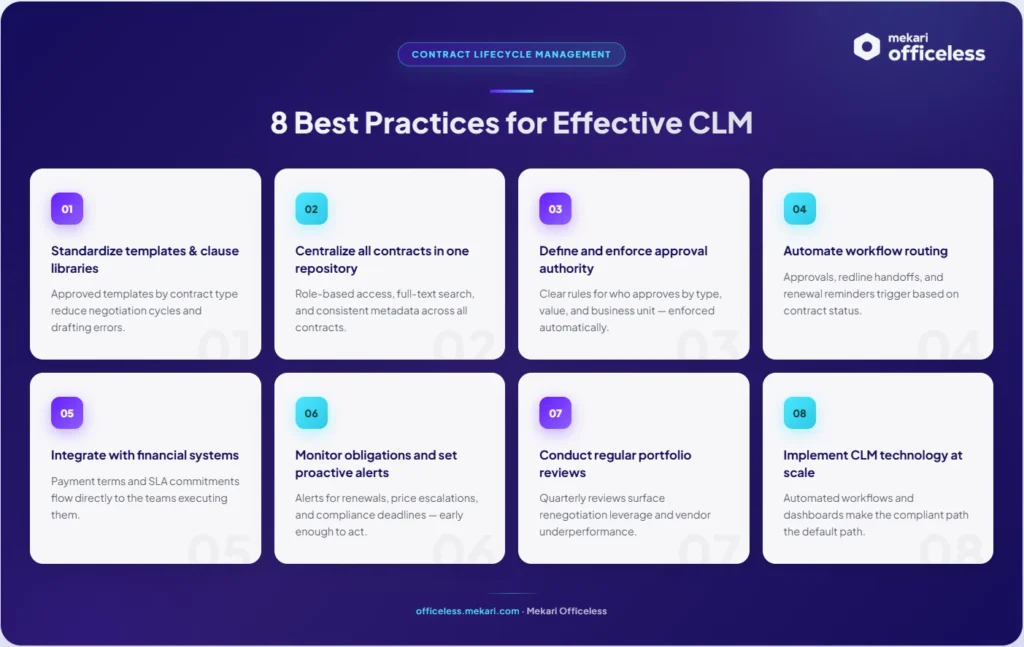
1. Standardize contract templates and clause libraries
Build an approved library of templates organized by contract type, with pre-approved clauses for common legal, commercial, and operational terms.
Teams that draft from standardized templates reduce negotiation cycles significantly compared to those starting from blank documents every time.
2. Centralize all contracts in a single repository
Every executed contract should live in one system with role-based access, full-text search, and consistent metadata covering parties, dates, obligations, contract owner, and renewal terms.
A shared repository eliminates the version control and visibility problems that arise when contracts are scattered across shared drives and email folders.
3. Define and enforce approval authority thresholds
Establish clear rules for who can approve contracts based on type, value, and business unit, then enforce those rules through automated workflow routing rather than manual coordination.
Approval authority should be documented and reviewed periodically as the organization grows.
4. Automate workflow routing and notifications
Approval routing, redline handoffs, signature requests, and renewal reminders should trigger automatically based on contract status and predefined rules rather than relying on individuals to follow up. Automation removes the coordination overhead that causes delays and missed deadlines without replacing the judgment required at each decision point.
5. Integrate CLM with financial and operational systems
Payment terms should flow to accounts payable, vendor data to ERP, SLA commitments to operations dashboards, and budget impact to finance planning tools.
Integration ensures that the terms negotiated in a contract are actually visible to the teams responsible for executing them.
6. Monitor obligations and set proactive alerts
Configure alerts for every critical date in a contract, including renewal windows, price escalation triggers, compliance review deadlines, and SLA checkpoints, and set them early enough for teams to act rather than react.
Obligation monitoring should be continuous rather than reserved for audit preparation.
7. Conduct regular contract portfolio reviews
Review the active contract portfolio quarterly to identify contracts approaching renewal, vendors underperforming on SLAs, spend concentration, and renegotiation opportunities.
Portfolio reviews turn CLM from a passive record-keeping function into an active source of procurement and financial intelligence.
8. Implement CLM technology to enforce compliance at scale
Policy and process discipline alone do not scale beyond a certain contract volume. Contract lifecycle management software helps you enforce the compliant path as the default by automating what manual processes depend on individuals to remember.
Key capabilities to look for in a good CLM tools include:
- Centralized repository: Full-text search, metadata indexing, and role-based access across all contract types.
- Configurable approval workflows: Multi-level routing with escalation rules and cycle-time reminders.
- E-signature integration: Native or connected signing that feeds executed contracts directly into the repository.
- Obligation tracking and alerts: Automated notifications for renewal windows, escalation triggers, and compliance deadlines.
- System integrations: Connectors to ERP, accounts payable, and finance planning tools so contract terms flow to the teams acting on them.
- Real-time dashboards: Portfolio visibility across active contracts, renewal pipeline, spend by vendor, and SLA performance.
When evaluating CLM software options, prioritize platforms that can adapt to your specific contract workflows rather than forcing your processes into a rigid system.
Look for solutions that integrate with the tools your teams already use across finance, procurement, and legal, and allow non-technical stakeholders to configure workflows without depending on IT for every change.
Streamline Contract Lifecycle Management with Mekari Officeless
Managing contracts at scale requires more than a structured process and disciplined team. It requires a system that enforces that process automatically, adapts to how your organization actually works, and connects with the tools your teams already use.
Mekari Officeless enables organizations to build and run CLM workflows tailored to their specific processes, without rebuilding existing systems from scratch or depending on a rigid off-the-shelf platform. Depending on where your organization is, you can:
- Start with a prebuilt E-procurement solution that covers the core CLM workflow out of the box, including contract request intake, multi-stage approvals, vendor contract tracking, and real-time reporting.
- Build on a no-code/low-code platform to configure and extend CLM workflows around your specific approval authority structure, contract types, integration requirements, and obligation tracking logic.
- Engage a custom software service for end-to-end CLM development tailored to complex enterprise workflows, with full integration into existing ERP, HRIS, and e-signature systems.
Beyond contract management, Mekari Officeless is part of the Mekari unified software ecosystem that connects with Mekari Sign for e-signature execution and Mekari Talenta for employment contract workflows.
This integration reduces manual handoffs across systems, enables seamless connectivity between business functions, and consolidates contract and operational data into a single source of truth for faster decision-making.
Streamline your contract lifecycle management with Mekari Officeless E-Procurement.
References and methodology
Methodology
Methodology
Articles published by Mekari Officeless are developed using trusted sources, including official data, company reports, academic research, and insights from industry practitioners. Whenever possible, we refer directly to primary sources before drawing conclusions. Our editorial team reviews and verifies the information to ensure accuracy and relevance. All references are listed so readers can trace each piece of information back to its original source.
Our editorial standards
Our editorial standards
- Primary source first: We consult official product documentation and pricing pages directly, not secondhand summaries or aggregator sites.
- Fact-checking: All product features, pricing, and claims are cross-verified against each platform’s official website at the time of writing.
- No paid placement: Tools are selected based on relevance and fit for Indonesian businesses, not commercial arrangements. Mekari Officeless is included as a first-party product and is transparently labeled as such.
- Regular review: Articles are periodically updated to reflect product changes or shifts in market relevance.
References
References
McKinsey. “Contracting for performance: Unlocking additional value”
SAP. “What is contract lifecycle management (CLM)?”
Sievo. “Contract Lifecycle Management: A Complete Guide to the 5 Stages”