


- Fintech onboarding must be structured, staged, and documented. It should cover more than account creation, including KYC, CDD, compliance review, account activation, product education, and ongoing monitoring.
- The biggest risk is often inconsistent execution, not the absence of a checklist. When agents, branches, or teams follow the same process differently, fintech companies face higher risks of customer drop-off, delayed approvals, and compliance gaps.
- Mekari Officeless Operations Checklist Management helps standardize fintech onboarding at scale. With centralized checklists, mandatory evidence attachment, issue tracking, approval workflows, and real-time dashboards, teams can ensure every onboarding case follows the same standard.
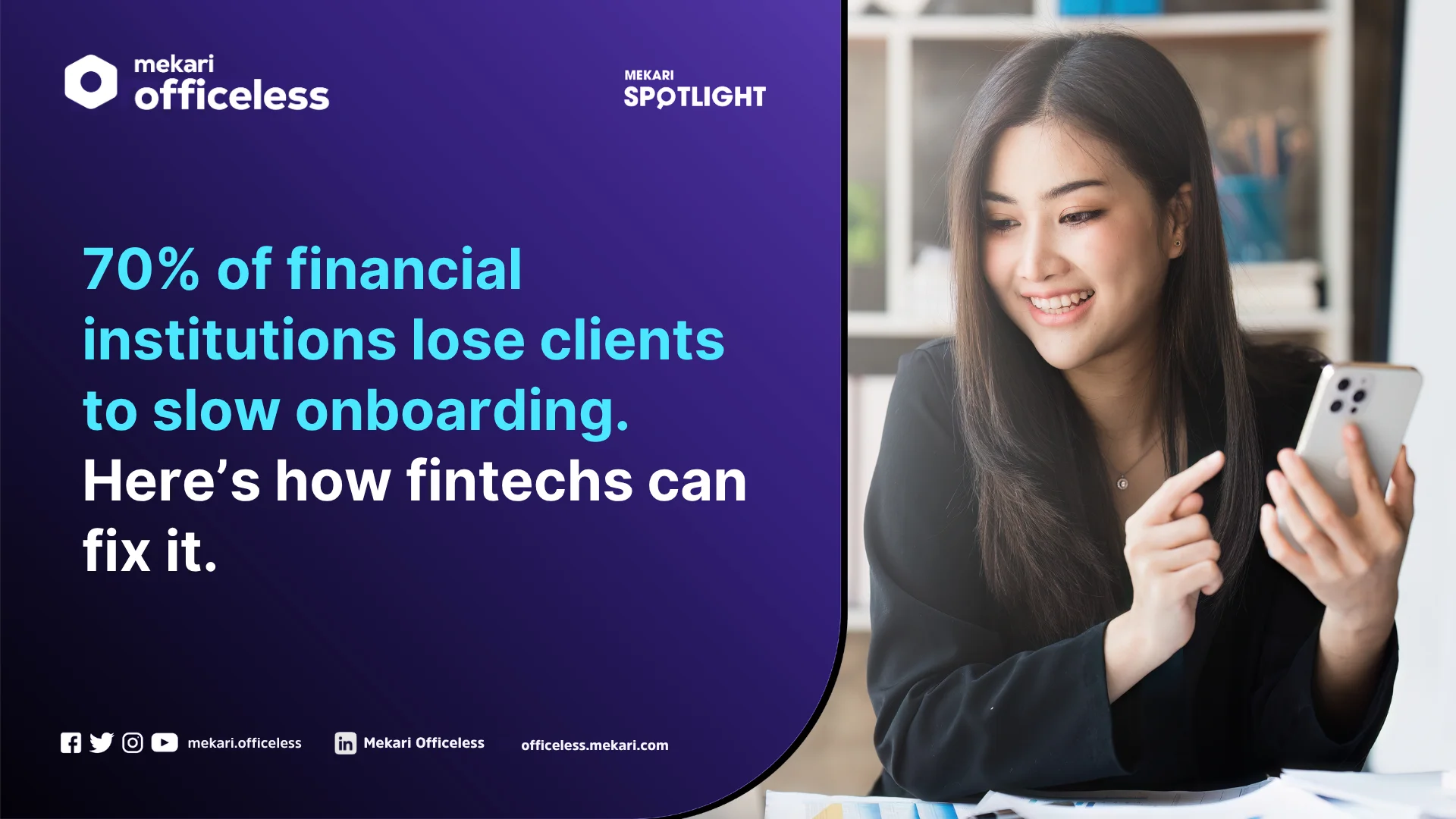
Fintech companies spend heavily to acquire customers, yet many prospects drop off before completing onboarding. A 2025 Fenergo survey found that 70% of financial institutions lost clients in the past year due to slow or inefficient onboarding, up from 48% two years earlier.
To reduce this risk, fintech companies need a structured customer onboarding checklist covering key stages such as KYC verification, compliance review, and account activation.
This guide explains what the checklist should include, why consistent execution matters, and how a digitized checklist management system helps maintain standards at scale.
What is customer onboarding in fintech?
Customer onboarding in fintech is the end-to-end process of welcoming, verifying, and activating a new client, from account creation to their first transaction or product interaction.
Unlike general SaaS onboarding, fintech onboarding includes mandatory regulatory steps that cannot be skipped or reordered, such as:
- KYC verification to confirm the customer’s identity
- AML screening to detect potential money laundering risks
- CDD checks to assess customer risk profiles
- Compliance review before account approval or activation
- Account setup and activation so the customer can start using the product safely
Onboarding also affects more than compliance. It shapes the customer’s first impression, influences activation rates, and supports long-term retention. According to Mixpanel’s 2025 State of Fintech Product Analytics report, 76% of fintech users who convert do so within the first 7 days.
The main risk is not always a missing process, but inconsistent execution. Common onboarding failures include:
- Missing checklist items, where important steps are not included
- Inconsistent execution, where teams follow the same process differently
This second issue is often harder to detect, making it a key focus for fintech companies that want to improve onboarding quality at scale.
Why most fintech onboarding processes fail
Most fintech onboarding problems do not happen because companies lack a checklist. In many cases, the SOP already exists. The real issue is that the process is not applied the same way every time.
Signicat via SaaSFactor found that 63% of onboarding attempts still end in drop-off, showing a clear gap between what is written in the SOP and what actually happens during execution.
Common causes include:
- Human variability: Different agents or relationship managers may apply steps differently. Some skip supporting document requests, while others rush compliance review when volumes are high.
- No proof of completion: Tasks may be marked as done verbally or in shared spreadsheets, without attached evidence. This creates incomplete or missing audit trails.
- Unresolved issues are not escalated: When documents are missing or verification flags appear, teams may proceed without logging a formal issue for resolution.
The consequence is regulatory exposure that companies may not notice until it becomes a problem.
Fenergo’s 2024 AML fines analysis found that global penalties reached $4.6 billion in 2024, with 94% concentrated in North America. Many of these issues were linked to weak KYC execution, not the absence of policies.
This is why a paper checklist is not enough. Fintech companies need a system that enforces consistent execution, captures evidence at each step, and flags unresolved issues before they turn into audit problems.
The complete customer onboarding checklist for fintech
A fintech customer onboarding checklist should be detailed enough to guide execution, not just describe broad stages. Each step must be clear, traceable, and consistently followed by every team involved.
Stage 1: Account creation and initial data collection
Start by collecting the customer’s basic information and making sure the submission is complete from the beginning.
Checklist:
- Collect the customer’s full legal name, date of birth, nationality, contact information, and preferred communication channel.
- Specify acceptable government-issued ID types before the customer starts the process.
- Use form validation to prevent incomplete or incorrect submissions.
- Set up account credentials and verify email or phone ownership using OTP or an equivalent method.
- Store all collected data in a centralized, access-controlled record, not in individual inboxes or shared drives.
Stage 2: KYC and identity verification
This stage confirms that the customer is who they claim to be.
Checklist:
- Verify a government-issued photo ID, such as a passport or national identity card.
- Collect proof of address, such as a utility bill or bank statement issued within the last 3 months.
- Run a biometric or liveness check using a selfie or video match against the submitted ID.
- For Indonesia, verify NIK against Dukcapil integration where applicable.
- Flag and formally log any issues, such as blurry scans, expired documents, or name mismatches.
- Do not move to the next stage until identity issues are resolved.
Stage 3: Customer due diligence
Customer Due Diligence, or CDD, helps fintech companies understand the customer’s risk profile before approval.
Checklist:
- Identify whether the customer is an individual or corporate client.
- Record employment, business activity, expected transaction volume, and source of funds.
- Screen the customer against sanctions lists, PEP watchlists, and adverse media databases.
- Classify the customer as low, medium, or high risk.
- Document the reason and evidence behind the risk classification.
- For high-risk customers, trigger an Enhanced Due Diligence, or EDD, workflow before approval.
Stage 4: Compliance review and formal approval
Once KYC and CDD are complete, the case should move through a formal compliance review.
Checklist:
- Route KYC and CDD outputs to the designated compliance officer or review team.
- Avoid ad hoc approvals through email or informal chat.
- Define review SLAs, such as same business day for low-risk customers, 2 days for medium-risk, and 5 business days for high-risk.
- Require the approver to attach a decision note.
- Prevent approval if there is no documented rationale.
- If rejected, log the reason, initiate the required notification process, and document the outcome in the customer file.
Stage 5: Account activation and product configuration
After approval, the account can be activated according to the customer’s approved profile.
Checklist:
- Activate the account only after approval is complete.
- Confirm permissions match the customer’s profile and risk tier.
- Link payment instruments, such as bank accounts or cards.
- Run a test transaction where applicable.
- Configure spend limits, transaction thresholds, and notification preferences.
- Send a structured confirmation message explaining what happens next.
Stage 6: Product education and first transaction milestone
A verified customer is not fully onboarded until they start using the product meaningfully.
Checklist:
- Provide onboarding resources, such as an in-app walkthrough, knowledge base, or guided session.
- Offer dedicated onboarding support for high-value clients.
- Set an internal activation milestone, such as the first transaction or key feature use within 7 days.
- Track engagement signals, including welcome email opens, platform access, and first action taken.
- Assign a named account owner to monitor the customer’s first 30 days.
Stage 7: Ongoing monitoring setup
Fintech onboarding does not end at activation. The customer record must be ready for continuous monitoring.
Checklist:
- Schedule periodic KYC re-verification based on risk tier, such as annually for low-risk customers and semi-annually for high-risk customers.
- Configure transaction monitoring alerts for unusual patterns, such as large unexplained transfers or sudden increases in transaction frequency.
- Define re-verification triggers, including major behavioral changes, new product access, new jurisdiction access, or sanctions list updates.
- Document the monitoring schedule in the customer record.
- Make the monitoring status visible to compliance oversight teams.
Common fintech onboarding mistakes that cost you customers
Even when fintech companies have a formal onboarding flow, small execution gaps can quickly turn into customer drop-offs, delayed approvals, or compliance exposure. Here are the most common mistakes to avoid:
- Front-loading document requests: Asking for too many documents at the start can overwhelm new customers before trust is established. A better approach is progressive disclosure, where you collect only the minimum required information at each stage while still meeting compliance needs.
- No defined SLA for compliance review: When compliance review has no clear deadline, applications can stall without visibility. Customers are unlikely to wait for long, especially when Deloitte’s 2025 research shows that 38% abandon onboarding because the process feels too slow.
- Manual routing with no tracking: Sending KYC documents through email or shared drives makes it difficult to know who reviewed what, when it was reviewed, and whether open issues were actually resolved.
- Treating rejection as a dead end: A rejected application should not end in silence. Regulatory rejections need a documented follow-up process, including the rejection reason, customer notification, and the final outcome.
- Inconsistent standards across agents or branches: When onboarding quality depends on who handles the case, compliance becomes unpredictable. As volume grows, this inconsistency becomes harder to control without a digitally enforced checklist.
How to enforce consistent execution at scale
Documenting a customer onboarding checklist in an SOP folder is only the starting point. As onboarding volume increases, execution can drift, especially when multiple agents, branches, or teams handle cases at the same time.
To keep execution consistent, fintech companies need:
- A single enforced source of truth: Every agent should work from the same checklist version, not outdated PDFs, personal notes, or informal workarounds.
- Mandatory evidence attachment: A step should only be marked complete when the required supporting document has been uploaded. This prevents “done verbally” situations that create compliance gaps.
- Formal issue logging: If a problem appears, such as an expired ID, failed watchlist match, or missing proof of address, it should be logged as an open issue that must be resolved before the case moves forward.
- Supervisor-level visibility: Compliance officers and team leads need real-time visibility into every active onboarding case, including the current stage, time spent at each step, and unresolved issues.
This is the operational gap that a purpose-built checklist management system helps close. The onboarding process may already exist, but the right technology ensures it is followed consistently by every team, every time.
How Mekari Officeless operations checklist management supports fintech onboarding
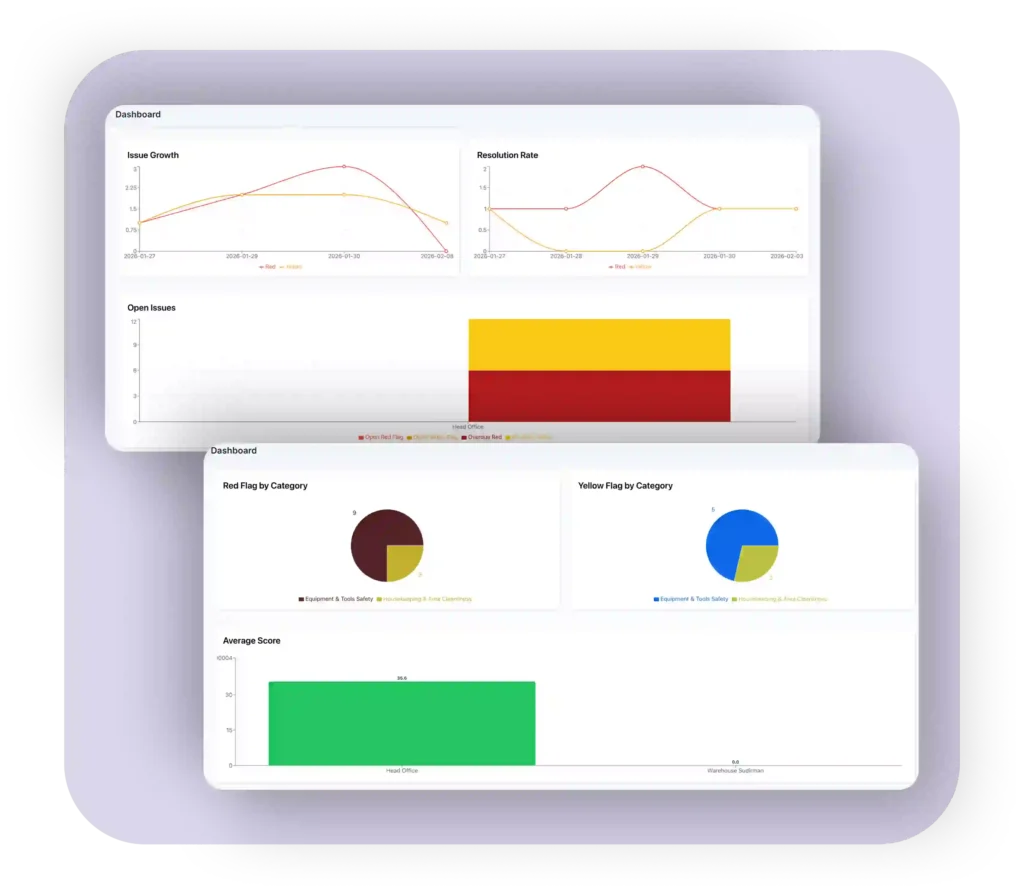
Mekari Officeless Operations Checklist Management, or OCM, helps enterprises run repeatable and compliance-sensitive workflows at scale.
This makes it highly relevant for fintech teams that need to manage high-volume customer onboarding without letting execution vary across agents, branches, or teams.
For fintech onboarding, Mekari Officeless OCM supports consistency through several key capabilities:
- Standardized checklist master data: Teams can define onboarding checklist categories, questions, answer options, scoring rules, issue flags, and mandatory evidence requirements. This helps ensure every onboarding case follows the same standard.
- Checklist execution and assessment: Agents can complete assigned or ad-hoc onboarding tasks, fill out checklist forms, attach required evidence, and record results in one structured workflow.
- Issue tracking and resolution: When a checklist item fails, such as missing documents, expired IDs, or unresolved verification issues, the system can generate and track issues until they are resolved.
- Scheduling and approval workflow: Onboarding activities, reviews, revisions, and approvals can be routed through a formal workflow, reducing informal handoffs and missed follow-ups.
- User and access configuration: Teams can manage user roles, groups, positions, and access permissions, so only authorized people can view, execute, or approve specific onboarding activities.
- Performance dashboard and analytics: Supervisors can monitor onboarding progress, compliance status, issue trends, resolution rates, and performance across teams or locations in real time.
- Centralized site database: For fintech operations involving multiple branches, regions, or service locations, operational site data can be managed centrally to keep information consistent.
With these capabilities, onboarding teams can apply the same standard whether they are processing 10 or 10,000 applications. Compliance risk decreases because every step is documented, while customer experience improves through faster, more predictable processing.
See how Mekari Officeless Operations Checklist Management can standardize your fintech onboarding process.
References and methodology
Methodology
Methodology
Articles published by Mekari Officeless are developed using trusted sources, including official data, company reports, academic research, and insights from industry practitioners. Whenever possible, we refer directly to primary sources before drawing conclusions. Our editorial team reviews and verifies the information to ensure accuracy and relevance. All references are listed so readers can trace each piece of information back to its original source.
Our editorial standards
Our editorial standards
- Primary source first: We consult official product documentation and pricing pages directly, not secondhand summaries or aggregator sites.
- Fact-checking: All product features, pricing, and claims are cross-verified against each platform’s official website at the time of writing.
- No paid placement: Tools are selected based on relevance and fit for Indonesian businesses, not commercial arrangements. Mekari Officeless is included as a first-party product and is transparently labeled as such.
- Regular review: Articles are periodically updated to reflect product changes or shifts in market relevance.
References
References
Fenergo. ‘’Global Financial Institutions Struggle with Rising Client Losses and Compliance Costs as AI Adoption Increases’’
Finverity. ‘’How to turn onboarding a fintech platform into a breeze’’