


Email automation tools can support different business goals, from running promotional campaigns to automating operational notifications inside business workflows. Here are several tools recommendation:
- Mekari Officeless Mekari Mailer Plugin: A workflow-native plugin for sending automated transactional and notification emails directly from Mekari Officeless workflows, without relying on a separate SMTP server or script-based setup.
- Mailchimp: A simple and popular option for creating email campaigns, managing audiences, and running basic automation with minimal setup.
- HubSpot: Strong for teams that want email automation connected with CRM data, lead management, sales activity, and customer visibility.
- ActiveCampaign: Notable for advanced automation features, including behavioral triggers, lead scoring, dynamic segmentation, and customer journey mapping.
- Salesforce Marketing Cloud: Built for enterprise-scale customer journeys, multi-channel campaign orchestration, AI personalization, and advanced analytics.
- Brevo: A practical multi-channel platform that combines email, SMS, WhatsApp, transactional email, segmentation, and campaign automation.
- Klaviyo: Focused on e-commerce automation, especially for abandoned cart emails, purchase-based segmentation, product recommendations, and revenue tracking.
- Moosend: A budget-friendly email automation tool with campaign creation, landing pages, templates, audience segmentation, and reporting.
Email can drive major business growth, with Litmus reporting $36 generated for every $1 spent. Yet many companies miss this potential because their email workflows are still manual, siloed, and disconnected from core systems.
Email automation tools solve this by sending the right message to the right person at the right time, triggered by real business activity. This helps teams move faster, reduce errors, and capture more sales opportunities.
This guide covers the top email automation tools, key features to compare, and how Mekari Officeless Mekari Mailer supports enterprise workflows.
Why businesses need email automation
For B2B and enterprise teams, email is no longer just a communication tool. It plays a direct role in lead nurturing, customer engagement, internal workflows, and revenue growth. The data below shows why automation is becoming essential.
- Massive ROI: Email marketing delivers an average return of $36 for every $1 spent. For B2B, 42% of marketers say email produces the best results compared to other channels. (Omnisend)
- Higher revenue from automation: In 2024, automated emails drove 37% of all email-generated sales, despite making up only 2% of total email volume.
- Time savings at scale: 58% of marketing leaders automated their email processes in 2024, making email the most automated marketing activity. (Statista)
- Better personalization with AI: Marketers using AI for email personalization saw revenue increase by 41%, with click-through rates rising by 13.44%.
- Strong role in B2B marketing: 81% of B2B marketers use email newsletters as their primary content distribution channel, while 71% use email to nurture leads.
Top email automation tools for business
Below is a curated list of email automation platforms, ranked in alphabetical order. Each platform serves a different business need, from marketing campaigns and CRM-based nurturing to workflow-triggered enterprise email automation.
| Tool | Type | Best for | Key feature | Pricing |
|---|---|---|---|---|
| Mailchimp | Email marketing platform | SMBs and e-commerce | Drag-and-drop automations, AI content tools | Free tier, paid plans from around $13/month |
| HubSpot | CRM and marketing suite | Mid-market to enterprise | CRM-native email automation and analytics | Free tier, paid plans from around $20/month |
| ActiveCampaign | Email and CRM automation | Growing businesses | Advanced behavioral automation and scoring | Paid plans from around $15/month |
| Salesforce Marketing Cloud | Enterprise email platform | Large enterprises | Journey Builder and AI-driven personalization | Custom enterprise pricing |
| Brevo | Email and SMS platform | SMB multi-channel marketing | Email, SMS, WhatsApp, and transactional email tools | Free tier, paid plans from around $9/month |
| Klaviyo | E-commerce email automation | E-commerce brands | Deep Shopify and WooCommerce integration | Free plan available, paid plans scale by contacts and usage |
| Moosend | Email marketing platform | Budget-conscious teams | Landing pages and automation builder | Paid plans from around $9/month |
| Mekari Officeless Mekari Mailer Plugin | Native email automation plugin | Indonesian enterprises using Officeless workflows | SMTP-compatible, workflow-triggered automated emails, and dynamic personalization inside Officeless apps | Check Mekari Officeless pricing page |
Mailchimp: Best for SMB and e-commerce email campaigns
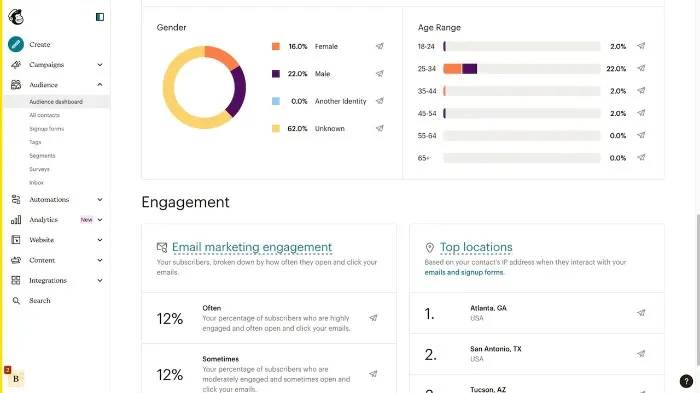
Mailchimp helps businesses create email campaigns, manage audiences, and automate customer communication with minimal technical setup.
Key features:
- Drag-and-drop email builder: Create polished campaigns without coding.
- Pre-built automation journeys: Use ready workflows for welcome emails, abandoned carts, and follow-ups.
- Audience segmentation: Group contacts by behavior, purchase history, or engagement.
- AI-supported content tools: Generate subject lines, copy, and campaign ideas faster.
- Campaign analytics: Track opens, clicks, conversions, and overall performance.
- E-commerce integrations: Connect store data for product-based and purchase-triggered emails.
Best for: SMBs and e-commerce teams that need an easy-to-use platform for marketing campaigns and basic customer automation.
HubSpot: Best for CRM-connected email automation
HubSpot connects email automation with CRM data, making it easier for sales and marketing teams to manage leads from one platform.
Key features:
- CRM-native automation: Trigger emails from lifecycle stage, form activity, or deal progress.
- Lead nurturing workflows: Send automated follow-ups based on funnel stage.
- Contact segmentation: Personalize messages by profile, behavior, or pipeline status.
- Forms and landing pages: Capture leads and connect them directly to workflows.
- Email analytics: Measure engagement and campaign impact inside the CRM.
- Sales and marketing visibility: Keep both teams aligned on customer interactions.
Best for: B2B and mid-market teams that need email automation connected to CRM, lead nurturing, and sales follow-up workflows.
ActiveCampaign: Best for advanced behavioral automation
ActiveCampaign is built for businesses that need deeper automation based on customer behavior, engagement, and sales activity.
Key features:
- Advanced automation builder: Build multi-step workflows with triggers, conditions, and branches.
- Behavioral triggers: Send emails after clicks, visits, purchases, or form submissions.
- Lead scoring: Prioritize prospects based on engagement and buying intent.
- CRM and sales automation: Connect email activity with deals, tasks, and follow-ups.
- Dynamic segmentation: Update audiences automatically as customer behavior changes.
- Customer journey mapping: Design personalized flows across the customer lifecycle.
Best for: Growing businesses that need more advanced email automation based on customer behavior, engagement, and sales activity.
Salesforce Marketing Cloud: Best for enterprise customer journeys
Salesforce Marketing Cloud supports large-scale email and customer engagement automation across multiple channels.
Key features:
- Journey Builder: Create automated customer journeys across multiple touchpoints.
- AI-driven personalization: Deliver more relevant content, timing, and recommendations.
- Multi-channel orchestration: Coordinate email with SMS, mobile, ads, and CRM data.
- Salesforce CRM integration: Use customer, sales, and service data in campaigns.
- Advanced segmentation: Target audiences by behavior, lifecycle stage, and preferences.
- Enterprise analytics: Analyze performance, attribution, and journey-level engagement.
Best for: Large enterprises that need advanced customer journey automation across multiple channels and Salesforce-connected data.
Brevo: Best for affordable multi-channel communication
Brevo combines email automation with SMS, WhatsApp, and transactional messaging for growing businesses.
Key features:
- Email automation: Build triggered campaigns for onboarding, follow-ups, and nurturing.
- SMS and WhatsApp campaigns: Reach customers across direct messaging channels.
- Transactional email: Send confirmations, resets, invoices, and account notifications.
- Contact segmentation: Target audiences by profile, behavior, or engagement.
- Forms and landing pages: Capture leads and add them to campaigns automatically.
- Campaign analytics: Monitor email and multi-channel communication performance.
Best for: SMBs that need affordable email, SMS, and multi-channel customer communication in one platform.
Klaviyo: Best for e-commerce email automation
Klaviyo helps e-commerce brands automate personalized email and SMS campaigns based on customer and purchase data.
Key features:
- E-commerce automation: Automate cart recovery, post-purchase, and win-back flows.
- Shopify and WooCommerce integrations: Sync store, product, and customer data.
- Purchase-based segmentation: Group customers by order history and buying behavior.
- Abandoned cart emails: Remind shoppers to complete unfinished purchases.
- Product recommendations: Suggest relevant products using customer and store data.
- Revenue attribution: See which campaigns and flows drive sales.
Best for: E-commerce brands that need automated, revenue-focused email and SMS campaigns based on customer shopping behavior.
Moosend: Best for budget-conscious marketing teams
Moosend provides email marketing automation, landing pages, and reporting at a more accessible price point.
Key features:
- Email campaign builder: Create newsletters, promotions, and announcements quickly.
- Automation workflows: Run onboarding, nurturing, abandoned cart, and re-engagement flows.
- Landing pages and forms: Collect leads and connect them to email campaigns.
- Audience segmentation: Personalize emails by behavior, profile, or engagement.
- Email templates: Speed up campaign creation with reusable layouts.
- Campaign reporting: Track opens, clicks, unsubscribes, and conversions.
Best for: Small businesses and budget-conscious marketing teams that need affordable email automation with landing page support.
Mekari Officeless Mekari Mailer Plugin: Best for workflow-native enterprise email automation
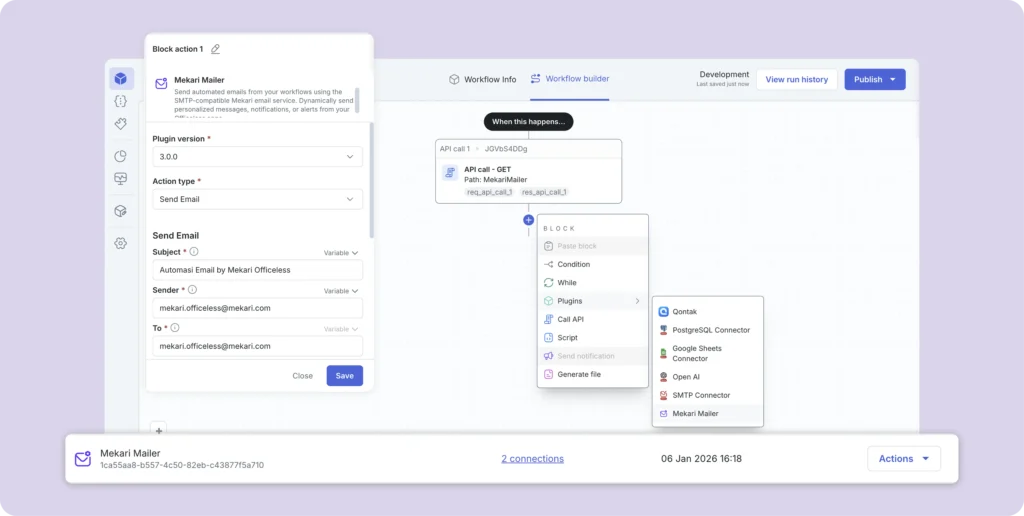
Mekari Officeless Mekari Mailer Plugin is designed for businesses that need to send transactional or notification emails directly from internal workflows.
It is especially useful when a company does not have its own SMTP server, wants a no-code or low-code alternative to script-based email sending, and needs emails to be delivered from a trusted Mekari domain.
Key features:
- Native Officeless integration: Send emails directly from internal workflows and apps.
- SMTP-compatible sending: Use a reliable engine for system-based email communication.
- Workflow-triggered emails: Automate messages from approvals, reminders, and task updates.
- Dynamic personalization: Insert names, request details, dates, and workflow data.
- Standardized templates: Keep operational emails consistent across departments.
- Operational alerts: Support HR, finance, IT, and operations notifications.
Best for: Indonesian enterprises using Mekari Officeless that need automated and personalized emails triggered directly from internal workflows and business applications.
How to choose the right email automation tool for your business
Choosing the right email automation tool starts with understanding what your team needs most. Some platforms are built for marketing campaigns, while others are better for CRM-based nurturing, e-commerce sales, or operational emails triggered by internal workflows.
- For marketing-first teams: Choose a tool that focuses on campaign management, audience segmentation, email templates, and promotional workflows. This type of platform is best for newsletters, product announcements, seasonal campaigns, and customer re-engagement.
- For CRM-driven businesses: Look for email automation that connects directly with customer records, sales pipelines, and lead management workflows. This helps sales and marketing teams send more relevant emails based on lifecycle stage, deal progress, or customer interactions.
- For e-commerce businesses: Prioritize tools with strong online store integrations, purchase-based segmentation, abandoned cart emails, product recommendations, and revenue tracking. These features help turn customer behavior into timely, personalized email campaigns.
- For operational or workflow-triggered emails: Choose a solution that can send automated emails directly from business processes, approvals, internal apps, or system events. This is useful for approval notifications, task reminders, status updates, system alerts, and transactional messages.
- For budget-constrained teams: Focus on platforms that offer essential automation features, segmentation, templates, and reporting at a lower starting cost. This works well for small teams that need reliable email automation without heavy enterprise features.
There is also an important difference between standalone email marketing tools and workflow-integrated email plugins. Standalone tools are powerful for outbound campaigns, lead nurturing, and promotional emails.
Workflow-integrated tools are more suitable for internal communications, approval updates, operational alerts, and transactional emails triggered by real business events.
How Mekari Officeless Mekari Mailer automates email in your business workflows
Mekari Officeless Mekari Mailer is a prebuilt plugin available in the Mekari Officeless Marketplace, designed for enterprises that need automated email sending directly inside their business workflows.
Instead of relying on manual sending or separate third-party tools, Mekari Mailer enables SMTP-compatible, workflow-triggered emails within applications built on Mekari Officeless.
Core functionality:
- Workflow-triggered emails: Automatically send emails when a workflow step is completed, a form is submitted, or an approval is granted.
- SMTP-compatible sending: Supports reliable email delivery while staying compatible with enterprise IT environments.
- Dynamic personalization: Insert real-time data such as recipient name, transaction ID, request details, or workflow status into email content.
- Notification and alert emails: Send system alerts, status updates, reminders, and operational notifications directly from Officeless apps.
- Native Officeless integration: Connects seamlessly with other Officeless plugins and workflow modules without third-party integration.
For Indonesian enterprises, this can support various use cases, such as:
- HR: Sending onboarding emails when a new employee record is created.
- Finance: Sending payment confirmations or invoice notifications after approval.
- Operations: Sending procurement status updates to vendors when a purchase request changes state.
- IT: Sending maintenance alerts or access approval notifications to relevant teams.
For businesses that want email automation to work directly within their operational processes, Mekari Mailer helps turn routine communication into a faster, more consistent, and more reliable workflow.
Explore Mekari Mailer on the Officeless Marketplace.
References and methodology
Methodology
Methodology
Articles published by Mekari Officeless are developed using trusted sources, including official data, company reports, academic research, and insights from industry practitioners. Whenever possible, we refer directly to primary sources before drawing conclusions. Our editorial team reviews and verifies the information to ensure accuracy and relevance. All references are listed so readers can trace each piece of information back to its original source.
Our editorial standards
Our editorial standards
- Primary source first: We consult official product documentation and pricing pages directly, not secondhand summaries or aggregator sites.
- Fact-checking: All product features, pricing, and claims are cross-verified against each platform’s official website at the time of writing.
- No paid placement: Tools are selected based on relevance and fit for Indonesian businesses, not commercial arrangements. Mekari Officeless is included as a first-party product and is transparently labeled as such.
- Regular review: Articles are periodically updated to reflect product changes or shifts in market relevance.
References
References
Omnisend. ‘’Email marketing statistics 2026: Key insights’’