


- Educational institutions manage some of the most sensitive and regulated documents of any sector; student records, financial aid files, health data, and accreditation materials, yet 72% of institutions still rely on a mix of paper and digital processes that create compliance gaps and administrative bottlenecks.
- A purpose-built document management system for education replaces fragmented filing with a centralized, automated, and audit-ready environment; allowing staff to spend less time on administration and more time supporting student success.
- Mekari Officeless provides a Document Management System prebuilt software designed for educational institutions, looking to digitize and streamline their administrative operations, Mekari Officeless delivers the workflow automation and compliance infrastructure required to manage the full institutional document lifecycle.
Educational institutions run on documentation, admissions files, academic records, HR paperwork, financial aid forms, accreditation submissions. The volume is relentless, and the margin for error is zero.
Yet 72% of institutions still juggle a fragmented mix of paper and digital processes, creating workflows that slow down staff and quietly put compliance at risk (Classter).
A document management system (DMS) for education fixes this by bringing every institutional record into one secure, searchable platform, so administrators spend less time chasing files and more time serving students.
What is a document management system for education?
A document management system (DMS) for education is a platform used to capture, store, organize, and manage all institutional documents in one centralized and secure environment.
This includes a wide range of records such as student files, faculty HR documents, financial aid paperwork, compliance reports, and day-to-day administrative correspondence.
Unlike generic document management tools, an education-specific DMS is built around the full academic lifecycle, such as:
- Student onboarding and enrollment processes
- Academic progression tracking
- Graduation and certification documentation
- Alumni record management
- Cross-department workflows (HR, finance, governance)
It’s also important to distinguish a DMS from a Learning Management System (LMS).
- DMS: Manages administrative, operational, and compliance-related documents
- LMS: Manages course delivery, learning materials, and student performance
Today, many modern education DMS platforms are designed to integrate with Student Information Systems (SIS) and LMS platforms to create a unified digital environment.
Why educational institutions need a document management system
Educational institutions handle a massive volume of documents across departments, making manual processes inefficient, risky, and costly.
A document management system helps address these challenges by improving efficiency, ensuring compliance, strengthening security, and boosting staff productivity.
The scale of the document problem
The volume of documents in educational institutions continues to grow, from student records to administrative files. Without a structured system, this creates operational bottlenecks and unnecessary costs.
- 60% of organizations report improved productivity after digitizing document management processes (AIIM)
- Institutions that automate workflows can reduce administrative workload by up to 45% (Gartner Research)
- Organizations spend around $8 billion annually managing paper documents, which could otherwise be redirected to core services like education and student support (The Paperless Project)
These numbers highlight how much time and budget institutions lose due to inefficient document handling.
Compliance and regulatory risk
Educational institutions must comply with strict regulations, including data protection laws and accreditation requirements. Poor document control increases the risk of non-compliance, especially during audits.
60% of organizations experience compliance issues due to poor document control (Quality System Now)
Without a proper system, institutions may struggle to track document versions, access logs, or retention schedules, leading to potential sanctions or even loss of accreditation.
Security of sensitive student data
Schools, universities, and training institutions store highly sensitive data, including personal, academic, and financial information. This makes them a prime target for data breaches.
- The average cost of a data breach is $3.86 million per incident (IBM Security)
- Implementing access controls and encryption can reduce security risks by up to 70% (Gartner)
A DMS helps mitigate these risks by enforcing role-based access, audit trails, and secure storage.
Staff productivity
Manual document handling slows down administrative processes and reduces staff efficiency. A DMS significantly improves how quickly information can be accessed and processed.
- OCR-enabled document retrieval is up to 70% faster than manual search (IDC Research)
- Automated workflows can reduce document processing time by up to 50% (Forrester)
With faster access and streamlined workflows, staff can focus more on high-value tasks rather than repetitive administrative work.
Key benefits of a document management system for education
Beyond improving basic document storage, a document management system delivers tangible benefits across academic, administrative, and compliance functions in educational institutions:
- Centralized student record management: All student documents, from application to alumni, are stored in one structured, searchable system, enabling instant retrieval without fragmented storage.
- Automated compliance and retention: Built-in retention schedules, auto-archiving, and data purge workflows ensure compliance with data regulations without relying on manual processes.
- Faster administrative processing: Automated routing of admissions, financial aid, and registration documents reduces processing time, minimizes backlogs, and improves operational efficiency.
- Improved audit readiness: Complete digital audit trails with timestamps, user logs, and document access history make accreditation and regulatory audits faster and more manageable.
- Enhanced security and privacy: Role-based access ensures sensitive data, such as health records, financial information, and disciplinary history, is only accessible to authorized personnel.
- Reduced operational cost: Eliminating paper storage, printing, and manual filing reduces overhead costs and allows institutions to reallocate budget to student-focused initiatives.
- Remote and multi-campus access: Cloud-based systems enable secure access to documents from any location, supporting collaboration across campuses and remote teams.
- Better student experience: Faster document processing across enrollment, financial aid, and certification improves responsiveness and reduces delays that often frustrate students.
Document management system recommendations for education
To help you choose the right solution, here are several Document Management Systems selected based on their ability to support key education use cases, such as managing student records, ensuring compliance, preparing for accreditation, and streamlining administrative workflows.
1. Mekari Officeless DMS
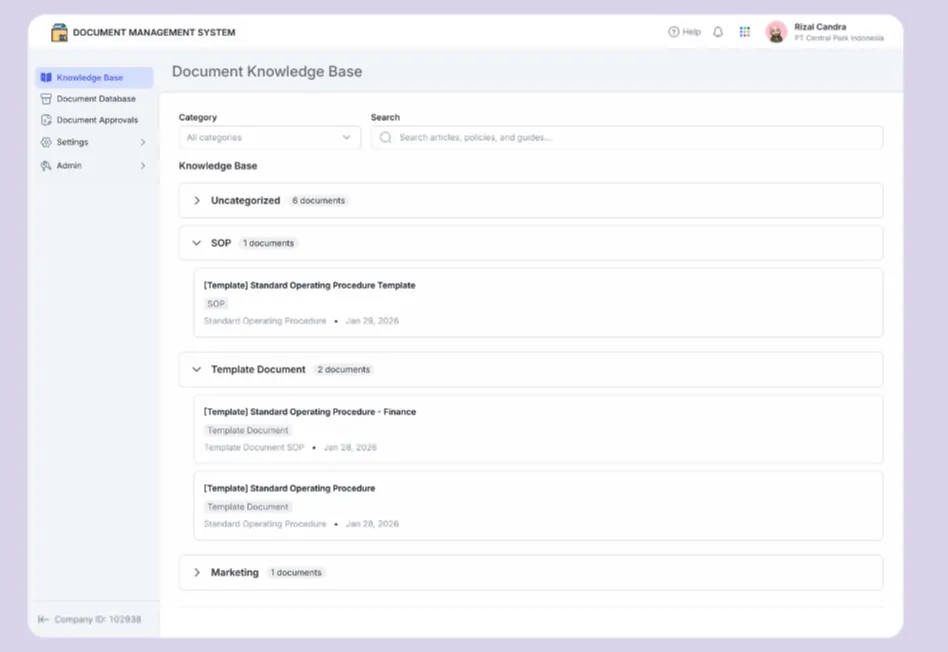
Mekari Officeless is an enterprise solution that extends core ERP and business systems to close operational gaps through Solution Accelerators, custom workflows and dashboards, and custom development services.
For educational institutions, its Document Management System provides a ready-to-deploy solution for centralizing institutional documents and managing structured workflows across departments.
This can include student records, faculty and staff documentation, accreditation materials, policies, and administrative records.
As part of the Mekari ecosystem, this DMS connects seamlessly with other business functions such as HR, payroll, and workflow automation. Institutions can digitize document processes end-to-end while maintaining control, visibility, and compliance through a centralized system.
Key features:
- Centralized knowledge base: Store and organize institutional policies, guidelines, and documents in a searchable digital library
- Document database and templates: Create, manage, and standardize documents using reusable templates in a single repository
- Automated document approvals: Route documents through structured approval workflows for validation, revisions, and periodic review
- Standardization and document control: Apply document types and automatic numbering to improve consistency and traceability
- Secure role-based access control: Restrict document access based on roles, departments, and responsibilities
- Administrative configuration and governance: Manage workflows, categories, folder structures, and document policies from a centralized admin panel
Key strengths:
- Pre-built DMS that can be deployed without IT development
- Configurable multi-level approval workflows for admissions, HR, and governance processes
- Role-based access aligned with institutional structure
- Full audit trail supporting compliance with UU PDP and accreditation requirements
- No-code workflow builder for flexible process adjustments by administrative teams
Limitation:
Requires initial configuration to align with institutional workflows and document structures.
Best for:
Schools, universities, and educational groups in Indonesia seeking a pre-built, enterprise-grade DMS that handles administrative document workflows across departments and campuses.
2. DocuWare
DocuWare is a well-established document management and workflow automation platform widely used by universities and colleges. It centralizes documents across departments such as admissions, financial aid, student records, HR, and facilities, while automating key processes like enrollment forms, transcript handling, invoice approvals, and alumni communications.
With its cloud-based architecture, DocuWare scales easily for institutions of different sizes and supports both cloud and on-premises deployment. It also offers role-based access and compliance tools to help institutions manage sensitive data securely.
Key strengths:
- Strong track record in higher education
- Cross-departmental document management
- Advanced workflow automation
- Flexible deployment (cloud and on-premise)
Limitation:
Requires structured implementation planning and is best suited for institutions with IT support during setup.
Best for:
Higher education institutions that need cross-departmental document management and workflow automation across multiple functions.
3. Document Logistix Document Manager
Document Logistix brings over 20 years of experience in the education sector, supporting institutions from K-12 to universities. Its Document Manager platform is designed to automate student record filing, manage retention schedules with auto-archiving, and ensure compliance with regulations like FERPA and GDPR.
It also integrates with Student Information Systems (SIS) and supports batch document capture, making it especially useful during high-volume periods such as admissions or enrollment cycles.
Key strengths:
- Education-focused solution
- Strong compliance and audit trail capabilities
- Automated retention and data lifecycle management
- SIS integration and batch processing support
Limitation:
Primarily tailored to UK and European regulations, so adaptation may be needed for Indonesian compliance requirements.
Best for:
Schools, colleges, and universities that need a specialist education DMS with strong compliance and student data protection features.
4. Contentverse (by Computhink)
Contentverse is designed to help educational institutions digitize and automate document workflows, particularly for student records and administrative processes. It reduces reliance on manual paperwork while ensuring secure document handling through encryption, audit trails, and role-based access control.
The platform is scalable and integrates with existing education systems, making it a flexible option for growing institutions.
Key strengths:
- Strong compliance and security features
- Automated workflows for administrative efficiency
- Scalable for growing institutions
- Integration with existing education platforms
Limitation:
Primarily focused on the North American market, so local compliance support in Indonesia may need further validation.
Best for:
Educational institutions of all sizes that need a scalable, compliance-focused DMS for student records and administrative workflows.
5. Square 9 Softworks
Square 9 Softworks offers an Enterprise Content Management (ECM) platform tailored for educational environments. It supports a wide range of document types, including student transcripts, health records, HR files, financial aid documents, and accounts payable workflows.
The platform includes strong compliance features aligned with regulations such as FERPA and HIPAA, along with role-based access controls, encryption, and full audit trails to ensure data security.
Key strengths:
- Comprehensive document coverage across departments
- Strong compliance and security controls
- Role-based access and audit trails
- Suitable for enterprise-level institutions
Limitation:
Feature depth is oriented toward U.S. regulatory requirements, so suitability for Indonesian compliance needs to be evaluated.
Best for:
K-12 school districts and universities that need secure, enterprise-grade document management across multiple departments.
Types of documents managed in an education DMS
Educational institutions manage a wide variety of documents across departments. A document management system helps organize these records into structured categories, making them easier to access, control, and maintain.
- Student admissions & enrollment: Application forms, acceptance letters, enrollment agreements, identity documents, immunization records, and initial academic transcripts
- Academic records: Grade reports, semester transcripts, academic calendars, course registration records, and degree audit documents
- Financial aid & tuition: Financial aid applications and awards, tuition payment records, scholarship documentation, and grant administration files
- Faculty & staff HR documents: Employment contracts, credential certificates, performance appraisals, professional development records, and payroll documents
- Compliance & accreditation: Accreditation submissions, regulatory inspection records, data protection compliance documentation, and retention schedules
- Student support & welfare: Counseling records, disability accommodation requests, disciplinary files, and health records (with restricted access)
- Institutional governance: Board meeting minutes, policy documents, strategic planning materials, and committee reports
- Communications & correspondence: Parent communications, external correspondence, enrollment confirmation letters, and alumni engagement records
Manual vs. digital document management in education: a side-by-side comparison
To understand the real impact of a document management system, it helps to compare it directly with traditional, paper-based or fragmented digital processes:
| Feature / Aspect | Manual / paper-based process | Education document management system |
| Student record storage | Physical filing cabinets; retrieval requires physical access | Centralized digital archive with search by student ID, name, or document type |
| Document retrieval | Minutes to hours to locate files | Seconds via keyword, metadata, or full-text search |
| Compliance management | Manual tracking of retention deadlines; prone to errors | Automated retention schedules and compliance workflows |
| Access control | Broad or uncontrolled access via shared storage | Role-based permissions with controlled visibility |
| Admissions processing | Paper forms routed manually; delays common | Automated workflows with status tracking |
| Financial aid administration | Manual review and routing; bottlenecks during peak periods | Automated review, approval, and notification workflows |
| Audit preparation | Time-consuming document collection (days or weeks) | Instant audit-ready reports with full logs |
| Security | Risk of loss, damage, or unauthorized access | Encrypted storage with access control and backups |
| Multi-campus access | Requires physical transfer or unsecured sharing | Secure cloud access from any location |
| Cost | Ongoing costs for printing, storage, and labor | Lower long-term cost through digital operations |
| Student experience | Delays in services like transcripts and enrollment | Faster processing and better transparency |
Must-have features in an education document management system
To deliver these benefits, an effective education DMS should include the following core capabilities:
- Centralized student and staff document repository: One organized, searchable system for all institutional records
- Role-based access control: Ensures sensitive data is only accessible to authorized personnel
- Automated retention and archiving: Built-in policies aligned with regulatory requirements, with alerts for document lifecycle management
- Workflow automation: Streamlines multi-step processes like admissions, financial aid approval, and HR workflows
- E-signature integration: Enables digital signing of forms and agreements without manual paperwork
- OCR and full-text search: Makes scanned documents searchable using keywords or metadata
- Version control and audit trail: Tracks document changes and access history for compliance and transparency
- Integration with SIS and LMS: Synchronizes data across systems to eliminate duplication and improve consistency
- Batch document processing: Supports bulk upload and organization of documents during peak periods
- Mobile and remote access: Allows secure document access and processing from any device or location
How Mekari Officeless can support document management in educational institutions
For institutions managing high volumes of documents across departments and campuses, Mekari Officeless provides a more structured, automated, and compliant way to handle document workflows through its enterprise platform.
Mekari Officeless offers a software Document Management System (DMS) to support complex, multi-stakeholder environments like schools and universities.
Key capabilities include:
- Centralized document storage: All institutional records, including student files, HR documents, and compliance materials, are stored in one secure, searchable digital repository, eliminating data silos and manual tracking.
- Automated approval workflows: Route admissions applications, financial aid approvals, faculty credentialing, and internal documents through configurable, multi-level approval processes.
- Role-based access control: Ensure sensitive student and staff records are only accessible to authorized personnel based on roles, departments, and responsibilities.
- Audit trail and compliance logs: Every document action, from upload to approval, is automatically logged, supporting audit readiness and regulatory compliance.
- No-code workflow configuration: Administrative teams can easily adjust document routing and approval workflows without requiring IT development resources.
- Integration with Mekari ecosystem: Connect seamlessly with Mekari’s HR, payroll, and operational tools to create a unified administrative system.
Explore more of Document Management System by Mekari Officeless.