


- 80% of organizations faced supply chain disruptions in 2024 (BCI). Most failures trace back not to logistics — but to poor upstream sourcing decisions.
- AI-enabled supply chains now deliver 65% higher service levels.
- Mekari Officeless Source-to-Pay unifies e-sourcing, vendor management, and procurement in one enterprise platform.
Supply chain disruptions often stem from sourcing decisions made long before issues become visible. In 2024, 80% of organizations reported at least one supply chain disruption.
Sourcing determines who you buy from, under what terms, and with what level of risk. Done well, it strengthens supply chain resilience; done poorly, it creates costly downstream problems.
This guide covers what sourcing is, how it differs from procurement, the sourcing process, key sourcing models, and how Source-to-Pay software can automate the process.
What is sourcing in supply chain management?
Sourcing in supply chain management is the process of identifying, evaluating, and selecting suppliers before any purchase is made. It is the upstream function that determines who a business buys from, under what terms, and with what level of risk.
Key characteristics of sourcing include:
- Supplier selection. Identifying and evaluating suppliers based on business requirements.
- Commercial decision-making. Defining pricing, contract terms, and sourcing criteria before procurement begins.
- Supply chain impact. As the “Source” stage in the SCOR framework, sourcing influences every downstream activity, from production to delivery.
- Growing strategic importance. As supply chains become more complex and exposed to global risks, organizations are investing more heavily in sourcing capabilities to improve resilience and performance.
Supply chains are no longer linear. They are global, multi-tier, and exposed to geopolitical risk, regulatory shifts, and climate volatility. The global supply chain management market was valued at $25.67 billion in 2024 and is projected to reach $48.59 billion by 2030. The organizations driving that growth are not building bigger warehouses — they are building smarter sourcing capabilities. (Grand View Research)
Sourcing vs. procurement and supply chain management
“Sourcing” and “procurement” are used interchangeably in most organizations. That confusion is expensive.
Sourcing is about choices and leverage. It is strategic: identify the market, shortlist suppliers, run RFx processes, negotiate terms, award contracts, and set risk parameters. Sourcing work happens upstream, while outcomes are still flexible.
Procurement is about execution and control. It is operational: issue purchase orders, manage approvals, receive goods, match invoices, process payments. Procurement steps in once the path is chosen.
The relationship between them:
| Dimension | Sourcing | Procurement |
|---|---|---|
| Timing | Before the buy decision | After the buy decision |
| Focus | Strategy, supplier selection, negotiation | Execution, compliance, payment |
| Output | Approved supplier list, contracts, frameworks | Purchase orders, invoices, receipts |
| Key KPIs | TCO savings, supplier quality, risk coverage | PO cycle time, invoice accuracy, spend compliance |
| Failure mode | Wrong suppliers, weak contracts, hidden risk | Maverick spend, late payments, poor audit trail |
As one framework from 4C Associates puts it: businesses typically spend over 60% of revenue purchasing goods and services from third parties, yet an estimated 70% of potential procurement savings can only be unlocked through strategic sourcing — not through procurement efficiency alone.
Supply chain management is broader than both sourcing and procurement. It encompasses the end-to-end flow of goods, information, and services across planning, sourcing, production, delivery, and returns.
When sourcing and procurement are clearly defined but tightly integrated, organizations can improve supplier performance, reduce risk, and achieve greater procurement savings.
Types of sourcing models in supply chain
There is no universal best model. The right sourcing model is a deliberate choice based on category criticality, risk tolerance, cost targets, and supply market complexity.
| Model | When It Works Best | Key Risk to Manage |
|---|---|---|
| Single sourcing | High-volume, stable demand; deep process integration required | Concentration risk; slow recovery if that supplier fails |
| Dual sourcing | Mission-critical categories; need for continuity and negotiation leverage | Complexity of managing two supplier relationships |
| Multi-sourcing | High resilience needed; commodity or interchangeable goods | Coordination overhead; potential loss of scale pricing |
| Outsourced / 3PL sourcing | Non-core categories; cost optimization through specialists | Loss of direct control; dependency on third-party performance |
| Global sourcing | Cost arbitrage; access to specialized capabilities | Geopolitical exposure, longer lead times, FX risk |
| Nearshore / local sourcing | Speed, compliance, supply continuity | Higher unit costs; smaller supplier pool |
The 7-step sourcing process in supply chain management
A structured sourcing process is what separates strategic sourcing from reactive purchasing. These seven steps form a repeatable, defensible framework.
Step 1: Needs analysis and spend categorization
The process starts with defining business requirements and understanding the spend category.
- Document specifications, volumes, and purchasing frequency.
- Categorize spend based on value, risk, and business impact.
- Prioritize strategic categories for more rigorous sourcing.
Step 2: Market research and supplier identification
Next, assess the supplier market and identify potential vendors.
- Research suppliers, market conditions, and pricing trends.
- Evaluate lead times, capabilities, and supply risks.
- Build a longlist of qualified suppliers.
Step 3: RFI, RFQ, or RFP issuance
Once suppliers are identified, launch a formal sourcing event.
- Use an RFI for information gathering, an RFQ for pricing, or an RFP for complex requirements.
- Define requirements and evaluation criteria upfront.
- Ensure all suppliers compete on equal terms.
Step 4: Supplier evaluation and shortlisting

Supplier responses are assessed against predefined criteria.
- Evaluate pricing, quality, delivery capability, and risk.
- Consider factors such as financial stability and ESG compliance.
- Shortlist the suppliers that best meet business needs.
Step 5: Negotiation and contract award
The next step is securing the best overall value.
- Negotiate pricing, service levels, payment terms, and contract conditions.
- Balance cost savings with risk and performance requirements.
- Award the contract to the selected supplier.
Step 6: Supplier onboarding and integration
After selection, suppliers must be prepared for operational collaboration.
- Complete compliance and documentation requirements.
- Set up supplier data and system integrations.
- Establish communication and performance expectations.
Step 7: Performance monitoring and continuous improvement
Sourcing continues after the contract is signed.
- Track KPIs such as delivery performance, quality, and responsiveness.
- Identify improvement opportunities and manage supplier performance.
- Use performance data to support future sourcing decisions and renewals.
Strategic sourcing: the evolution beyond transactional buying
Strategic sourcing goes beyond securing the lowest price. It aligns sourcing decisions with business objectives and focuses on total cost of ownership (TCO), including quality, logistics, supplier risk, and long-term value.
Three key principles define strategic sourcing:
- Supplier relationship management. Strong supplier partnerships can drive innovation, improve reliability, and provide greater flexibility during disruptions.
- Risk-based sourcing decisions. Evaluate suppliers based on financial health, operational resilience, geopolitical exposure, and compliance risks to reduce supply chain vulnerabilities.
- ESG and sustainability integration. Environmental, social, and governance criteria are increasingly becoming a core part of supplier selection and evaluation.
Challenges of managing sourcing manually
Despite its importance, many organizations still rely on emails, spreadsheets, and disconnected workflows to manage sourcing activities.
Common challenges include:
- Fragmented supplier data. Supplier records, contracts, certifications, and performance data are often scattered across multiple systems.
- Limited supply chain visibility. Organizations struggle to identify risks beyond their immediate suppliers.
- Slow RFx and approval cycles. Manual processes increase administrative work and delay sourcing decisions.
- Inconsistent evaluations. Different teams may apply different criteria, making supplier selection less transparent and harder to audit.
- Compliance and audit risks. Incomplete documentation can create governance and regulatory challenges.
- Difficulty scaling. As supplier networks grow, manual processes become increasingly difficult to manage.
How source-to-pay automation solves these challenges
Source-to-Pay (S2P) connects sourcing activities with procurement execution in a single workflow, creating a seamless process from supplier selection to payment.
Key benefits include:
- End-to-end visibility. Centralize sourcing, contracts, purchasing, invoices, and supplier data in one system.
- Faster processes. Reduce manual tasks, approval bottlenecks, and data re-entry.
- Stronger compliance. Maintain a complete audit trail of sourcing and procurement activities.
- Better decision-making. Use real-time data to monitor supplier performance, spending, and sourcing opportunities.
- Greater strategic focus. Free procurement teams from administrative work so they can focus on supplier relationships, risk management, and value creation.
By digitizing sourcing and procurement workflows, organizations can improve efficiency, strengthen governance, and build more resilient supply chains.
How Mekari Officeless powers sourcing and procurement in one platform
Managing sourcing and procurement across spreadsheets, emails, and disconnected systems often leads to inefficiencies, compliance risks, and limited visibility.
Mekari Officeless is an enterprise app development platform that enables businesses to build custom applications, automate workflows, and connect fragmented systems to improve operational efficiency.
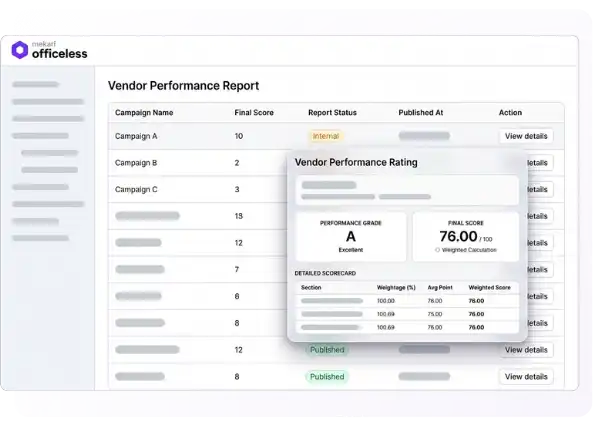
Offering enterprise-grade Source to Pay solution, Mekari Officeless also helps organizations manage the entire procurement lifecycle—from sourcing to payment—within a single integrated platform.
Core capabilities for sourcing teams:
- Vendor lifecycle and risk management. Centralize vendor registration, qualification, document collection, approvals, and risk assessments before supplier activation.
- Sourcing and vendor selection. Manage sourcing requests, RFx processes, supplier submissions, evaluations, scoring, and vendor comparisons in one system.
- Contract, catalogue, and purchase management. Convert awarded suppliers into active contracts, catalogues, and purchase orders while maintaining approved pricing and purchasing controls.
- Receiving, reconciliation, and spend visibility. Track goods receipts, invoice matching, reconciliation, and spending data through a single workflow for better financial control.
- Mekari ecosystem integration. Mekari Officeless connects natively with Mekari Jurnal (finance and supply chain), Mekari Expense (spend control and reimbursement), Mekari Pay (vendor payment execution), and Mekari Sign (digital contract authorization), creating a fully automated procurement-to-payment loop.
The result is a connected procurement ecosystem where sourcing decisions flow seamlessly into purchasing, finance, and payment processes—improving visibility, control, and operational efficiency.
Ready to bring sourcing and procurement into one transparent workflow? Explore Mekari Officeless Source-to-Pay.