


Most procurement failures happen before a vendor is ever contacted; when spend is poorly defined, market options are underresearched, or requirements drift between document versions.
The sourcing process exists to prevent exactly this. Done well, it turns procurement into a competitive advantage: better prices, stronger suppliers, lower risk. This guide covers the seven core steps and how digital eProcurement tools change what is possible at each stage
What is the sourcing process?
The sourcing process is a structured approach to identifying, evaluating, and selecting suppliers for the goods and services an organization needs.
It takes place before purchasing begins and helps ensure the business works with the right suppliers under the right terms.
Key points include:
- Sourcing and procurement are different. Sourcing focuses on supplier selection, negotiations, and contracts, while procurement handles purchasing, purchase orders, invoicing, and payments.
- Sourcing lays the foundation for procurement. It determines who the organization buys from and the terms governing those purchases.
- Strategic sourcing is more effective than ad hoc buying. Rather than relying on familiar vendors out of convenience, organizations use data, market analysis, and competitive bidding to make informed supplier decisions.
- Sourcing is an ongoing process. Businesses should regularly review suppliers, reassess market conditions, and renegotiate contracts to maintain value and reduce risk.
Why sourcing process matters
A structured sourcing process helps organizations reduce costs, improve efficiency, and strengthen supplier relationships. Its importance is reflected in several industry trends:
- A top procurement priority: Strategic sourcing is the leading priority for 56% of procurement executives because it directly impacts business value and cost savings. (The Hackett Group)
- Greater operational efficiency: Procure-to-pay automation can cut invoice processing costs by up to 70% and shorten cycle times by 40%, transforming manual finance operations into strategic, insight-driven functions. (Datamatics)
- Better contract outcomes: Procurement teams that actively manage tail spend typically uncover 5–10% savings, yet tail spend can account for up to 80% of all transactions and 15–20% of total spend — much of it operating outside negotiated contracts due to poor supplier selection and inadequate oversight. (JAGGAER)
- Growing investment in sourcing technology: Rapid growth in e-sourcing and vendor management software highlights the need for scalable, data-driven supplier management processes.
The 7 steps of an effective sourcing process
A successful sourcing process follows a structured sequence that helps organizations identify the right suppliers, secure competitive terms, and manage supplier relationships effectively.
Step 1: Define and categorize spend
Every sourcing initiative begins with a clear understanding of what the organization is buying and where the biggest opportunities exist.
This involves grouping purchases into categories and analyzing spend patterns to identify which areas require strategic sourcing attention.
- Categorize spend by areas such as IT, logistics, raw materials, and professional services.
- Assess spend volume, supplier concentration, business criticality, and price volatility.
- Prioritize categories with the greatest potential impact on cost and performance.
Without spend categorization, procurement teams may spend the same effort on low-value purchases as they do on strategically important categories.
Step 2: Analyze the supply market

Once spending patterns are clear, the next step is understanding the supplier landscape.
Market analysis helps procurement teams identify opportunities, risks, and negotiation leverage before engaging suppliers.
- Identify incumbent suppliers, alternatives, and new market entrants.
- Analyze pricing structures, cost drivers, and supply risks.
- Determine whether market conditions favor buyers or suppliers.
Skipping this step can lead to weaker negotiations and missed cost-saving opportunities.
Step 3: Develop a sourcing strategy
With spend and market insights in hand, procurement teams can define their sourcing approach.
A clear strategy ensures supplier engagement aligns with business objectives and procurement policies.
- Decide between competitive bidding, negotiated sourcing, or direct awards.
- Determine whether to use a single supplier or a multi-supplier model.
- Define evaluation criteria, governance requirements, and timelines.
Documenting the strategy upfront promotes consistency, transparency, and stakeholder alignment.
Step 4: Identify and shortlist suppliers
The next stage is narrowing the supplier market to the most qualified candidates.
This process transforms market research into a shortlist of suppliers invited to participate in the sourcing event.
- Source suppliers through vendor databases, industry directories, referrals, and market research.
- Assess financial stability, experience, certifications, and geographic coverage.
- Complete qualification and compliance checks where required.
Maintaining a centralized supplier database can significantly speed up future sourcing activities.
Step 5: Run the RFx event
The RFx event is the formal process through which suppliers submit proposals or quotations.
A structured approach ensures fairness, transparency, and consistent supplier evaluation.
- Provide all suppliers with the same information and updates.
- Clearly define submission requirements, formats, and deadlines.
- Manage supplier questions through a controlled and documented process.
Strong document control is essential to maintain integrity throughout the sourcing event.
Step 6: Evaluate, negotiate, and select
Once proposals are received, procurement teams assess suppliers against predefined criteria.
The goal is to identify the supplier that delivers the best overall value, not simply the lowest price.
- Evaluate pricing, technical capability, service levels, and risk factors.
- Use a consistent scoring methodology across all submissions.
- Negotiate commercial and contractual terms before making a final decision.
The process concludes with the formal selection of the preferred supplier or suppliers.
Step 7: Award contract and onboard supplier
The final step is converting the sourcing decision into an operational supplier relationship.
This stage ensures suppliers are contractually aligned and ready to begin delivering goods or services.
- Finalize contracts covering scope, pricing, SLAs, and payment terms.
- Complete vendor registration, system setup, and data verification.
- Establish performance monitoring and reporting processes.
Effective onboarding supports a smooth supplier transition and provides valuable data for future sourcing cycles.
Manual sourcing vs. digital sourcing
The manual column is not a description of poorly run teams. It is the structural reality of managing a complex, multi-party process without purpose-built tooling. The risk is not incompetence — it is the architecture.
| Dimension | Manual Process | With eProcurement |
|---|---|---|
| Document distribution | Email attachments, version confusion | Single platform, all participants see live documents |
| Supplier Q&A | Email threads, inconsistent responses | Structured Q&A module, all responses published to all bidders |
| Bid collection | Email submissions, manual collation | Standardized digital submission, automatic aggregation |
| Evaluation scoring | Spreadsheets, subjective application | Weighted scoring engine, consistent methodology |
| Approval routing | Email chains, unclear status | Configurable multi-level workflows, real-time status tracking |
| Audit trail | Fragmented across inboxes | Complete, timestamped activity log |
| Vendor qualification | Manual verification, ad-hoc database | Centralized vendor registry with qualification status |
| Reporting | Manual extraction, delayed | Real-time dashboards and analytics |
How eProcurement digitizes every step of the sourcing process
Modern eProcurement platforms streamline sourcing by centralizing workflows, automating manual tasks, and improving visibility across the procurement function.
- Centralized e-sourcing and vendor bidding. Manage RFIs, RFPs, RFQs, and reverse auctions in one platform with version-controlled documents, secure supplier access, and automatic activity tracking.
- Automated evaluation and scoring. Predefined criteria and scoring models ensure suppliers are evaluated consistently while reducing manual effort and errors.
- Vendor management and qualification. Maintain a centralized supplier database with qualification records, certifications, performance history, and compliance information for faster supplier selection.
- Multi-level approval workflows. Route sourcing strategies, award decisions, and contracts through automated approval chains that improve accountability and reduce delays.
- Real-time analytics and reporting. Track sourcing activities, spend, supplier performance, and savings opportunities through live dashboards and reports.
How Mekari Officeless automates your sourcing process end-to-end
Managing sourcing events manually across email, spreadsheets, and disconnected approval chains fragments the process, limits visibility, and makes compliance difficult to demonstrate.
Mekari Officeless is an enterprise app development platform that enables businesses to build custom applications, automate workflows, and connect fragmented systems to improve operational efficiency.
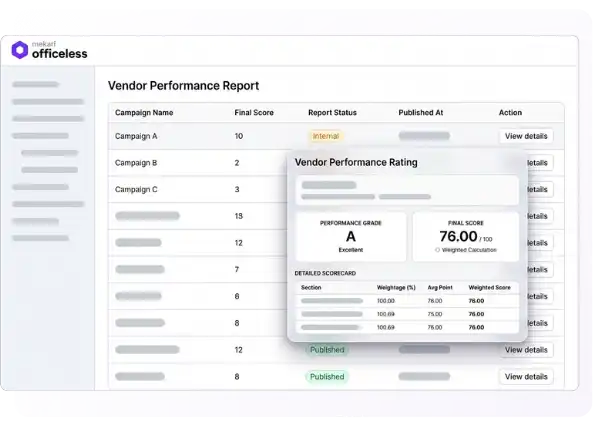
Offering enterprise-grade eProcurement solution, Mekari Officeless also helps organizations manage the entire procurement lifecycle—from sourcing to payment—within a single integrated platform.
Core capabilities for sourcing teams:
- Vendor lifecycle and risk management. Centralize vendor registration, qualification, document collection, approvals, and risk assessments before supplier activation.
- Sourcing and vendor selection. Manage sourcing requests, RFx processes, supplier submissions, evaluations, scoring, and vendor comparisons in one system.
- Contract, catalogue, and purchase management. Convert awarded suppliers into active contracts, catalogs, and purchase orders while maintaining approved pricing and purchasing controls.
- Receiving, reconciliation, and spend visibility. Track goods receipts, invoice matching, reconciliation, and spending data through a single workflow for better financial control.
- Mekari Ecosystem Integration: Mekari Officeless connects natively with Mekari Jurnal (finance and supply chain), Mekari Expense (spend control and reimbursement), Mekari Pay (vendor payment execution), and Mekari Sign (digital contract authorization) — creating a fully automated procurement-to-payment loop.
By connecting every stage of the sourcing process, Mekari Officeless helps procurement teams improve efficiency, strengthen governance, and gain greater visibility into supplier performance and spending.
Ready to run your sourcing process without the manual overhead? Explore Mekari Officeless eProcurement Source to Pay.