


- Manual safety management doesn’t scale. As operations grow, paper-based processes and spreadsheets introduce gaps that cost companies financially and legally. HSE software closes those gaps with automation, real-time visibility, and structured workflows.
- The right software depends on your industry context. Global platforms like SafetyCulture or CorityOne are well-built, but they aren’t designed with Indonesian regulatory requirements or local industry conditions in mind. Evaluate tools not just on features, but on how well they fit your specific operational environment.
- If you’re managing safety across multiple sites, prebuilt Mekari Officeless HSE is worth a closer look. Built for Indonesian industries and fully customizable, it covers everything from incident management to work permits, with the flexibility to grow alongside your business.
Every 15 seconds, a worker somewhere in the world dies from a work-related accident or illness. According to the ILO, that adds up to nearly 3 million deaths per year, a staggering figure that puts the stakes of workplace safety into sharp perspective.
For companies operating in high-risk industries, the question is no longer whether to invest in health and safety management, but how to do it effectively. That’s where HSE software comes in.
What is HSE software?
Health, Safety, and Environment (HSE) software is a centralized platform that helps companies manage all aspects of workplace safety, from incident reporting and risk assessments to regulatory compliance and employee training.
Rather than juggling spreadsheets, paper forms, and disconnected systems, companies use HSE software to consolidate safety operations into a single, trackable workflow. The result: faster response times, fewer gaps in compliance, and a safer working environment overall.
In Indonesia, this aligns with what’s locally known as K3 (Keselamatan dan Kesehatan Kerja), the national framework for occupational health and safety. HSE is the international equivalent, with the added dimension of environmental impact management.
- $163 billion, the estimated annual cost of workplace injuries in the U.S. alone, according to the National Safety Council.
- 70% reduction in lost workday incident rate, reported by one company after implementing HSE technology, per the American Society of Safety Professionals (ASSP).
- 450 fewer lost-time injuries per year than the industry average, translating to $930,000 in annual savings, as documented in the same ASSP report.
- 2.78 million workers die annually from occupational accidents and diseases, while 374 million non-fatal work-related injuries occur each year, according to the ILO.
- 26% of companies using digital safety management tools report measurable improvements in audit readiness and regulatory compliance, according to Verdantix’s Global Corporate Survey on EHS.
What HSE software actually does
Good HSE software isn’t just a digital filing cabinet. It actively supports safety operations across the organization:
- Incident reporting and investigation, Log incidents as they happen, track root causes, and assign corrective actions without the back-and-forth of email chains.
- Risk assessment, Identify hazards, evaluate likelihood and severity, and document mitigation steps in a structured, auditable way.
- Training management, Schedule safety training, track attendance, and monitor completion rates across teams and locations.
- Inspections and audits, Set recurring inspection schedules, conduct checks via mobile, and flag non-conformities in real time.
- Real-time dashboards, Give safety managers a live view of key metrics so decisions are based on current data, not last month’s report.
- Work permits and site instructions, Manage permits to work digitally, reducing delays and ensuring all approvals are documented.
HSE software comparison
Here are six HSE software recommendations that can help your company strengthen workplace safety management, each with a different fit depending on your industry, team size, and budget.
| Software | Key Features | Pricing |
|---|---|---|
| Mekari Officeless | Incident Management, Risk Assessment, Work Permit, Site Instruction, Traffic Management, Training Management, Asset & Equipment Inspection | Custom pricing based on business complexity |
| SafetyCulture (iAuditor) | Safety checklists, mobile inspections, photo documentation, detailed inspection reports | Free up to 10 users; premium from $24/month |
| Assure by Evotix | Multilingual app, customizable forms, in-app HSE training | From $20,000/year |
| CorityOne by Cority | Health, safety, environment & analytics modules, predictive data tools, automated inspections | From $50,000/year |
| Safesite | Safety Meetings, safety score analytics, hazard log, safety notifications | Free (basic); premium from $16/user/month |
| Xafy Safety App | QR code checklists, multilingual support, machine monitoring | From €149/month |
1. Mekari Officeless
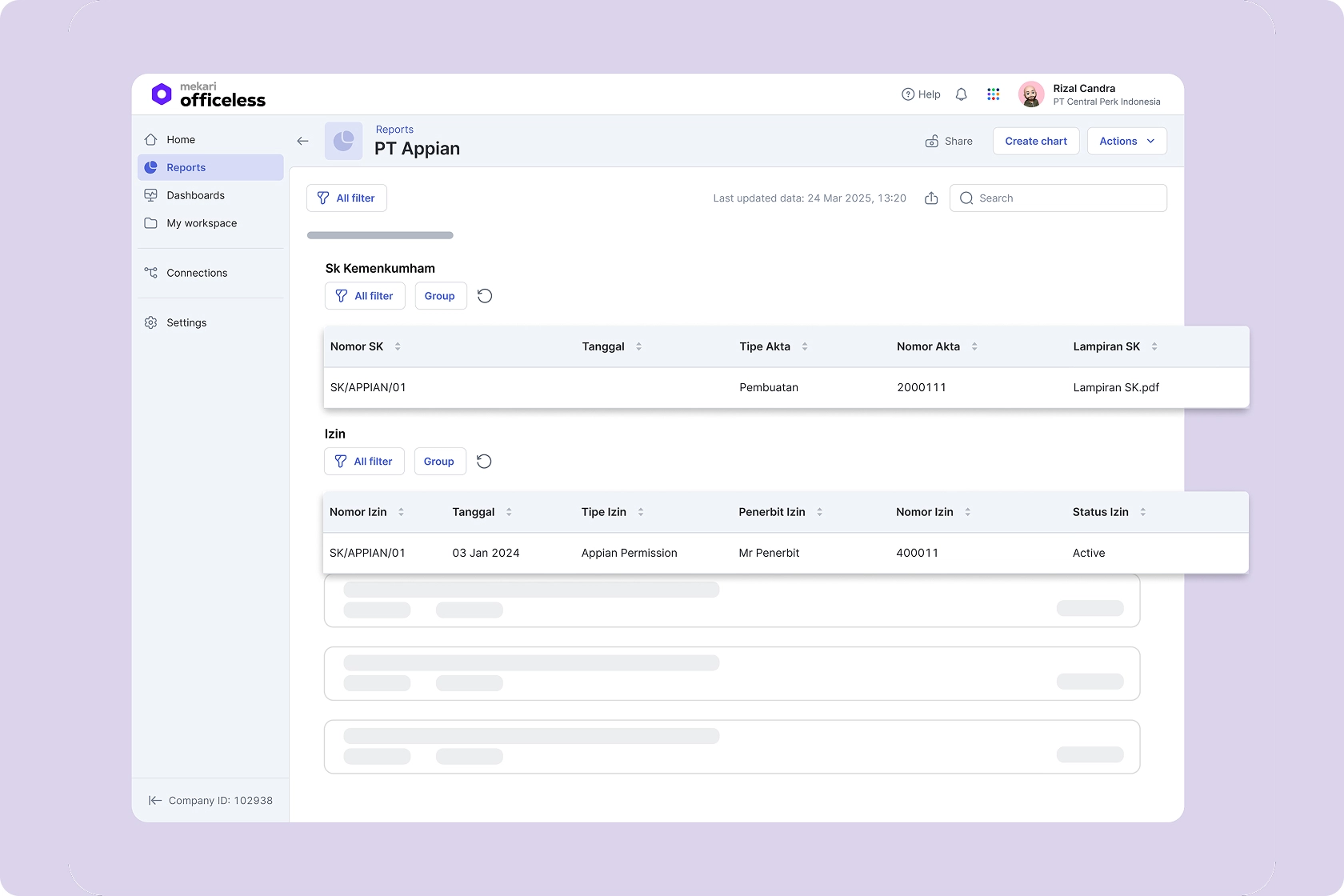
Mekari Officeless offers a prebuilt HSE System, a unified platform built to help organizations oversee workplace safety, environmental compliance, and risk management in a consistent, auditable way.
It standardizes HSE practices across the organization, enhances visibility into incidents, and supports regulatory adherence through structured workflows and reporting.
Core Capabilities
- Incident & Accident Management: A centralized hub for logging and tracking incidents and accidents, complete with investigation workflows and resolution monitoring.
- Non-Conformity Report & CAPA: End-to-end management of identified non-conformities, backed by Corrective and Preventive Action (CAPA) tracking to drive resolution.
- Risk Assessment & Hazard Identification: A systematic approach to identifying, evaluating, and monitoring workplace hazards and their associated risks.
- Work Permit Management: A digital workflow for issuing and controlling work permits, ensuring that high-risk activities are properly authorized and compliant.
- Visitor Management: A structured process for registering and tracking site visitors to uphold safety standards and manage access control.
- Inspection Management: Supports both scheduled and unplanned inspections to verify that safety procedures and standards are consistently followed.
- Audit Planning & Execution: Provides a structured framework for planning, conducting, and documenting HSE audits — both internal and external.
- Audit Reporting: Delivers consolidated audit findings and results to strengthen visibility, traceability, and timely follow-up.
Pricing: Custom, based on business complexity. Contact sales for a consultation.
Platforms: Web, iOS, Android
Strengths:
- Most comprehensive HSE feature set among local solutions
- Fully customizable to match your actual business processes
- Built with Indonesian industry regulations and conditions in mind
Limitations:
- Free trial is only available after an initial discussion with the sales team
2. SafetyCulture (iAuditor)
SafetyCulture is a well-established global platform that simplifies safety inspections and reporting through mobile-first design. Teams can download pre-built checklists, conduct on-site inspections, and generate detailed reports, all from a smartphone.
Key features: Public library of safety checklists, mobile inspections, photo evidence capture, real-time reporting
Pricing: Free for teams up to 10 people; premium from $24/month
Platforms: iOS, Android, Web
Strengths:
- Intuitive interface, easy to get started
- Strong reporting capabilities
- Free tier available for smaller teams
Limitations:
- Learning curve for users unfamiliar with digital audit tools
3. Assure by Evotix
Assure is designed for HSE professionals and operations managers who need to coordinate safety across multiple regions or languages. Its dashboard-driven approach surfaces relevant data for different roles across the organization.
Key features: Multilingual interface, customizable forms, in-app interactive HSE training
Pricing: From $20,000/year
Platforms: Web
Strengths:
- Well-suited for multinational teams
- Customizable to specific business workflows
- Engaging in-app training tools
Limitations:
- Price point puts it out of reach for SMEs
- No free trial available
4. CorityOne by Cority
CorityOne is a cloud-based enterprise platform covering health, safety, environment, and quality, with predictive analytics capabilities that help organizations get ahead of potential incidents rather than just responding to them.
Key features: Unified modules for health, safety, and environment; data-driven decision tools; automated audit and inspection workflows
Pricing: From $50,000/year
Platforms: Web
Strengths:
- Comprehensive module library in a single interface
- Strong analytics for evidence-based decision-making
Limitations:
- High cost, suited primarily to large enterprises
- Feature complexity requires dedicated training
5. Safesite
Safesite offers a practical, accessible approach to safety management, especially useful for companies that want to get started without a major upfront investment. The free tier covers essential functions, while the premium plan adds analytics and expanded tracking.
Key features: Safety Meetings tracking, safety score analytics, hazard logging, email reminders, customizable checklists
Pricing: Free (basic); premium from $16/user/month
Platforms: iOS, Android, Windows, Mac, Web
Strengths:
- Easy to use with clear weekly reports
- Email reminders help teams stay on schedule
- Flexible checklist customization
Limitations:
- Reports of occasional app crashes
- Safety Meetings feature can be slow to respond
6. Xafy Safety App
Xafy is designed for fast-paced operational environments where speed of setup and response matters. QR-code-based checklists reduce setup time, and the cross-department reporting network helps safety, logistics, and production teams coordinate quickly.
Key features: QR code-based checklists, multilingual support, machine monitoring, cross-department breakdown reporting
Pricing: From €149/month
Platforms: Android, Windows, Mac, Chromebook, Linux, Web
Strengths:
- Language-agnostic, works well across diverse teams
- Clear production facility monitoring
- Smooth implementation with responsive support
Limitations:
- No free tier
- Machinery focus limits relevance outside manufacturing
Common shortcomings of legacy HSE software
Safety management software should make things easier, not add friction. Yet many older platforms still fall short in ways that reduce their effectiveness in real-world operations.
- Poor mobile support. Safety incidents happen in the field, not at a desk. Software that only works on desktop limits how quickly workers can report and respond.
- One-way data entry. If workers can only submit reports without receiving feedback or relevant information in return, engagement drops. Effective safety culture depends on communication going both ways.
- No real-time data. Delayed or static reporting makes it harder to act when it matters most. Dashboards need to reflect what’s happening now, not what happened last week.
- Integration barriers. Safety data doesn’t exist in a vacuum. Software that doesn’t connect with other business systems limits your ability to analyze patterns and make better decisions.
- Reactive rather than proactive. Recording incidents after the fact is the bare minimum. Modern HSE tools should help prevent incidents with real-time alerts and predictive insights.
Why custom HSE software is worth considering
Many off-the-shelf K3 applications on the market can’t fully address the unique needs of every organization. When your operations have specific workflows, regulatory requirements, or existing systems to integrate with, a custom solution often delivers better long-term value.
Benefits of going custom:
- Features built around your actual processes, not generic templates
- Scalable as your business grows or regulations change
- Designed with your end users in mind, reducing training time and adoption friction
- Seamless integration with your existing tools and data infrastructure
- Better cost efficiency over time compared to paying for features you’ll never use
Mekari Officeless provides both pre-built HSE applications and fully custom software development, meaning you can start with a ready-made solution and adapt it as your needs evolve. Talk to the team to find out what’s possible.