


Contracts govern nearly every dollar a business earns and spends, yet most organizations still manage them through a mix of email threads, shared drives, and spreadsheets.
World Commerce & Contracting research shows that poor contract management erodes value equivalent to an average of 9% of annual revenue, a figure that climbs above 15% in more complex industries.
Contract lifecycle management software addresses this gap by centralizing and automating the full contract process, from initial drafting through renewal or termination.
Modern CLM platforms give procurement, sales, HR, and finance teams a shared environment to create, approve, sign, and track agreements without manual handoffs.
This article covers what CLM software does, the key features to evaluate, and a comparison of the top platforms available in 2026.
What Is Contract Lifecycle Management Software?
Contract lifecycle management software is a tool that centralizes and automates the full contract process, from creation through renewal or termination, in a single system. Unlike point solutions like e-signature tools or document storage platforms, CLM software manages every stage of the contract lifecycle across seven distinct phases:
- Creation: Teams select pre-approved templates and populate contract fields, often pulling data directly from CRM or procurement systems.
- Review and negotiation: Internal and external stakeholders collaborate on redlines and comments in a shared environment, without juggling email attachments.
- Approval: Contracts route automatically to the right reviewers based on value, type, or risk level.
- Signature: E-signature finalizes the agreement digitally, with a full audit trail.
- Storage: Executed contracts live in a centralized, searchable repository linked to related documents and vendor records.
- Obligation tracking: Automated alerts surface key dates, renewals, and commitments before they are missed
- Renewal or termination: Teams act on contracts proactively rather than discovering expiries after the fact.
While legal teams are the most common users, CLM software delivers value well beyond the legal department.
Procurement, sales, HR, and finance teams all interact with contracts regularly, and a well-implemented CLM platform gives all of them visibility and self-service capabilities without routing every request through legal.
Top 9 Contract Lifecycle Management Software in 2026
Each tool on this list was selected based on feature depth, lifecycle coverage, integration options, and fit across different organization types and contract volumes.
1. Mekari Officeless
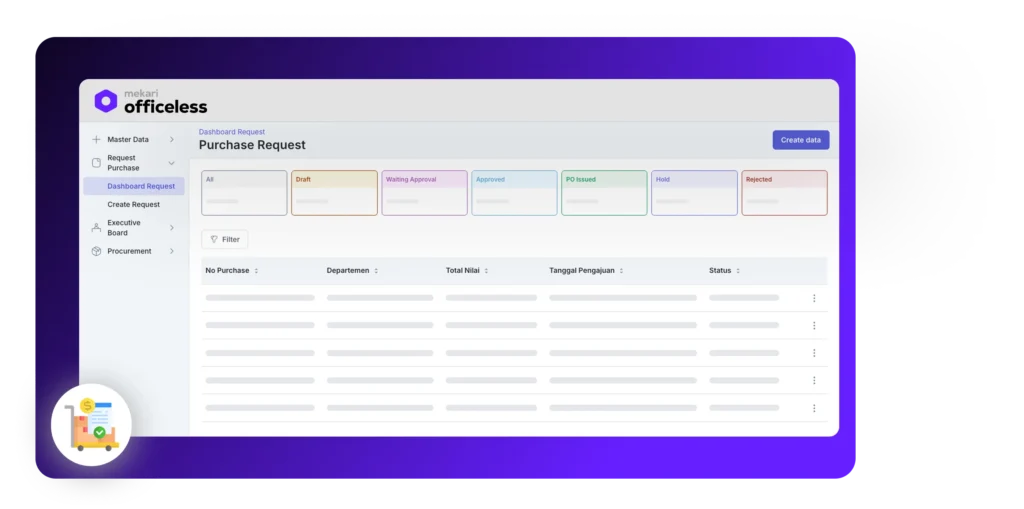
Mekari Officeless is an enterprise software development platform that enables companies to build contract management modules tailored to their specific operational processes, rather than forcing workflows into a rigid off-the-shelf CLM.
It is particularly well suited for procurement-heavy organizations that need contract management embedded in a broader operational system, from vendor qualification, approval hierarchies, obligation tracking, and compliance reporting, without rebuilding what already works.
Key capabilities relevant to contract lifecycle management:
- Custom contract management modules: Teams can build contract intake forms, approval chains, and status tracking dashboards using a drag-and-drop interface, with no coding required.
- E-procurement integration: Contract management sits inside the full procure-to-pay cycle, covering vendor qualification, purchase orders, contract creation, and performance tracking in one system.
- Workflow automation: Contract-related actions such as reminders, approvals, and escalations trigger automatically based on conditions like contract value, vendor tier, or contract type.
- Insight and reporting builder: Teams can build custom dashboards for contract status, spend by vendor, and compliance metrics without relying on a separate analytics tool.
- Mekari unified software ecosystem integration: Mekari Officeless works alongside Mekari Sign for legally valid e-signature and Mekari Jurnal for financial reconciliation tied to contract terms, as part of the broader Mekari software ecosystem.
Best for: Enterprise procurement, legal-ops, and operations teams that want contract lifecycle management embedded in their broader ERP or operational system rather than managed as a standalone tool.
2. Ironclad
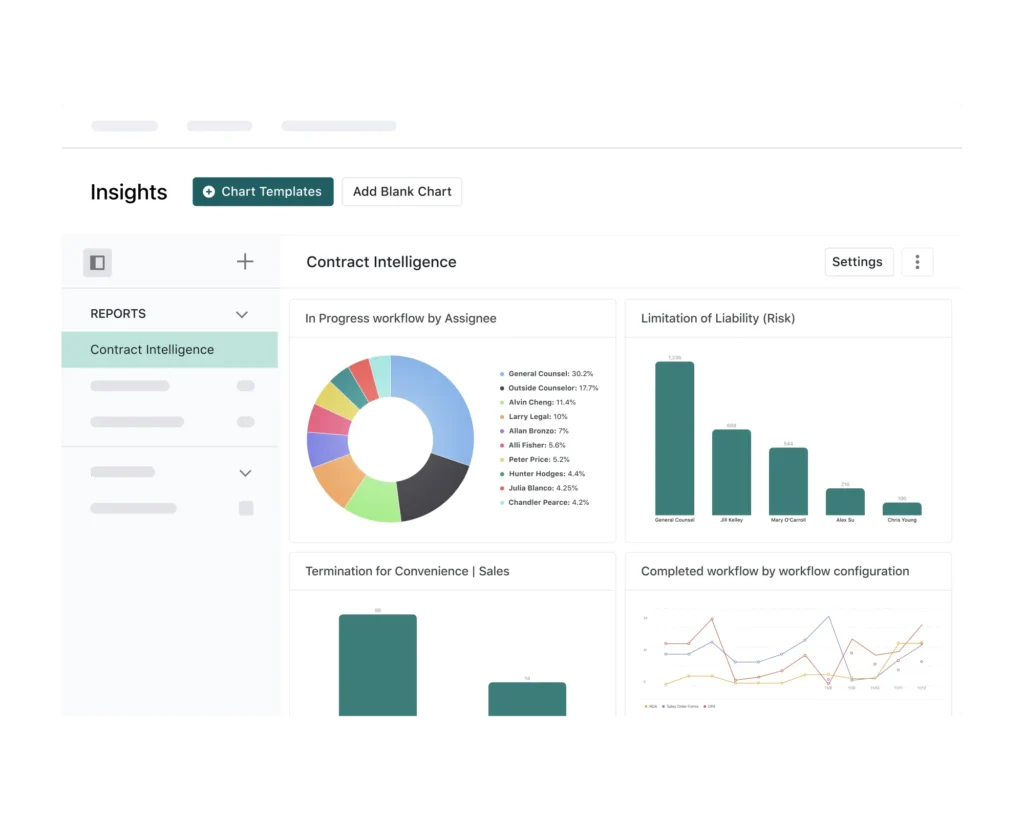
Ironclad is an AI-powered CLM platform built for enterprise legal and sales teams managing high contract volumes with complex approval requirements.
Key features:
- AI contract drafting and review: Accelerates contract creation and flags non-standard clauses during review, reducing time spent on routine legal work.
- Native Salesforce integration: Sales teams can generate and progress contracts without leaving their CRM, keeping legal workflows connected to revenue operations.
- Conditional workflow routing: Approval paths adjust automatically based on contract type, value, or risk level.
- Contract analytics dashboard: Tracks cycle times, identifies bottlenecks, and monitors team performance across the full contract pipeline.
Best for: Mid-to-large enterprises that prioritize AI-assisted contract review and want legal workflows tightly connected to their CRM.
Pricing: Contact sales.
3. Icertis
Icertis is an enterprise-grade CLM platform built for large organizations managing complex, multi-jurisdictional contracts across procurement and legal functions.
Key features:
- Deep ERP integration: Connects natively with SAP and Microsoft environments, keeping contract data in sync with broader enterprise systems.
- Obligation management: Tracks contractual commitments and compliance requirements automatically across the full post-signature lifecycle.
- Multi-language support: Handles contracts across languages and jurisdictions, suitable for global procurement and legal operations.
- Compliance analytics: Surfaces risk exposure and regulatory adherence across the entire contract portfolio.
Best for: Large global enterprises with complex regulatory environments and existing SAP or Microsoft infrastructure.
4. DocuSign CLM
DocuSign CLM extends the company’s e-signature product into a full contract lifecycle platform, connecting document generation, approvals, and storage in one system.
Key features:
- Automated document generation: Populates contracts from pre-approved templates, reducing manual drafting time.
- Multi-system integrations: Connects with Salesforce, Coupa, and other enterprise platforms to keep contract data flowing across teams.
- Centralized repository: Stores executed contracts in a searchable, audit-ready system linked to related records.
- Approval workflow engine: Routes contracts to the right reviewers based on configurable rules.
Best for: Teams already embedded in the DocuSign ecosystem that want to extend into full contract workflow management.
5. Juro
Juro is a browser-native CLM designed for in-house legal and commercial teams at scaling businesses with high contract volumes.
Key features:
- Collaborative contract editing: Internal and external stakeholders can comment and redline in a shared browser environment, without email attachments.
- Self-serve contract requests: Commercial teams can initiate and progress contracts independently using pre-approved templates, without routing every request through legal.
- AI-assisted drafting: Accelerates contract creation and surfaces clause suggestions during the drafting process.
- CRM integrations: Connects with HubSpot and Salesforce so sales teams can manage contracts without leaving their existing tools.
Best for: Scaling businesses with high contract volume that want legal and commercial teams working in one shared platform.
6. Sirion
Sirion is an AI-native CLM platform built around agentic AI, covering the full contract lifecycle with particular depth in post-signature governance and obligation management.
Key features:
- Agentic AI extraction: Automatically ingests and structures legacy and third-party contracts at scale, building a searchable metadata layer across the entire portfolio.
- AI-enhanced negotiation: Flags clause-level risks, suggests redlines based on custom playbooks, and tracks changes through the review cycle.
- Obligation and KPI tracking: Monitors contractual commitments, SLAs, and performance metrics continuously after execution.
- Multi-language support: Manages contracts across 100+ languages, suited for global procurement and legal operations.
Best for: Large enterprises managing high-value, high-complexity contracts that need strong post-execution intelligence, not just pre-signature workflow.
7. Agiloft
Agiloft is a highly configurable CLM platform built on a no-code rules engine, giving organizations deep control over contract workflows and data structures without custom development.
Key features:
- No-code workflow builder: Teams can configure approval flows, escalation rules, and contract logic without developer involvement.
- Integration hub: Connects with 1,000+ business tools via drag-and-drop integrations, including ERP, CRM, and HRIS systems.
- AI contract review: Extracts clause data, flags deviations, and surfaces obligation information using ConvoAI natural-language search.
- Audit trail and compliance controls: Maintains a complete record of every contract action for regulatory and internal audit purposes.
Best for: Organizations with complex or non-standard contract workflows that need deep configurability and dedicated IT resources for setup.
8. Leah (formerly ContractPodAi)
Leah is a GenAI-driven CLM platform recognized as a Visionary in Gartner’s Magic Quadrant, with a focus on AI-powered contract intelligence across legal, procurement, and finance teams.
Key features:
- Agentic CLM: AI agents handle contract authoring, clause analysis, obligation tracking, and workflow automation within a single platform.
- Multi-language support: Covers 40+ languages, making it viable for global enterprise deployments.
- Microsoft 365 integration: Contracts move between Word, Teams, and the CLM repository without switching tools.
- Modular pricing: Organizations can start with core CLM features and expand to additional AI capabilities as needed.
Best for: Mid-to-large enterprises that want an AI-first CLM with strong Microsoft ecosystem integration and scalable deployment.
9. Conga CLM
Conga CLM is part of the Conga Revenue Lifecycle Cloud, connecting contract management tightly with CPQ and billing for Salesforce-centric revenue teams.
Key features:
- Salesforce-native integration: Triggers contract generation directly from Opportunity records, keeping sales and legal workflows connected inside one CRM environment.
- Clause and template management: Stores pre-approved clauses and templates with version control, reducing review time on standard agreements.
- Agreement hierarchy visualization: Maps relationships between parent agreements and related documents for easier portfolio management.
- Workflow automation: Routes contracts through configurable approval flows with automated notifications at each stage.
Best for: Revenue teams managing high contract volumes inside Salesforce who need CLM tightly connected to CPQ and billing processes.
Benefits of Using Contract Lifecycle Management Software
CLM software delivers measurable impact across legal, procurement, and finance teams, including
- Faster contract cycles: Automates drafting, routing, and approvals to cut time spent waiting in revision loops or email chains.
- Reduced compliance risk: Standardized clause libraries and obligation tracking prevent missed deadlines and non-compliant language from slipping through.
- Cross-team self-service: Sales, HR, and procurement can initiate contracts without routing every request through legal.
- Full contract visibility: Centralized repository with status dashboards keeps active, expiring, and overdue agreements in one view.
- Lower administrative overhead: Less time spent on manual tracking, signature chasing, and invoice-to-contract reconciliation.
- More efficient negotiations: AI-assisted CLM tools accelerate the negotiation and document completion process, reducing back-and-forth between legal and commercial teams.
Research points to concrete gains for organizations that make the switch.
Key Features to Look for in CLM Software
When evaluating CLM platforms, companies should look beyond basic document storage and e-signature.
Enterprise-grade CLM software needs to support the full contract lifecycle across multiple teams and business units, from authoring through post-signature obligation management.
- Contract authoring and template library: Pre-approved templates with variable fields and clause libraries reduce drafting time and keep language consistent across agreement types.
- Automated approval workflows: Multi-level routing based on contract type, value, or risk classification ensures the right reviewers are involved without manual coordination.
- E-signature integration: Native or third-party e-signature support finalizes agreements digitally with a full audit trail.
- Centralized contract repository: A searchable, version-controlled repository gives teams a single source of truth for all active and historical agreements.
- Obligation and deadline tracking: Automated alerts for renewals, expirations, and milestone dates prevent commitments from being missed after signing.
- Reporting and analytics: Cycle time tracking, bottleneck identification, and compliance dashboards give legal and procurement leaders visibility into contract performance.
- System integrations: Native connectors or API access to CRM, ERP, HRIS, and procurement systems ensure contract data flows across the organization without manual re-entry.
The more of these capabilities a platform covers natively, the less your team relies on workarounds, manual handoffs, or disconnected point solutions to manage contracts at scale.
How to Choose the Right CLM Software for Your Organization
Not every CLM platform is built for the same use case. The right choice depends on where your biggest friction lives, how your teams are structured, and what systems the platform needs to connect with.
- Map your primary pain point first: Pre-signature friction (drafting, approvals) and post-signature gaps (obligations, renewals, performance tracking) call for different platform strengths, and not every CLM covers both equally well.
- Evaluate integration requirements: A CLM that cannot connect to your CRM, ERP, or procurement system will create new data silos rather than eliminate existing ones.
- Consider user adoption: Platforms that route every contract action through legal will face resistance from commercial teams. Assess self-service capabilities for sales, HR, and procurement before committing.
- Assess configurability vs. out-of-the-box fit: Enterprises with complex or unique workflows need a platform that adapts to their process, not one that forces process changes to fit the software.
- Check scalability and pricing model: Evaluate contract volume today and projected growth over the next two to three years. Per-contract, per-user, and flat-fee pricing models carry very different cost implications at scale.
No single platform wins across every dimension. Prioritize the two or three criteria that matter most to your organization and use those as the primary filter before evaluating features in detail.
Build a CLM That Fits Your Business with Mekari Officeless
Managing contracts at scale requires more than a structured process. It requires a system that enforces that process automatically, adapts to how your organization actually works, and connects with the tools your teams already use.
Mekari Officeless enables organizations to build and run CLM workflows tailored to their specific processes, without rebuilding existing systems from scratch. Depending on where your organization is starting from, there are three ways to get there:
- Start with a prebuilt e-procurement software that covers core CLM workflows out of the box, including contract request intake, multi-stage approvals, vendor contract tracking, and real-time reporting.
- Build on a no-code/low-code platform to configure and extend CLM workflows around your specific approval structures, contract types, integration requirements, and obligation tracking logic.
- Engage a custom software service for end-to-end CLM development tailored to complex enterprise workflows, with full integration into existing ERP, HRIS, and e-signature systems.
Mekari Officeless also connects with Mekari Sign for e-signature execution and Mekari Talenta for employment contract workflows as part of the broader Mekari unified software ecosystem, reducing manual handoffs across systems and consolidating contract data into a single source of truth.Automate contract workflows, approvals, and obligation tracking with Mekari Officeless E-Procurement Solution.
References and methodology
Methodology
Methodology
Articles published by Mekari Officeless are developed using trusted sources, including official data, company reports, academic research, and insights from industry practitioners. Whenever possible, we refer directly to primary sources before drawing conclusions. Our editorial team reviews and verifies the information to ensure accuracy and relevance. All references are listed so readers can trace each piece of information back to its original source.
Our editorial standards
Our editorial standards
- Primary source first: We consult official product documentation and pricing pages directly, not secondhand summaries or aggregator sites.
- Fact-checking: All product features, pricing, and claims are cross-verified against each platform’s official website at the time of writing.
- No paid placement: Tools are selected based on relevance and fit for Indonesian businesses, not commercial arrangements. Mekari Officeless is included as a first-party product and is transparently labeled as such.
- Regular review: Articles are periodically updated to reflect product changes or shifts in market relevance.