


- With stricter rules from OJK, Bank Indonesia, UU PDP, POJK 3/2024, and POJK 40/2024, fintech companies need to manage compliance continuously across licensing, AML, data protection, payment security, consumer protection, cybersecurity, AI governance, and vendor risk.
- Spreadsheets and email make it harder to standardize checklists, collect evidence, track issues, monitor completion, and respond quickly to regulatory changes. As fintech operations scale, these gaps can increase the risk of missed checks, delayed escalation, and incomplete audit trails.
- Mekari Officeless Operations Checklist Management software helps fintech teams standardize compliance workflows, schedule recurring checks, capture evidence, track issues, monitor performance, and maintain year-round audit readiness in one system.
In fintech, compliance mistakes are never just administrative issues. They can lead to costly fines, license risks, reputational damage, and operational disruption.
With global AML, KYC, and sanctions penalties reaching $6.6 billion in 2023, and Indonesia tightening its fintech rules through OJK, Bank Indonesia, UU PDP, POJK 3/2024, and POJK 40/2024, companies can no longer rely on scattered spreadsheets or manual follow-ups.
This fintech compliance checklist highlights 10 key areas every fintech business should monitor, along with how Operations Checklist Management software helps turn compliance into a structured, trackable, and audit-ready process.
What is fintech compliance?
Fintech compliance refers to the legal, regulatory, and operational requirements that fintech companies must follow to operate safely and legally.
It covers areas such as data privacy, payment security, anti-money laundering, consumer protection, risk management, and corporate governance.
For Indonesian fintech companies, compliance is a continuous operational responsibility, not just a one-time audit process. Oversight is mainly handled by:
- OJK: Supervises P2P lending, equity crowdfunding, digital financial innovation (ITSK), investment management, crypto assets, and consumer protection in financial services.
- Bank Indonesia: Oversees payment system operators, electronic money issuers, and AML/CFT implementation in payment services.
Since the P2SK Law or Law No. 4 of 2023, crypto asset supervision has shifted from Bappebti to OJK, expanding OJK’s role in fintech regulation.
The scope of compliance depends on each fintech’s business model. For example:
- P2P lenders must focus on lending rules, risk management, and borrower protection.
- Payment processors must comply with payment system, transaction security, and AML/CFT rules.
- Crypto platforms must follow digital asset, licensing, reporting, and consumer protection requirements.
- BNPL providers must manage credit risk, customer transparency, and responsible lending obligations.
Why fintech compliance is getting harder to manage manually
Fintech compliance is becoming harder to manage as regulations expand and manual processes struggle to keep pace. For enterprise fintechs, the challenge is ensuring every requirement is completed, documented, reviewed, and escalated consistently across teams.
Mounting regulatory complexity
- Fintech companies must comply with OJK rules, Bank Indonesia regulations, UU PDP, and international standards such as FATF and PCI DSS.
- Each requirement may have different reporting timelines, documentation needs, and approval flows.
- Under POJK 40/2024, P2P lending minimum capital increased from IDR 2.5 billion to IDR 25 billion, alongside new equity ratio, liquidity ratio, and verification requirements.
The cost of manual compliance tracking
- Global regulatory fines for AML, KYC, and sanctions violations reached $6.6 billion in 2023, a 57% increase year-over-year.
- In 2024, enforcement continued to rise, with KYC fines increasing 102% year-over-year.
- 60% of fintech firms globally paid at least $250,000 in compliance fines in a single year.
- Manual tracking increases the risk of missed checks, delayed follow-ups, incomplete evidence, and human error.
- A single missed AML violation can trigger penalties ranging from $500,000 to $50 million.
Why spreadsheets and email fail
- They do not provide a reliable real-time audit trail.
- Task updates, approvals, and evidence are often scattered across inboxes and shared drives.
- Management cannot easily see which sites, departments, or teams have completed required checks.
- Checklist versions can become inconsistent when regulations change.
- Manual escalation slows down response when compliance gaps appear.
The fintech compliance checklist: 10 key areas to cover
A fintech compliance checklist should act as an operational control framework, not just a list of regulations.
For enterprise fintechs, each requirement needs to be translated into clear ownership, recurring tasks, documented evidence, escalation workflows, and audit-ready records.
1. OJK licensing and regulatory reporting
OJK licensing is the foundation of fintech compliance in Indonesia, especially for P2P lending, ITSK, equity crowdfunding, BNPL, and digital asset services.
Depending on the business model, companies may need ITSK registration, sandbox participation, and full business licensing under POJK 3/2024.
P2P lenders must also meet capital obligations under POJK 40/2024, including paid-up capital and minimum equity requirements.
Operational checklist tasks:
- Track OJK license status, renewals, and reporting deadlines.
- Verify capital adequacy, equity ratios, and liquidity ratios.
- Review financial and operational report submissions.
- Maintain updated governance and compliance function documentation.
2. Anti-money laundering and counter-terrorism financing
AML and CFT controls are mandatory for fintechs supervised by OJK and Bank Indonesia. Companies must apply a risk-based program covering customer due diligence, enhanced checks for high-risk users, transaction monitoring, suspicious activity reporting, and record retention.
Operational checklist tasks:
- Review suspicious activity report status and submission logs.
- Refresh CDD and EDD records for high-risk customers.
- Monitor transaction alerts and unresolved escalation cases.
- Track AML policy reviews and staff training completion.
3. Personal data protection
Fintechs process sensitive customer and financial data, making UU PDP compliance a core requirement.
Companies must obtain documented consent, secure personal data, define retention rules, prepare breach response procedures, and ensure third-party vendors follow data protection obligations.
Operational checklist tasks:
- Audit consent logs and customer authorization records.
- Review data mapping, retention, and deletion procedures.
- Verify vendor Data Processing Agreements.
- Test breach response and escalation workflows.
4. PCI DSS compliance
PCI DSS applies to fintechs that store, process, or transmit cardholder data. It requires strong controls across encryption, access management, network segmentation, vulnerability scanning, penetration testing, monitoring, and audit log review.
Operational checklist tasks:
- Review user access to payment systems.
- Schedule vulnerability scans and penetration tests.
- Validate encryption and payment environment segmentation.
- Track remediation of security findings.
5. Payment system compliance
Payment service providers, e-money issuers, and remittance operators must comply with Bank Indonesia rules on licensing, fund transfers, capital, reserves, operational reliability, and incident reporting. Since payment operations run continuously, these controls need regular monitoring.
Operational checklist tasks:
- Perform float reconciliation.
- Prepare and review BI regulatory reports.
- Monitor capital and reserve requirements.
- Review system incident logs and reporting timelines.
6. Consumer protection
Consumer protection rules require fintechs to be transparent, fair, and accountable in customer-facing activities. This includes product disclosures, fees, interest rates, risks, complaint handling, debt collection standards, and marketing accuracy.
Operational checklist tasks:
- Review complaint logs and resolution timelines.
- Audit marketing materials and product disclosures.
- Monitor debt collection practices.
- Track recurring customer issues and corrective actions.
7. Cybersecurity and IT risk management
Cybersecurity is critical because fintechs handle financial transactions, personal data, credentials, and service infrastructure.
Companies need structured controls for risk assessment, security monitoring, patch management, incident response, business continuity, and disaster recovery.
Operational checklist tasks:
- Review patch and vulnerability status.
- Conduct cybersecurity risk assessments.
- Schedule penetration tests and BCP/DRP drills.
- Track security training and incident response documentation.
8. AI and algorithmic governance
AI governance applies when fintechs use automated systems for credit scoring, underwriting, fraud detection, onboarding, or risk assessment. These systems should be explainable, monitored, documented, and reviewed to reduce bias, inaccuracy, and unfair outcomes.
Operational checklist tasks:
- Review AI model performance and decision accuracy.
- Monitor bias and fairness risks.
- Maintain model documentation and decision logs.
- Verify alternative credit scoring registration status where applicable.
9. Governance, internal controls, and audit readiness
Strong governance ensures compliance responsibilities are assigned, reviewed, and documented across the organization. Enterprise fintechs need internal controls, approval workflows, policy version history, audit committee records, and remediation tracking.
Operational checklist tasks:
- Conduct internal control self-assessments.
- Document audit and risk committee meetings.
- Review policy version history and approval logs.
- Track audit findings, owners, and remediation deadlines.
10. Vendor and third-party risk management
Fintechs often rely on vendors for cloud infrastructure, payment gateways, KYC tools, cybersecurity, analytics, and data processing. Vendor risk management ensures third parties meet compliance, data protection, security, and continuity expectations.
Operational checklist tasks:
- Maintain a vendor registry with risk classifications.
- Conduct due diligence before onboarding vendors.
- Review vendor security and compliance documents.
- Audit DPAs and test contingency plans for critical vendors.
Manual checklist vs. automated OCM: A comparison
Manual compliance tracking may work in the early stages, but it becomes harder to control as fintech operations scale across products, teams, branches, and regulatory categories. An Operations Checklist Management (OCM) system helps turn compliance activities into standardized, scheduled, and traceable workflows.
| Aspect | Manual spreadsheet/email | With OCM software |
| Checklist standardization | Checklists are ad-hoc, and versions may differ across teams or sites. | A centralized master checklist ensures every team follows the same standard. |
| Task scheduling | Teams rely on calendar invites, email reminders, or manual follow-ups, which are easy to miss. | Tasks are scheduled automatically with reminders, approval flows, and notifications. |
| Evidence collection | Supporting files are stored in email threads, folders, or separate drives. | Evidence is attached directly to each checklist item and stored in one central system. |
| Issue tracking | Issues are logged in separate spreadsheets and can be overlooked. | Issues are generated from failed checklist items and tracked until resolution. |
| Audit trail | Records are scattered across inboxes, chats, and shared files, making them hard to reconstruct. | Every action is logged with timestamp, user, status, and supporting evidence. |
| Compliance visibility | Leaders only know the status after asking teams for updates. | Dashboards show real-time compliance status across teams, sites, and categories. |
| Regulatory reporting | Data must be compiled manually, increasing the risk of errors. | Reports and analytics can be exported on demand. |
| Scalability | The process becomes slower as teams, locations, and checklist volume grow. | Compliance execution can scale without relying on additional manual headcount. |
| Regulatory updates | Updated requirements are shared through email, and adoption may be inconsistent. | The master checklist can be updated centrally and distributed instantly. |
| Audit preparation | Teams may spend weeks collecting documents before an audit. | Evidence is collected continuously, supporting faster audit readiness. |
Organizations that implement automated compliance tools can typically reduce audit preparation time by 40–60% and maintain 95%+ compliance readiness throughout the year, instead of only preparing close to audit periods.
The business impact for OCM software in fintech compliance
OCM software helps fintech companies reduce manual work, lower compliance risk, and stay audit-ready as operations scale. Instead of relying on spreadsheets and email follow-ups, teams can automate recurring checks, collect evidence continuously, and monitor compliance status in real time.
Time and labor savings
Automated compliance tools can reduce time spent on manual compliance tasks by 60–80%. For fintech teams, this means less time chasing updates, compiling evidence, and preparing reports, and more time focusing on risk review, issue resolution, and strategic compliance improvements.
Risk and penalty avoidance
Manual tracking increases the risk of missed checks, late escalation, and incomplete documentation. With OCM software, failed checklist items can automatically trigger issue logs, assign owners, set deadlines, and track corrective actions. This helps reduce the chance of regulatory gaps that may lead to costly fines or operational disruption.
Audit readiness year-round
OCM software supports continuous audit readiness by keeping every task, approval, issue, and evidence file in one system. Instead of spending weeks collecting documents before an audit, fintech teams can maintain a complete digital audit trail and respond to regulatory requests faster.
How Mekari Officeless operations checklist management supports fintech compliance
Mekari Officeless Operations Checklist Management helps fintech teams turn compliance checklists into structured workflows that are easier to standardize, monitor, and audit.
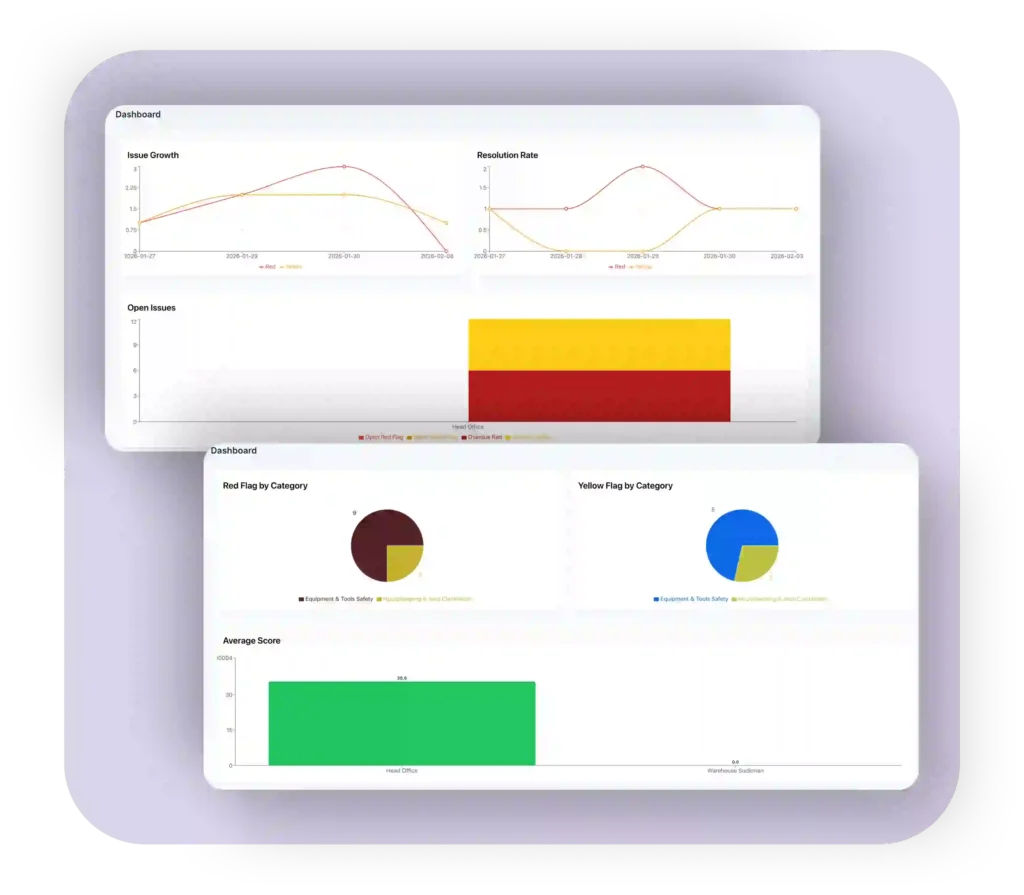
Instead of managing AML reviews, vendor checks, cybersecurity controls, and operational assessments through spreadsheets, teams can manage them in one system.
Key features that fit fintech compliance include:
- Standardized Checklist Master Data: A master checklist configuration that defines categories, questions, answer options, scores, issue flags, and mandatory evidence to ensure all operational inspections follow the same standard.
- Scheduling and Approval Workflow: A structured scheduling workflow that manages operational activity requests, approvals, revisions, and rejections to ensure all activities are formally reviewed before execution.
- Checklist Execution and Assessment: An operational checklist execution module that allows users to perform assigned or ad-hoc inspections, complete checklist forms, attach evidence, and automatically calculate final scores.
- Issue Tracking and Resolution: An integrated issue tracking system that automatically generates issues from checklist failures and tracks them until resolution, ensuring all findings are handled and documented.
- Performance Dashboard and Analytics: A real-time dashboard that visualizes operational performance, compliance status, issue trends, resolution rates, and site-level comparisons for monitoring and analysis.
- User and Access Configuration: System configuration features to manage users, groups, positions, and access permissions to control who can view, execute, and manage operational activities.
Ready to turn your fintech compliance checklist into a structured, automated, and audit-ready operational system? Explore Mekari Officeless Operations Checklist Management.
References and methodology
Methodology
Methodology
Articles published by Mekari Officeless are developed using trusted sources, including official data, company reports, academic research, and insights from industry practitioners. Whenever possible, we refer directly to primary sources before drawing conclusions. Our editorial team reviews and verifies the information to ensure accuracy and relevance. All references are listed so readers can trace each piece of information back to its original source.
Our editorial standards
Our editorial standards
- Primary source first: We consult official product documentation and pricing pages directly, not secondhand summaries or aggregator sites.
- Fact-checking: All product features, pricing, and claims are cross-verified against each platform’s official website at the time of writing.
- No paid placement: Tools are selected based on relevance and fit for Indonesian businesses, not commercial arrangements. Mekari Officeless is included as a first-party product and is transparently labeled as such.
- Regular review: Articles are periodically updated to reflect product changes or shifts in market relevance.
References
References
Global Legal Insight. ‘’Fintech Laws and Regulations.’’