


- Construction document management is not just about storage, it is about version integrity and accountability. With 52% of rework caused by poor project data and miscommunication, and field professionals losing up to 14 hours per week on non-value-adding document tasks, the financial impact of uncontrolled documentation is measured directly in project overruns, disputes, and margin erosion.
- A construction document management system eliminates these risks by enforcing version control, automating transmittal tracking, and providing a tamper-proof audit trail across every project document, so that field teams, subcontractors, and clients always work from the same, current version.
- Mekari Officeless provides a configurable Document Management System with the multi-level workflows and document control structure that construction organizations need. From drawing submittals to closeout handovers, manage every document in one secure, organized system, and protect your projects from the costly consequences of poor documentation.
In construction, document errors can quickly become expensive. Globally, 52% of rework is linked to poor project data and miscommunication, contributing to 2% to 20% of total project costs (Rib Software). On-site, this often means teams working from outdated drawings, leading to failed inspections, rework, and delays.
A construction document management system (CDMS) helps prevent this by ensuring every document is accurate, up to date, and accessible to the right stakeholders, with a clear audit trail for accountability.
This guide covers what a construction DMS is, why it matters, its key benefits, and how to implement it effectively.
What is a construction document management system?
A construction document management system is a platform designed to organize, control, distribute, and archive all project documentation across the construction lifecycle, from pre-construction planning through to project handover.
In construction, document control carries higher stakes than in most industries. A single outdated drawing used on-site can lead to safety risks, compliance issues, disputes, and costly rework that impacts both budget and timeline. Because multiple stakeholders are involved, maintaining a single source of truth for every document becomes critical.
At its core, a construction DMS supports several key functions:
- Version control and drawing management, ensuring teams always work from the latest issued-for-construction documents while clearly tracking superseded revisions
- Document distribution and transmittal tracking, so every update is shared with the right parties and fully recorded
- RFI (Request for Information) and RFC (Request for Change) management to streamline communication and decision-making
- Permit and regulatory submission tracking to support compliance throughout the project
- Subcontractor document portals with controlled access based on roles and responsibilities
- Construction closeout and as-built documentation to ensure accurate final records for handover
Unlike generic document management systems or project management tools, a construction DMS is purpose-built around industry-specific workflows such as drawing revisions, transmittals, inspection records, and multi-party collaboration.
Why construction projects need a dedicated document management system based on data
Taken together, these data points highlight a clear pattern: without a dedicated construction document management system, projects face avoidable risks that impact cost, timelines, and compliance at every stage.
1. The cost of poor document control
Poor document control has a direct and significant financial impact on construction projects. An estimated 52% of rework is caused by poor project data and miscommunication, contributing to billions in avoidable costs each year. (Rib Software)
Rework itself accounts for 2% to 20% of total project costs, eroding margins and reducing overall project profitability. On a global scale, bad data including poorly managed documents led to approximately $1.8 trillion in losses in 2020, with 14% of avoidable rework tied directly to data mismanagement. (Ineight)
2. Time lost to document problems
Beyond cost, document inefficiencies consume a substantial portion of project time. Construction professionals spend up to 35% of their workweek, or around 14 hours, on non-value-adding tasks such as searching for documents or resolving version conflicts. (Ineight)
Compounding this, 25% of misplaced documents are never recovered, forcing teams to recreate information or continue working with incomplete data, both of which increase project risk. (Kyro)
3. Rework as a compounding cost
Rework does not occur in isolation, it compounds across the project lifecycle. More than half of all rework globally is linked to poor communication, costing between 9% and 20% of total project budgets. (Revicheck)
Miscommunication alone accounts for 26% of rework, while bad or inaccurate data contributes an additional 14% to 22%. Without structured document control, these issues scale quickly across teams, contractors, and project phases. (PlanRadar)
4. Compliance and legal exposure
Large construction projects are already prone to overruns, with many running 20% longer than scheduled and up to 80% over budget. Weak document control further increases exposure to disputes, regulatory non-compliance, and penalty clauses. (Ineight)
Missing approvals, outdated permits, or incomplete documentation can lead to failed inspections and legal complications that delay project completion and inflate costs even further.
Key benefits of a construction document management system
A construction document management system delivers tangible benefits across the entire project lifecycle, from planning to closeout. By structuring how documents are controlled and shared, it reduces risk while improving coordination across all stakeholders.
- Version control for drawings and specifications
Ensures field teams always use the latest issued-for-construction (IFC) drawings, with clear tracking of superseded revisions to avoid costly on-site errors - Reduced rework and cost overruns
Controlled document distribution minimizes miscommunication and version confusion, directly reducing rework and protecting project margins - Transmittal tracking and accountability
Every document shared is logged with sent, acknowledged, and responded status, creating a complete and defensible audit trail - Faster RFI and change management
RFIs and change requests are managed within structured workflows, speeding up resolution and preventing informal, error-prone communication - Better client and subcontractor relationships
Clients receive organized, up-to-date documents, while subcontractors access only relevant files through controlled portals, reducing confusion and disputes - Audit readiness and legal protection
Full document history, including revisions and approvals, supports compliance and protects against disputes, claims, and inspections - Efficient project closeout
As-built documents and O&M manuals are compiled systematically throughout the project, enabling a smoother and more organized handover
Document management system recommendations for construction company
The following solutions are recommended based on their fit for construction document management use cases, covering drawing revision control, transmittals, RFI management, subcontractor portals, and site mobility.
1. Mekari Officeless
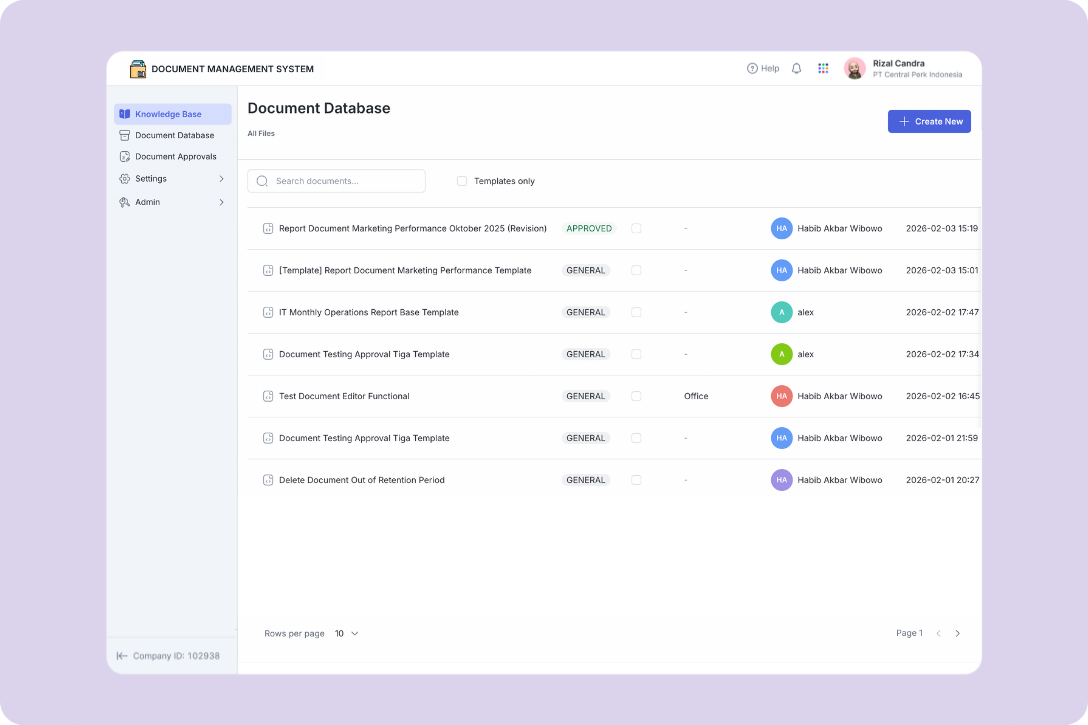
Mekari Officeless is an enterprise solution that extends core ERP and business systems to close operational gaps through solution accelerators, custom workflows and dashboards, and custom development services.
For construction organizations, its Document Management System provides a ready-to-deploy solution for managing project documents across design, procurement, construction, and closeout. It helps replace fragmented document processes with structured, traceable workflows while giving project teams controlled access to the information they need.
Key capabilities include:
- Structured document repository: Organize project documents by phase, discipline, or type using configurable structures and standardized metadata.
- Multi-level approval workflows: Configure approval chains for submittals, method statements, change requests, and other project documents.
- Audit trail and access logging: Track document uploads, revisions, approvals, and other activities with user and timestamp records.
- Role-based access control: Give contractors, subcontractors, clients, and internal teams access based on their roles and responsibilities.
- No-code workflow configuration: Adapt document routing, approval flows, and business rules without requiring traditional software development.
- Integration with business systems: Connect document workflows with relevant procurement, finance, and operational processes across the broader business ecosystem.
This approach allows construction organizations to deploy a ready-made document management solution while retaining the flexibility to adapt workflows as project and operational requirements evolve.
Best for: Indonesian construction companies and project owners seeking a pre-built, enterprise-grade DMS without complex implementation
2. Oracle Aconex
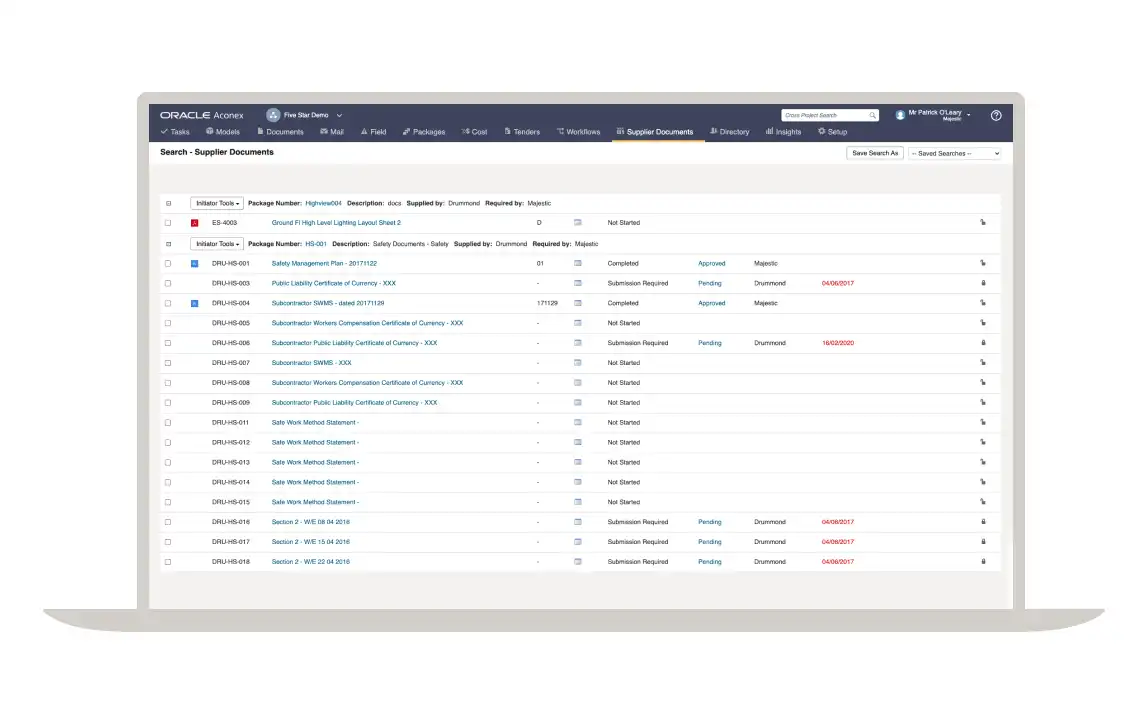
Oracle Aconex is widely recognized for its strong document control capabilities in large construction projects. It offers unalterable audit trails, robust transmittal management, and a data ownership model that allows multiple organizations to collaborate without losing control over their data.
Key strengths:
- Unalterable audit trails
- Advanced transmittal management
- Proven scalability for enterprise projects
Best for: Large general contractors and infrastructure projects with complex multi-party collaboration
Limitation: High cost and steep learning curve
3. Procore
Procore combines document management with full project management capabilities, including RFIs, drawings, and submittals. It offers strong mobile access and integrates with a wide range of third-party tools.
Key strengths:
- All-in-one construction platform
- Strong mobile usability
- Extensive integration ecosystem
Best for: Mid-to-large contractors needing integrated project and document management
Limitation: Cost and feature complexity for smaller projects
4. Autodesk Construction Cloud (ACC)
Autodesk Construction Cloud connects design and construction processes in a centralized environment. It is particularly strong for teams using Autodesk tools, offering real-time collaboration, version control, and model coordination.
Key strengths:
- Deep BIM and CAD integration
- Real-time collaboration on models and documents
- Advanced document handling features
Best for: Design-build firms with BIM-heavy workflows
Limitation: Best suited for Autodesk-centric environments
5. Bluebeam Revu
Bluebeam Revu is widely used for PDF-based drawing review and collaboration. While not a full DMS, it plays a key role in document markup and version comparison workflows.
Key strengths:
- Industry-standard PDF markup tools
- Strong document comparison capabilities
- Real-time collaboration via Bluebeam Studio
Best for: Teams focused on document review, markup, and submittal collaboration
Limitation: Not a complete document control system, typically used alongside a DMS
Types of documents managed in a construction DMS
A construction DMS organizes documents across every phase of the project, ensuring each stakeholder can access accurate and up-to-date information when needed.
- Pre-construction: Environmental permits, planning approvals, geotechnical reports, design briefs, preliminary drawings, feasibility studies
- Design and engineering documents: Architectural drawings, structural calculations, MEP (mechanical, electrical, plumbing) drawings, specifications, civil engineering designs
- Procurement documents: Bills of quantities, tender documents, subcontractor agreements, purchase orders, material submittals
- Contract management: Main contract, subcontracts, variation orders, scope of work documents, extension of time claims
- Site documentation: Daily site reports, inspection and test records, method statements, safety plans, toolbox talk records
- Quality assurance: Non-conformance reports (NCRs), inspection checklists, material approval requests (MARs), factory acceptance test records
- Regulatory and compliance: Building permits, inspection certificates, authority approvals, HSE documentation, OSHA compliance records
- Communications: RFIs, transmittals, meeting minutes, formal correspondence, site instructions
- Closeout and handover: As-built drawings, O&M manuals, warranties, commissioning reports, defect liability records
Manual document control vs. construction DMS: a side-by-side comparison
To better understand the impact of adopting a construction DMS, the comparison below highlights the key differences between manual document control and a structured, system-driven approach.
| Feature / Aspect | Manual / Paper-Based Control | Construction Document Management System |
|---|---|---|
| Drawing Version Control | Multiple drawing revisions in circulation; field teams unsure which is current | Single current version accessible; superseded drawings automatically archived |
| Document Distribution | Emailed as attachments or printed for site; no tracking of receipt | Controlled transmittals with delivery confirmation and acknowledgment tracking |
| RFI Management | Email threads; no clear status or resolution tracking; easy to lose | Centralized RFI register with status, response time, and closure logging |
| Subcontractor Access | Emailing document packages; risk of outdated versions being used on site | Secure subcontractor portals with access only to current, relevant documents |
| Site Inspection Records | Paper forms completed on site; scanned or emailed after the fact | Digital inspection forms completed on-site via mobile; auto-linked to drawing records |
| Change Order Tracking | Spreadsheet-tracked; easy to miss approvals or omit scope items | Integrated change management with approval workflow and cost impact logging |
| Compliance Documentation | Physical files retrieved manually for inspections; preparation takes days | Instant retrieval and audit-ready reporting; compliance documentation always current |
| Dispute Resolution | Difficult to reconstruct document history; “he said, she said” situations | Complete transmittal records, access logs, and change history for every document |
| Project Closeout | Manual collation of as-builts from multiple teams; frequently incomplete | Structured closeout checklist with document completeness tracking and handover package |
| Remote / Multi-Site Access | Physical files unavailable to teams not on that site | Cloud access from any authorized device; all sites see the same document set |
| Rework Risk | High, site teams regularly work from outdated or conflicting drawings | Significantly reduced, controlled distribution ensures version accuracy at all times |
How Mekari Officeless can support construction document management
Mekari Officeless is an enterprise workflow automation platform that offers a pre-built DMS system through its marketplace.
The solution is designed to adapt to complex, multi-party environments like construction, where document control must handle frequent revisions, strict approvals, and coordination across multiple stakeholders and projects.
For construction companies managing large volumes of drawings, submittals, contracts, and compliance documents, Mekari Officeless provides a structured system that replaces fragmented manual processes with controlled, traceable workflows.
Key capabilities include:
- Structured document repository
Organize project documents by phase, discipline, or type using a configurable folder structure and standardized metadata, making retrieval faster and more consistent - Multi-level approval workflows
Set up approval chains for submittals, method statements, and change requests, with escalation paths and mobile approvals for project managers working on-site - Audit trail and access logging
Every document action, from upload to revision and approval, is automatically recorded with timestamps, supporting compliance and dispute resolution - Role-based access control
Grant controlled access to internal teams, subcontractors, clients, and regulators without exposing the entire document repository - No-code workflow configuration
Document controllers can adjust approval flows, routing rules, and access permissions without relying on IT development resources - Integration with Mekari unified software ecosystem
Seamlessly connects with procurement, finance, and operational workflows across Mekari products, enabling end-to-end visibility across construction projects
If you’re looking to bring structure and control to your construction document processes, explore document management system by Mekari Officeless.
References
Ineight. ‘’4 Ways Modern Document Control Overcomes Construction Complexity’PlanRadar. ‘’Cost of Rework in Construction: Causes, Data & Prevention’’
Rib Software. ‘’Top Construction Document Management Benefits & Tips’’