


- Engineering document mismanagement is not just an administrative inconvenience, it is a direct financial risk. With bad data responsible for 14–22% of all project rework, and engineering professionals losing up to 14 hours per week on non-value-adding document-related tasks, the operational cost of poor document control is measured in millions, not thousands.
- An engineering document management system closes these gaps by enforcing revision control, automating approval workflows, and maintaining a complete audit trail; so that every team member, contractor, and client always works from the same, correct version of a document.
- Mekari Officeless provides a configurable Document Management System built for enterprise document control needs. Whether you are managing project documentation in construction, manufacturing, or infrastructure, a structured system ensures your technical documents are always current, accessible, and audit-ready.
Engineering projects generate huge volumes of documents, from drawings and specifications to revisions and compliance records. Without proper control, this quickly becomes costly.
An FMI study estimates poor data management caused $1.8 trillion in global losses in 2020, with 14% of avoidable rework tied to data issues.
An engineering document management system (EDMS) solves this by ensuring the right document version reaches the right team, with every change tracked and traceable. This guide covers how EDMS works, its benefits, key features, and how to implement it effectively.
What is an engineering document management system?
An engineering document management system (EDMS) is a specialized software designed to manage the full lifecycle of technical documents, including creation, revision, distribution, and archiving. These documents typically include engineering drawings, CAD files, specifications, SOPs, inspection records, and transmittals.
Unlike a generic document management system, an engineering DMS is purpose-built for project-driven environments such as construction (AEC), oil and gas, manufacturing, and utilities.
It is structured around strict revision control, formal document exchanges, and standardized numbering systems, all of which are critical to maintaining accuracy and coordination across teams.
Several key concepts make engineering DMS unique:
- Revision control: Every document version (such as Rev A, Rev B) is tracked with a clear history of changes, approvals, and current status, ensuring teams always work on the latest version.
- Transmittal management: Documents shared between contractors, clients, or regulators are formally logged, making it easy to track what was sent, received, and acknowledged.
- Document numbering: Standardized naming and numbering conventions allow fast retrieval and consistent cross-referencing across large project datasets.
- IFC / IFR status: Documents are categorized based on project stages, such as Issued for Construction (IFC) or Issued for Review (IFR), helping teams manage readiness and compliance throughout the project lifecycle.
Why engineering teams need a dedicated document management system
Engineering teams operate in environments where documentation is not just operational, but critical to cost, timelines, and compliance. Without a dedicated system, the risks quickly compound across projects.
1. Rework caused by bad documentation
Poor documentation and miscommunication are among the biggest drivers of inefficiency in engineering projects. Studies show that 14–22% of all rework in construction and engineering is caused by bad data and unclear information. (PlanRadar)
This is significant when you consider that rework can account for 2% to 20% of total project costs, directly impacting already tight contractor margins. Globally, 52% of rework is linked to poor project data and communication breakdowns, highlighting how critical proper document control really is. (Ineight)
2. Time lost searching for documents
A surprising amount of time is wasted simply trying to find the right information. Engineering and construction professionals spend up to 35% of their workweek, or around 14 hours per week, on non-value-adding tasks such as searching for documents, verifying versions, and fixing errors caused by outdated files. (Ineight)
To make matters worse, 25% of misplaced documents are never recovered, leading to delays, duplication of work, and potential project risks. (Kyro)
3. Compliance and audit risk
In regulated industries such as energy, infrastructure, and manufacturing, documentation is closely tied to legal and compliance requirements. Without a structured system, companies may struggle to prove that the correct procedures, approvals, and standards were followed.
This can result in serious consequences, including regulatory penalties. For example, OSHA violations alone can lead to fines reaching hundreds of thousands of dollars, especially when documentation gaps expose safety or process failures.
Document management system recommendations for engineering document management
Below are some of the best document management systems designed to support engineering document management, selected based on their ability to manage revisions, streamline approvals, ensure compliance, and scale across project-driven organizations.
1. Mekari Officeless DMS (Recommended for Indonesian enterprises)
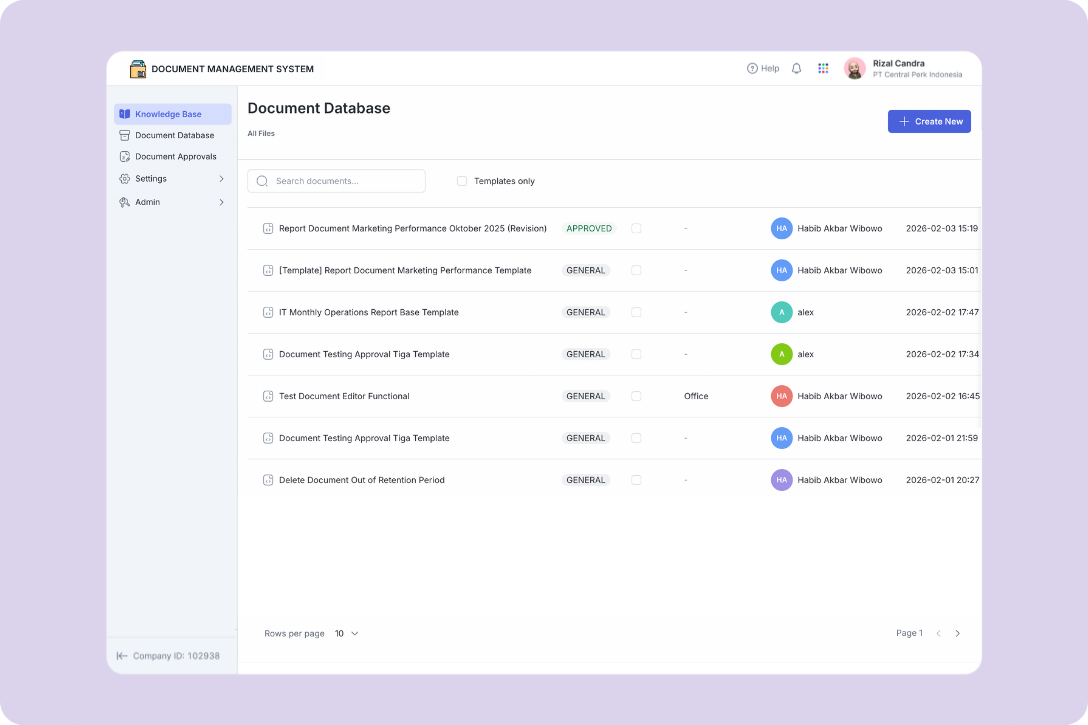
Mekari Officeless provides a pre-built Document Management System available in its marketplace, designed to support the structured document control requirements of engineering and capital-intensive project environments. What makes it stand out is its flexibility.
Instead of forcing teams to adapt to rigid software, Mekari Officeless allows companies to build a custom engineering document management system that mirrors their existing workflows, approval structures, and document hierarchies.
This makes it particularly suitable for organizations managing complex documentation across multiple stakeholders, projects, and compliance requirements.
Key strengths for engineering document management:
- Centralized document database: Organize engineering documents in a structured, hierarchical repository with granular access control, physical document mapping, and enforced relationships between files
- Automated approval workflows: Replace manual approvals with configurable multi-stage workflows, including sequential or parallel routing, role-based responsibilities, and automated feedback loops
- Native authoring and version control: Create and manage documents directly within the platform using standardized templates, with automatic versioning and document numbering aligned to company conventions
- Secure content publishing: Ensure only approved document versions are visible to users, while drafts and outdated files are automatically restricted
- Immutable audit trails and secure distribution: Track every document action with timestamped logs, enable secure external sharing with expiry controls, and automatically deprecate outdated versions
- Knowledge base self-service portal: Provide teams with a centralized library of verified documents, policies, and technical references for easy, independent access
- Integration with Mekari unified software ecosystem: Seamlessly connect with other Mekari solutions to streamline workflows across finance, HR, and operations
Best for: Engineering and project-driven organizations in Indonesia that need a structured, enterprise-grade DMS with configurable workflows and no IT development overhead.
2. Oracle Aconex
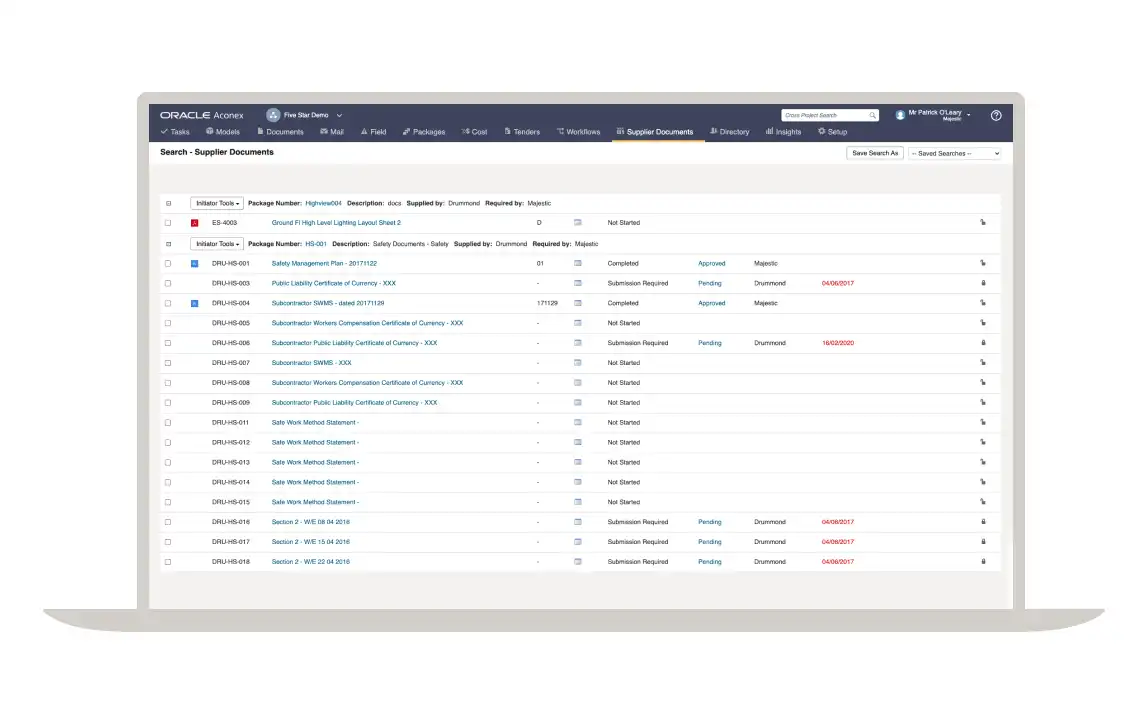
Oracle Aconex is a leading engineering and construction document management platform designed for complex, multi-disciplinary projects. It supports version control, transmittals, RFIs, and unalterable audit trails, with a data ownership model suited for multi-party collaboration.
Key strengths:
- Robust transmittal management
- Unalterable audit trails
- Strong compliance and accountability features
- Mobile access for project teams
Best for: Large engineering and construction firms managing complex, compliance-heavy projects
Limitation: Steep learning curve; best suited for enterprise teams
3. Autodesk Construction Cloud (ACC) / Autodesk Vault
Autodesk offers integrated platforms for engineering document control and design data management, connecting BIM, CAD, and project workflows in one environment.
Key strengths:
- Deep CAD and BIM integration
- Strong for design-heavy engineering workflows
- Centralized common data environment
Best for: Engineering and AEC teams using Autodesk tools for design and project execution
Limitation: High cost; most value within Autodesk ecosystem
4. Bentley ProjectWise
Bentley ProjectWise is built for infrastructure and engineering projects, enabling centralized control of engineering documents across long asset lifecycles.
Key strengths:
- Strong fit for infrastructure engineering
- Supports long-lifecycle document management
- Deep integration with Bentley tools
Best for: Engineering organizations in civil, utilities, and transportation sectors
Limitation: Primarily suited for Bentley-based environments
5. Procore
Procore combines project management and document control, supporting engineering teams with drawings, RFIs, submittals, and collaboration tools in one platform.
Key strengths:
- Broad capabilities beyond document control
- Strong mobile access for field coordination
- Large integration ecosystem
Best for: Mid-to-large engineering and construction contractors needing an all-in-one platform
Limitation: High cost; feature depth may add complexity for focused use cases
Key benefits of an engineering document management system
An engineering document management system is not just about storage. It directly improves project efficiency, cost control, and compliance by bringing structure and visibility to complex document workflows.
- Revision control and version integrity: Ensures every team member works on the latest approved version, eliminating risks from outdated drawings or superseded specifications
- Reduced rework and associated costs: Controlled document distribution keeps field teams and subcontractors aligned, significantly reducing costly rework
- Faster document retrieval: Structured numbering, metadata tagging, and full-text search enable engineers to find documents in seconds instead of hours
- Transmittal tracking: Provides a complete audit trail of document exchanges, including what was sent, to whom, when, and the response received
- Regulatory compliance and audit readiness: Built-in retention policies, access controls, and change logs support compliance with standards such as ISO 9001 and ISO 17025
- Cross-team collaboration: Allows internal teams, contractors, clients, and regulators to access documents through controlled portals without relying on email
- Project closeout efficiency: Ensures all documents are complete and organized at handover, simplifying closeout and supporting ongoing operations
Types of documents managed in an engineering DMS
An engineering DMS supports a wide range of document types across the entire project lifecycle. Understanding these categories helps teams map their real-world workflows into the system.
- Design and technical documents: Engineering drawings (2D and 3D), CAD files, design specifications, calculations, schematics, P&ID diagrams
- Project management documents: Project execution plans, work breakdown structures, schedules, and meeting minutes
- Procurement documents: Material requisitions, purchase orders, vendor submittals, and equipment datasheets
- Quality assurance documents: Inspection and test plans, non-conformance reports, quality records, and FAT documentation
- Regulatory and compliance documents: Permits, safety data sheets, regulatory filings, environmental reports, and OSHA records
- Transmittals and correspondence: Transmittal logs, RFIs (Requests for Information), RFCs (Requests for Change), and formal communications
- Construction and site documents: IFC drawings, site inspection reports, punch lists, and as-built drawings
- Operations and maintenance documents: O&M manuals, equipment registers, commissioning reports, and maintenance procedures
How Mekari Officeless can support your engineering document management
Mekari Officeless is a platform that accelerate business app creation, workflow automation, and analytics; part of Mekari unified software ecosystem, with a pre-built Document Management System (DMS) available in its marketplace, designed for the structured and workflow-heavy needs of engineering organizations.
It helps teams manage technical documents in a controlled environment, with clear approvals and cross-department coordination.
Key capabilities include:
- Structured document repository: Organize documents by project, discipline, or department with customizable hierarchies and metadata
- Multi-level approval workflows: Set up review and approval chains across teams with escalation and delegation rules
- Audit trail and version logging: Automatically track every document action with user and timestamp records
- Role-based access control: Ensure only authorized users can access or modify specific documents
- No-code workflow automation: Configure and adjust document workflows without IT involvement
- Integration with Mekari ecosystem: Connect with procurement, finance, and HR systems for better visibility
Explore how engineering DMS from Mekari Officeless works for your organization.