


- Each RFx tool serves a distinct purpose. RFI helps you explore the market, RFP evaluates solutions, and RFQ drives price competition — using them correctly ensures better sourcing decisions.
- The sequence matters for better outcomes. Running RFI → RFP → RFQ in the right order reduces uncertainty, improves vendor selection, and creates a more structured, defensible procurement process.
- Technology turns RFx into a scalable system. With solutions like Mekari Officeless e-Procurement, you can automate workflows, standardize evaluations, and manage vendor selection with full visibility and control.
Imagine you’re organizing a big event. You wouldn’t instantly hire a vendor. First, you’d explore what options exist, then compare prices, and finally ask a few shortlisted vendors to present detailed plans.
This is similar to how companies make purchasing decisions. To bring structure into the process, procurement teams use three key tools: request for information (RFI), request for quotation (RFQ), and request for proposal (RFP).
Each serves a different purpose, from understanding the market, to comparing costs, to selecting the best vendor. So, when should you use each one? Let’s break it down.
RFI (request for information): the market discovery phase
An RFI is a structured, early-stage procurement tool used to gather general market intelligence about potential suppliers’ capabilities, offerings, and capacity — before making any commitment.
Unlike casual vendor outreach, it creates a formalized, comparable framework for collecting and evaluating vendor data.
What it does & why it matters
The RFI answers one fundamental question: What’s out there? Before writing a specification or running a competitive bid, you need to understand what the market actually offers.
The RFI is your reconnaissance mission — it maps the vendor landscape, surfaces capabilities you didn’t know existed, and reveals gaps that may reshape your requirements entirely. Think of it as the research phase before you commit to the exam.
When to use an RFI
- You’re early in sourcing and don’t yet know your full requirements
- You’re exploring a new category or market you haven’t sourced before
- You need to understand what solutions exist before defining your specification
- You want to shortlist vendors from a large pool for deeper evaluation later
- You need to identify gaps or white-space in the vendor landscape
- You want to shape a smarter, more informed RFP or RFQ
Key characteristics
- Non-binding: Neither buyer nor supplier is committed to anything. It’s fully exploratory, with no obligation to proceed on either side.
- Capability-focused: Questions center on “What can you do?”: not detailed specs, pricing, or delivery terms. You’re learning, not buying.
- Broad outreach: Sent to a wide pool of potential vendors, not just pre-qualified ones. The goal is maximum market coverage at this stage.
- Fast turnaround: Typically 1–2 weeks for vendor responses. It’s designed to be lightweight and low-friction for both parties.
- Shapes what comes next: RFI responses directly inform and improve the RFP or RFQ that follows. A well-run RFI makes every subsequent step smarter.
- Pre-qualification tool: Only vendors with strong RFI responses advance. It filters the field before you invest more time and resources.
What to include in an RFI
- Company background & context: Who you are, what you do, and why you’re in the market right now
- High-level business need: The challenge you’re addressing, without locking into a specific solution
- Capability questions: Open-ended questions about what vendors offer, their experience, and fit for your context
- Lightweight timeline & criteria: A rough sense of when you need to move and what matters most (no formal weighting required)
- How you’ll use responses: Set expectations clearly: this is for shortlisting, not final selection
RFQ (request for quotation): the price competition phase
An RFQ is a formal request for detailed pricing and commercial terms from pre-qualified suppliers for clearly defined goods or services.
It’s used when the buyer knows exactly what they need and wants to compare cost and delivery options across multiple suppliers in a structured, apples-to-apples format.
What it does & why it matters
The RFQ is the most transactional of the three instruments. By the time you issue one, all ambiguity should be gone — specs are final, suppliers are pre-screened, and the only meaningful differentiator is price and delivery.
The RFQ is a precision instrument: it creates genuine competitive tension around cost, compresses weeks of manual analysis into hours, and typically drives supplier pricing down because every bidder knows they’re competing head-to-head on a level playing field.
When to use an RFQ
- Your specifications are completely locked down and non-negotiable
- You’re sourcing standardized products or services with no meaningful variation
- Price and delivery are the primary differentiators — not technical capability or methodology
- You’re buying on a recurring basis (standing purchase orders, MRO procurement)
- You’ve already pre-qualified suppliers and narrowed the field
- You want competitive bidding to pressure supplier pricing downward
Key characteristics
- Transactional focus: The core questions are price, quantity, delivery schedule, and payment terms: not capability or approach.
- Pre-qualified suppliers only: Issued exclusively to vendors who’ve already passed earlier screening. No new entrants at this stage.
- Identical specifications to all bidders: Every supplier receives the exact same brief: essential for fair, defensible, side-by-side cost comparison.
- Fast process: Response time is typically 1–3 weeks. Evaluation is straightforward because cost is the primary (often only) lens.
- Easy comparison: Side-by-side cost and terms analysis is clean, fast, and auditable. No complex or subjective scoring required.
- Drives prices down: Competitive pressure is structurally built in. Suppliers know they’re bidding against one another and sharpen their pencils accordingly.
What to include in an RFQ
- Exact product/service specifications: Technical drawings, dimensions, quantities, materials, and performance requirements. Zero ambiguity.
- Delivery schedule & lead times: Required dates, phasing, logistics expectations, and penalties for late delivery
- Terms & conditions: Payment terms, warranty provisions, liability, and any contractual penalties or incentives
- Quality standards & testing requirements: Applicable standards (ISO, ASTM, etc.), inspection rights, and acceptance criteria
- Evaluation criteria: Typically cost-focused; state clearly how bids will be scored and what winning looks like
- Required quote format: Specify exactly how suppliers must present pricing so comparisons remain clean and consistent
RFP (request for proposal): the solution evaluation phase
An RFP is a comprehensive document requesting detailed proposals from qualified suppliers on how they would deliver a complex solution — covering not just price, but methodology, expertise, implementation approach, compliance, and long-term value.
It’s used when strategic goals are clear, but the best path to achieving them is open to vendor input.
What it does & why it matters
The RFP is where procurement becomes genuinely strategic. Unlike the RFQ — which assumes you know exactly what you want — the RFP acknowledges that different vendors may have fundamentally different, equally valid approaches to solving your problem. It invites vendors to think, not just quote.
The result is a richer evaluation that surfaces not just cost but methodology, risk, innovation, and long-term partnership potential. It’s the instrument you reach for when the stakes are high and the decision is complex.
When to use an RFP
- You’re sourcing a complex, high-stakes solution (software, professional services, managed services)
- Requirements are clear at a high level, but you want vendors to propose their approach
- You need to evaluate multiple dimensions beyond price: technical fit, methodology, vendor stability, experience
- Implementation approach or customization matters — this is not a commodity purchase
- Multiple stakeholders with different priorities are involved (cost, quality, risk, innovation)
- The decision will lead to a long-term relationship, not a one-time transaction
Key characteristics
- Multi-dimensional evaluation: Cost is just one factor. Technical fit, vendor stability, methodology, compliance, and innovation all carry formal weight.
- Longer timeline: Typically 4–8 weeks for responses. Vendors need real time to develop thoughtful, tailored proposals: rushed RFPs produce poor proposals.
- Cross-functional evaluation teams: Involves Procurement, Finance, IT, Legal, and Operations: not just one buyer making a unilateral call.
- Weighted scoring: Each criterion carries an explicit, pre-defined weight. A common example: cost 30%, technical fit 40%, vendor stability 20%, innovation 10%.
- Relationship-building opportunity: Vendors explain their thinking, not just their pricing. The RFP process is the beginning of a real partnership conversation.
- Leads to negotiation: Unlike the RFQ (which feeds directly into a purchase order), the RFP typically leads to contract negotiation and implementation planning.
What to include in an RFP
- Company background & strategic context: Who you are, where you’re going, and why this decision matters strategically
- Detailed requirements & scope: Clear on what must be achieved, while leaving flexibility in how vendors propose to get there
- Proposed solution questions: Explicitly ask “How would you…?” to draw out vendor methodology and approach
- Implementation timeline & support expectations: Expected milestones, go-live dates, and what post-delivery support is required
- Compliance & security requirements: Regulatory, data, and risk requirements that vendors must address directly
- Scoring criteria & weightings: Be fully transparent about how proposals will be evaluated; this signals your true priorities to bidders
- References & past experience: Case studies, client references, and examples of comparable past engagements
- Full cost breakdown: Not just a total: itemized by phase, service type, licensing, support, and any variable or optional costs
RFI vs RFP vs RFQ: Quick comparison
While RFI, RFQ, and RFP serve different purposes, the table below highlights how they differ across key dimensions in the procurement process.
| Dimension | RFI (Request for Information) | RFP (Request for Proposal) | RFQ (Request for Quotation) |
|---|---|---|---|
| Primary Purpose | Gather market intelligence & vendor capabilities | Evaluate comprehensive solutions & approaches | Secure competitive pricing for defined goods/services |
| When to Use | Early sourcing, exploring market, undefined requirements | Complex solutions, multiple evaluation criteria, strategic fit matters | Well-defined specs, price is primary factor, pre-qualified suppliers |
| Vendor Pool | Broader, exploratory (may include new vendors) | Pre-qualified vendors, narrowed list | Highly pre-qualified, proven capability |
| Evaluation Focus | Vendor capability, market offerings, fit | Technical approach, methodology, expertise, cost, compliance, risk | Price, delivery, terms (cost-driven comparison) |
| Typical Timeline | 1–2 weeks | 4–8 weeks or more | 1–3 weeks |
| Outcome | Information shortlist of qualified vendors for RFP/RFQ | Proposal of selected vendor + negotiation of terms | Quotation for vendor selection or purchase order issuance |
| Cost Impact | Low (research phase) | High (extensive evaluation resources) | Medium (competitive pressure drives costs down) |
| Legal Binding | No | No, but signals serious intent | No, but closest to purchase commitment |
| Best For | New categories, complex markets, exploratory buying | Integrated solutions, managed services, software, consulting | Commodity purchases, standing orders, MRO, components |
How they work together
While each instrument stands on its own, RFI, RFP, and RFQ are most powerful when used in sequence. Each stage builds directly on the last, the RFI narrows the field, the RFP identifies the right solution and partner, and the RFQ (where applicable) locks in final pricing.
Together they form a disciplined, evidence-based sourcing lifecycle that reduces risk, drives value, and creates a defensible audit trail.
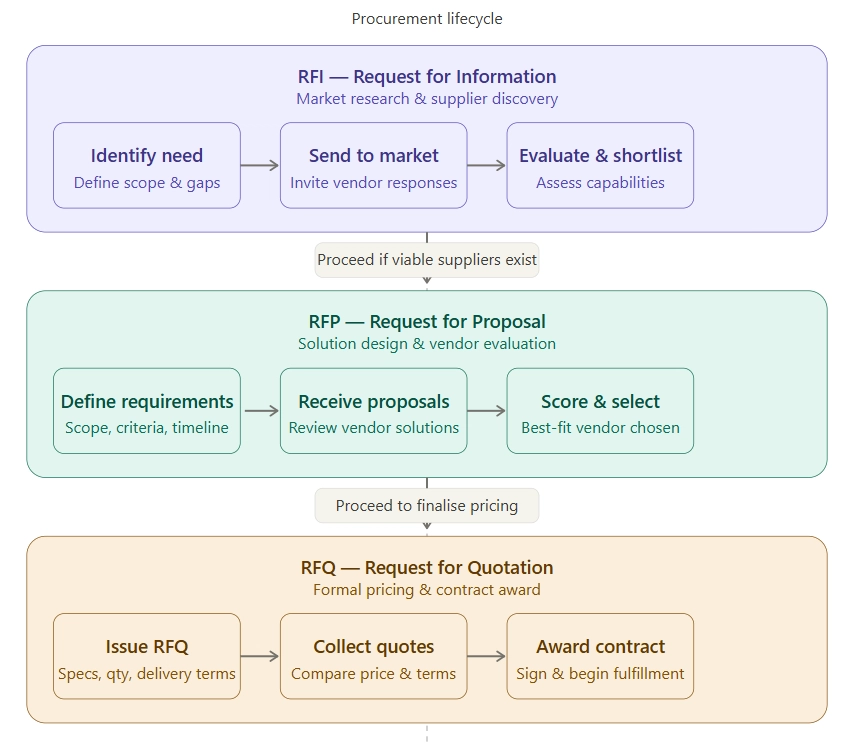
Stage 1 RFI phase (weeks 1–2): cast wide, learn fast
You start here when you don’t yet have enough market knowledge to write a meaningful specification. The RFI goes out to a broad, largely unfiltered pool of vendors, the goal isn’t to find a winner, it’s to understand the competitive landscape and identify who deserves a closer look.
By the end of this phase you should have gathered enough intelligence to know what’s realistic, what isn’t, which vendors are credible, and which capabilities actually exist in the market. That knowledge directly shapes the requirements and evaluation criteria you’ll put into your RFP.
Activities:
- Send to broad vendor pool
- Gather market intelligence
- Ask open-ended capability questions
- Assess vendor fit at a high level
Outcome: A shortlist of 5–10 qualified candidates + market insights that inform the next stage
Stage 2 RFP phase (weeks 3–10): go deep with the right vendors
With your shortlist in hand, the RFP goes only to vendors who passed the RFI screen. This stage is where the real evaluation happens. You’re no longer asking “Can you do this?”, you’re asking “How would you do this, and why should we trust you to do it well?”
Vendors invest significant time in their proposals, and your team invests equally serious effort in scoring them.
This is typically the most resource-intensive phase, and for good reason, the decision made here determines your partner, your approach, and the foundation of the contract. Rushing it is the single most common procurement mistake.
Activities:
- Issue detailed RFP to shortlisted vendors
- Collect full proposals covering approach, methodology, timeline, risk, and cost
- Run cross-functional scoring sessions
- Conduct vendor presentations or clarification rounds if needed
Outcome: A selected vendor and a set of negotiated terms ready to move toward contract execution
Stage 3 RFQ phase (weeks 11–13, if applicable): precision pricing
This stage is not always required. For software, professional services, or complex managed services, pricing is typically embedded in the RFP proposal and negotiated directly, no separate RFQ needed.
Where the RFQ earns its place is in manufacturing, MRO procurement, and component sourcing, where the selected vendor (or a small set of pre-qualified finalists) needs to submit itemized pricing against specific SKUs, quantities, and delivery schedules.
At this point, the hard work is done. The vendor is known, the specifications are locked, and the RFQ is simply the mechanism that translates an agreed solution into a purchase-ready commercial document.
Activities:
- Issue RFQ to selected or pre-qualified vendor(s)
- Specify exact quantities, SKUs, and delivery schedules
- Collect and compare final itemized pricing · Execute purchase order
Outcome: A signed purchase order and formal contract execution
When to skip a stage
Not every sourcing process needs all three. The sequence should match the complexity of what you’re buying:
| Scenario | Recommended Flow |
|---|---|
| New category, complex solution | RFI → RFP → (RFQ if needed) |
| Known category, complex solution | RFP only |
| Standardized goods, known suppliers | RFQ only |
| Standardized goods, unknown market | RFI → RFQ |
| Recurring commodity purchase | RFQ only |
The worst mistake is using a light instrument for a heavy decision, issuing an RFQ when you needed an RFP, or skipping the RFI and discovering mid-RFP that your requirements were wrong. Matching the tool to the situation is the foundation of effective procurement.
Common mistakes in RFI, RFP, and RFQ
Even well-intentioned procurement processes fail, not because the tools are wrong, but because they’re misused. The mistakes below are the most common reasons sourcing slows down, vendors disengage, and decisions get made on bad information.
RFI mistakes
These mistakes typically happen when teams rush early-stage discovery or blur the line between exploration and evaluation.
- Turning the RFI into an RFP. Asking for pricing or detailed plans too early leads to inconsistent responses and poor market visibility.
- Ignoring the responses you receive. Lack of follow-up reduces vendor engagement and weakens participation in later stages.
- Asking too many detailed questions too early. Overloading the RFI turns it into an inefficient, unstructured RFP.
- No clear criteria for shortlisting. Without predefined criteria, vendor selection becomes subjective and inconsistent.
RFP mistakes
At this stage, the biggest risks come from unclear evaluation frameworks and poor process discipline.
- Mixing RFP and RFQ objectives in the same document. Combining solution design and final pricing creates confusion for both vendors and evaluators.
- Vague or absent scoring criteria. Without clear weighting, proposals become difficult to compare objectively.
- Unrealistic response timelines. Short deadlines lead to rushed, low-quality proposals.
- Changing requirements mid-process. Shifting scope wastes vendor effort and delays decision-making.
- Undefined stakeholder roles. Lack of clarity in ownership causes bottlenecks and slow approvals.
RFQ mistakes
RFQ issues often stem from poor preparation and overemphasis on price.
- Sending the RFQ to unqualified vendors. Leads to low-cost but non-compliant or risky quotes.
- Ambiguous or incomplete specifications. Results in inconsistent pricing that cannot be fairly compared.
- Rushing the evaluation. Skipping validation increases the risk of selecting non-compliant bids.
- Treating price as the only criterion. Ignores total cost factors like quality, reliability, and delivery.
- Omitting delivery, payment terms, and quality standards. Creates gaps that can’t be enforced contractually.
Overarching mistakes
These issues cut across all three instruments and typically indicate a lack of structured procurement strategy.
- Using the terms interchangeably. Misunderstanding each tool leads to mismatched processes and poor outcomes.
- Mixing objectives in a single document. Trying to achieve multiple goals reduces clarity and effectiveness.
- Not giving vendors enough time. Tight timelines result in generic or incomplete responses.
- Poor communication of evaluation criteria and decision timeline. Lack of transparency reduces response quality and vendor trust.
How to streamline RFx procurement with technology
Manual RFx processes (emails, spreadsheets, disconnected docs) slow down procurement, cause errors, and make evaluation inconsistent. Technology reduces friction, improves accuracy, and speeds up decision-making.
- eSourcing platforms: Centralized portal to issue RFx, collect responses, and compare bids in real time. Improves visibility, standardization, and auditability while reducing manual consolidation work.
- RFP management software: Standardizes RFP creation and evaluation with structured templates, vendor portals, and weighted scoring. Ensures consistent, defensible comparisons across proposals.
- Procurement automation: Automates approvals, routing, notifications, and data entry. Reduces manual effort and speeds up procurement cycles by removing workflow bottlenecks.
- AI-powered analytics: Analyzes vendor responses to surface risks, gaps, and insights quickly. Supports scoring and benchmarking while augmenting (not replacing) human judgment.
- Spend analysis tools: Aggregates historical spend data to identify savings opportunities, high-impact categories, and vendor optimization areas. Enables more strategic, data-driven sourcing.
- Choosing the right tool for your maturity level: Align technology adoption with organizational maturity, from basic templates to full procurement suites with AI and analytics, to maximize value without overcomplicating processes.
How Mekari Officeless e-procurement can streamline RFx workflows
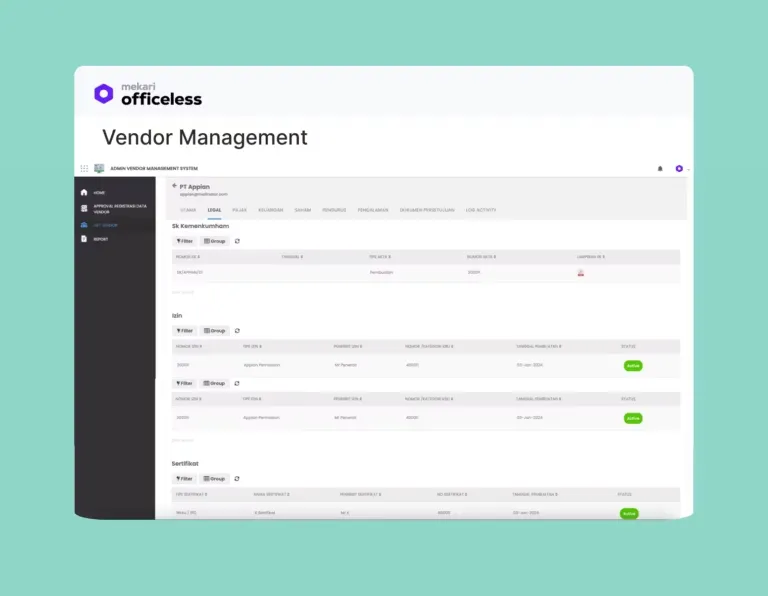
Mekari Officeless e-Procurement is a comprehensive, no-code solution that automates the entire RFx procurement lifecycle, from RFI distribution, RFP evaluation, and RFQ bidding through approval, PO creation, and supplier communication, making vendor selection faster, more transparent, and fully auditable.
Key features:
- Automated RFx distribution & response collection: Distribute RFI, RFP, RFQ with templates; collect vendor responses in one centralized portal with audit trails
- Vendor pre-qualification workflows: Automate evaluation and route qualified vendors using a centralized, status-based database
- Weighted evaluation & scoring: Run multi-criteria RFP scoring with transparent, cross-team evaluation (no spreadsheets)
- Approval routing & governance: Automate approvals across procurement, finance, legal, and operations
- Real-time visibility & collaboration: Track RFx progress, responses, and approvals via dashboards with built-in collaboration
- Seamless PO generation & integration: Auto-generate POs with pre-filled terms and connect to accounting/payment systems
Master your RFx process without the chaos. Mekari Officeless e-Procurement automates RFI distribution, RFP scoring, and RFQ bidding with transparent workflows, vendor pre-qualification, and audit-ready documentation.
Build custom procurement workflows in minutes with no coding required. Explore how to streamline your entire vendor selection process.
References
Cloud Eagle. ‘’RFI vs RFP vs RFQ: How Do They Differ?’’
Coupa. ‘’RFI vs. RFQ vs. RFP: Which Does Your Company Need?’’
Ivalua. ‘’RFI, RFP, RFQ Key Differences & Strategic Use Cases in Procurement’’