


- Most procurement inefficiencies don’t originate from poor execution — they originate from a broken connection between strategic sourcing and transactional buying. When S2C and P2P operate in silos, even the best-negotiated contracts lose value through maverick spending, invoice errors, and compliance gaps. Poor contract management alone is estimated to cost businesses $2 trillion per year globally.
- Source-to-Contract and Procure-to-Pay are not competing approaches — they are complementary halves of a complete procurement lifecycle. S2C builds the strategic foundation (qualified suppliers, favorable terms, documented contracts), while P2P executes against that foundation (controlled purchasing, verified invoices, timely payments). Organizations that integrate both can achieve procurement savings of 30–50% in purchase order and invoice costs.
- Mekari Officeless eProcurement brings both S2C and P2P capabilities into a single platform— from e-sourcing and vendor qualification through quotation management, approval workflows, and real-time spend analytics. For Indonesian enterprises managing growing supplier bases and complex procurement processes, it provides the governance and visibility needed to move from reactive buying to strategic procurement.
Procurement teams often operate in silos — with strategic sourcing decisions upstream rarely connecting smoothly to purchasing and payment processes downstream. This disconnect comes at a cost. Only 39% of business leaders say procurement is “highly coordinated” across functions like finance, legal, and compliance (Kissflow).
At the same time, the global procure-to-pay (P2P) solutions market is growing from USD 8.02 billion in 2024 to a projected USD 14.07 billion by 2033, reflecting how urgently businesses are trying to fix this gap (Kissflow).
At the center of the issue are two commonly confused frameworks: Source-to-Contract (S2C) and Procure-to-Pay (P2P). This article breaks down what each covers, how they differ, and how aligning both can drive end-to-end procurement efficiency.
What is source-to-contract (S2C)?
Source-to-contract (S2C) is the upstream, strategic phase of the procurement lifecycle. It covers everything from identifying a business need for goods or services through to selecting a supplier and signing a contract.
At this stage, no purchases have been made and no payments have occurred, the focus is entirely on setting the foundation for future transactions.
S2C typically includes four core activity areas:
- Spend analysis: Evaluating historical and current spending to identify cost-saving opportunities and improve sourcing decisions
- Supplier discovery & qualification: Identifying and assessing vendors through RFI/RFP processes based on pricing, capabilities, compliance, and reputation
- Negotiation & contract management: Defining commercial terms such as pricing, delivery timelines, SLAs, and penalties, then storing and tracking contracts for visibility
- Contract approval & compliance tracking: Routing contracts through internal approvals (legal, finance, stakeholders) and ensuring adherence to policies
At its core, S2C is about value creation and building strong supplier relationships. It is strategic in nature, focused on securing the best possible terms before any transaction takes place. S2C is also a subset of the broader Source-to-Pay (S2P) framework, which extends beyond sourcing into purchasing and payments.
What is procure-to-pay (P2P)?
Procure-to-pay (P2P) is the downstream, operational phase of procurement that begins after contracts are in place. It manages the execution of purchases, from internal request to final payment to suppliers.
The P2P cycle typically consists of five key steps:
- Requisition: Internal teams submit requests for goods or services, including specifications, quantities, and budget details
- Purchase order (PO): Approved requests are converted into formal POs and sent to vendors
- Receiving: Goods or services are delivered and verified; three-way matching is performed (PO, invoice, goods receipt)
- Invoicing: Suppliers submit invoices, which are checked against the PO and delivery records
- Payment: Accounts payable processes payment according to agreed terms, completing the transaction
The primary value of P2P lies in operational efficiency, compliance, and cost control. It standardizes purchasing processes, reduces manual work, enforces contract terms, and minimizes maverick spending.
P2P is both a subset of Source-to-Pay (S2P) and the execution phase that follows S2C. In practice, it operates within the supplier relationships and contract terms established during the S2C process.
Source to contract vs procure to pay: Key differences
While S2C and P2P are part of the same procurement lifecycle, they operate at very different stages and serve distinct purposes. The table below highlights how they compare across key dimensions:
| Dimension | Source-to-Contract (S2C) | Procure-to-Pay (P2P) |
|---|---|---|
| Process stage | Upstream / strategic | Downstream / operational |
| Starts when | Business identifies a need for goods/services | A contract with a supplier is already in place |
| Ends when | Contract is signed with selected supplier | Payment is made and reconciled with the supplier |
| Core focus | Supplier selection, negotiation, contract management | Requisitioning, purchasing, receiving, invoicing, payment |
| Nature of work | Strategic — value creation, relationship-building | Transactional — execution, compliance, efficiency |
| Key activities | Spend analysis, RFI/RFP, vendor qualification, contract negotiation | PO creation, approval workflows, three-way matching, accounts payable |
| Outcome | Signed contract with best-value supplier | Goods/services received and supplier paid on time |
| Impact on business | Determines long-term supplier strategy and cost baseline | Determines day-to-day operational efficiency and cash flow |
| Technology used | Sourcing platforms, contract lifecycle management (CLM), supplier portals | Procurement software, ERP, invoicing systems, AP automation |
| Compliance role | Ensures only qualified vendors are contracted; sets policy terms | Enforces approved supplier/contract use; prevents maverick spend |
| Relationship to S2P | Upstream half of Source-to-Pay (S2P) | Downstream half of Source-to-Pay (S2P) |
| Who owns it | Strategic sourcing team, legal, procurement leadership | Procurement team, accounts payable, finance |
Source to pay (S2P) vs procure to pay (P2P): Where does S2C fit?
To fully understand the difference, it helps to look at all three frameworks together.
- Source-to-pay (S2P) is the complete, end-to-end procurement lifecycle — from identifying needs and selecting suppliers, through contract management, to purchasing, invoicing, and final payment. It represents the full picture.
- Source-to-contract (S2C) is the upstream, strategic portion of S2P. It ends when a contract is signed — before any purchasing or financial transaction begins.
- Procure-to-pay (P2P) is the downstream, operational portion of S2P. It starts once a contract exists and runs through to supplier payment.
In simple terms:
S2P = S2C + P2P
This distinction matters in practice. Companies that only optimize P2P may improve operational efficiency, but miss out on strategic sourcing value. On the other hand, organizations that focus only on S2C may secure strong contracts, but struggle with execution — leading to issues like contract leakage or maverick spend.
Many searches for “source to pay vs procure to pay” are actually trying to understand this relationship. The key takeaway is that real procurement efficiency comes from integrating both S2C and P2P into a single, connected S2P workflow.
Business impact: What breaks when S2C and P2P are disconnected
When S2C and P2P operate in silos, the impact is immediate, and costly. What looks like a complete procurement process on paper often fails in execution.
- Contract leakage: Purchases are made without referencing negotiated contracts, causing agreed savings to disappear. Contracts exist, but aren’t enforced in actual buying
- Maverick spending: Employees buy from unauthorized vendors or outside agreed terms when P2P doesn’t enforce S2C decisions
- Visibility gaps: Sourcing teams can’t track whether contracts are followed, while finance struggles to reconcile spend against commitments
- Wasted negotiation effort: Time spent securing favorable terms is lost when downstream teams don’t execute accordingly
The scale of this problem is reflected in the data:
- Only 39% of business leaders say procurement is highly coordinated across departments (Kissflow, sourced from market research)
- Poor contract management costs businesses up to $2 trillion annually (Deloitte/DocuSign, via Concord)
- Organizations can achieve 30–50% savings in PO and invoice costs by reducing maverick spend and increasing spend under management (Focal Point)
Advantages and disadvantages of each approach
Source-to-contract (S2C)
Advantages:
- Builds strong supplier relationships and secures better contract terms upfront
- Establishes a solid cost baseline through competitive sourcing
- Improves compliance and reduces risk via structured vendor qualification
- Aligns procurement with long-term business strategy
- Enables performance tracking against contract terms
Disadvantages:
- Longer lead time before purchasing begins
- Requires upfront investment in tools and sourcing expertise
- Value depends on strong downstream execution (risk of contract leakage)
- Less effective for urgent or low-value purchases
Procure-to-pay (P2P)
Advantages:
- Improves operational efficiency, automation can cut cycle times by 40–70% (Focal Point)
- Provides real-time visibility into spend and budgets
- Enforces policy compliance and reduces unauthorized purchases
- Streamlines invoicing and payment, reducing errors and delays
- Around 60% of organizations see ROI within 12 months (Kissflow)
Disadvantages:
- Cannot fix poor supplier selection or weak contract terms
- Focuses on execution, not strategic value creation
- Limited impact on broader procurement strategy compared to S2C or full S2P
Which does your business need: S2C, P2P, or both?
The right approach depends on where your procurement function is today and what problems you need to solve first.
Start with P2P if:
- Procurement processes are manual, slow, or error-prone
- Invoice backlogs and approval bottlenecks are the main issue
- Supplier contracts already exist but purchasing is uncontrolled
- You need fast ROI and efficiency improvements
Start with S2C if:
- Supplier selection is inconsistent or purely transactional
- Contracts are missing, weak, or not enforced
- Procurement is reactive rather than strategic
- You lack visibility into spend categories and sourcing decisions
Pursue full S2P (S2C + P2P integration) if:
- Your organization is scaling and needs both control and strategy
- P2P exists, but contract leakage is eroding savings
- You want end-to-end procurement visibility and governance
Even if you begin with P2P, S2C should not be ignored. Upstream sourcing decisions directly shape downstream performance, and true procurement maturity comes from integrating both into a single, connected S2P workflow.
How Mekari Officeless supports end-to-end procurement management
Managing S2C and P2P separately often leads to the exact inefficiencies discussed earlier.
Mekari Officeless eProcurement addresses this by providing an all-in-one e-procurement solution that connects strategic sourcing and operational purchasing in a single, unified platform, helping businesses reduce costs, mitigate risks, and make more informed decisions.
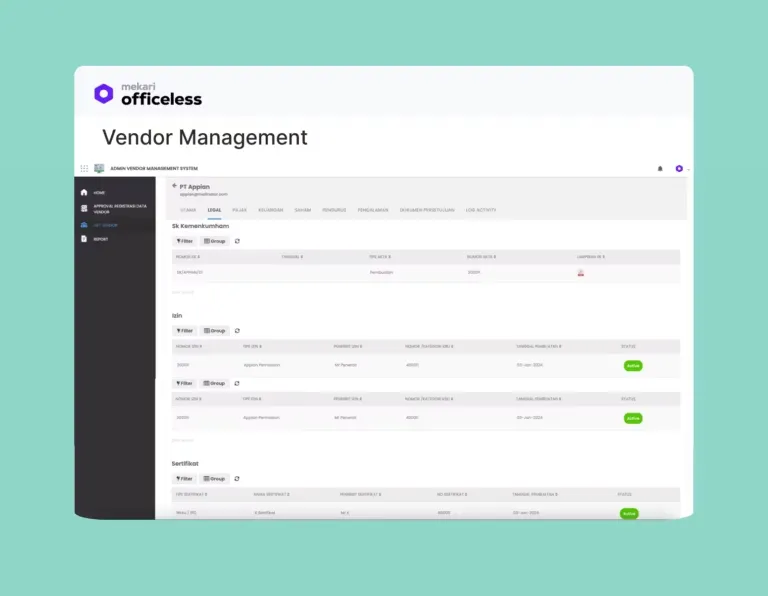
Built for Indonesian enterprises with complex procurement workflows, Mekari Officeless bridges both S2C and P2P processes through configurable, end-to-end capabilities:
- E-sourcing: Run competitive vendor bidding, collaborate with suppliers, and collect structured data to support better sourcing decisions
- Vendor management: Centralize vendor data, performance, and compliance tracking in one dashboard for more accurate evaluation and risk control
- Quotation management: Automate RFQ processes to reduce manual errors, standardize documentation, and accelerate procurement cycles
- Procure-to-pay workflows: Manage the full purchasing cycle, from requisition and approval to invoice matching and payment execution
- Contract management: Track contract status, terms, and compliance with full visibility across teams
- Reporting and analytics: Access real-time dashboards to monitor spend, supplier performance, and procurement efficiency across both S2C and P2P
With ISO 27001 certification, Mekari Officeless eProcurement is designed for enterprise-grade security, scalability, and flexibility, making it suitable for both growing businesses and large organizations.
Ready to connect your strategic sourcing and day-to-day procurement into one streamlined system? Consult with the Mekari Officeless team to see how the platform fits your procurement workflow.