


Each Bubble.io alternative has its own strengths, so the best choice depends on what your business wants to build, how technical your team is, and how much scalability or integration you need. Here is a quick summary of what each platform is best for:
- Mekari Officeless: Best for Indonesian enterprises that need to automate internal workflows, build departmental apps, manage approval processes, and gain real-time operational visibility within the Mekari unified software ecosystem.
- Adalo: Best for solo builders, entrepreneurs, and SMBs that want to launch mobile and web apps quickly without coding.
- FlutterFlow: Best for startups, product teams, designers, and technical founders who want native Flutter apps with code ownership.
- Microsoft Power Apps: Best for mid-size and large companies already using Microsoft 365, Azure, or Dynamics 365.
- Retool: Best for engineering and IT teams that need to build internal tools quickly.
- Softr: Best for teams that already use Airtable or Google Sheets and need to build portals or internal tools quickly.
- WeWeb: Best for teams building SaaS products, dashboards, CRMs, and client portals that need flexibility, code export, and less vendor lock-in.
Bubble.io has long been a go-to platform for building web apps without code, especially for startups, founders, and teams launching MVPs quickly. But as business needs grow more complex, many users start looking for alternatives with better performance, stronger scalability, more design flexibility, or greater control.
This is part of a bigger shift: 84 percent of enterprises have adopted low-code or no-code platforms to reduce IT backlogs and accelerate application delivery (Gartner via Kissflow).
In this guide, we’ll explore the 7 best Bubble.io alternatives for business, so you can choose the right platform based on your goals, budget, and technical needs.
What is Bubble.io and why do businesses look for alternatives?
Bubble.io is a no-code visual web app builder that allows users to design, build, and host web applications without writing code. Founded in 2012, Bubble has raised over $150 million and now has more than 400 employees worldwide. It is commonly used to build marketplaces, CRMs, SaaS products, internal tools, and MVP web apps.
However, many businesses start looking for Bubble.io alternatives because of these urgent limitations:
- Steep learning curve: Bubble is no-code, but its visual editor, workflow builder, and backend logic can still take weeks to master, especially for non-technical business teams.
- No source code export: Businesses are locked into Bubble’s infrastructure. If they want to migrate, they usually need to rebuild the app from scratch.
- Performance bottlenecks: Apps with complex logic, large datasets, or heavy workflows can become slower, with limited control over deeper performance optimization.
- Limited native mobile support: Bubble mainly builds responsive web apps, while publishing true native iOS or Android apps requires additional tools or workarounds.
- Design and editor limitations: Bubble’s drag-and-drop editor is useful at first, but it can feel restrictive when businesses need pixel-perfect layouts, deeper customization, or more control over how features work.
For Indonesian enterprises that need enterprise-grade workflow automation, operational apps, and business process management, these limitations can make Bubble less suitable than platforms built for scalable business operations.
Here are several recommended Bubble.io alternatives for businesses to consider:
1. Adalo
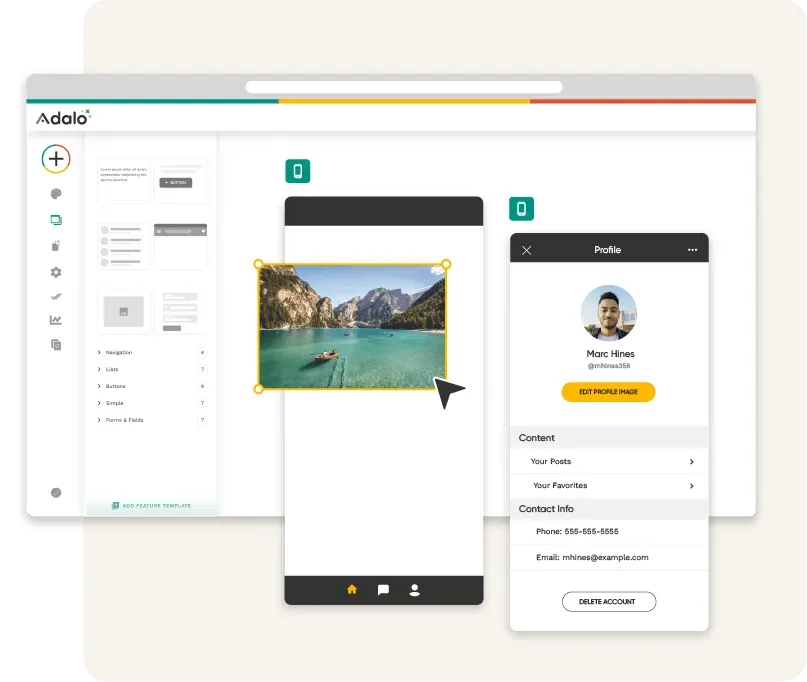
Adalo is an AI-powered no-code platform for building native iOS, Android, and web apps from one codebase. It supports direct publishing to the Apple App Store and Google Play Store, making it a strong option for mobile-first products.
Best for: Solo builders, entrepreneurs, and SMBs that want to launch mobile and web apps quickly without coding.
Key features
- AI-assisted app creation with Magic Start and Magic Add
- Cross-platform publishing for iOS, Android, and web
- Built-in database with support for Airtable, Xano, and Google Sheets
- Pre-built components, push notifications, geolocation, and Stripe integration
- Zapier integration for connecting with external tools
Limitations: Adalo offers less backend control than more technical platforms. Apps also require an internet connection, and some advanced integrations are only available on paid plans.
2. FlutterFlow
FlutterFlow is a visual app development platform built on Google’s Flutter framework. It allows users to build native mobile and web apps, export clean Dart code, and continue development outside the platform.
Best for: Startups, product teams, designers, and technical founders who want native Flutter apps with code ownership.
Key features
- Full Flutter source code export
- One-click deployment to iOS, Android, and web
- Firebase, Supabase, REST API, and GitHub integrations
- AI Copilot for generating pages and components
- Collaboration, branching, and development environments
Limitations: FlutterFlow is closer to low-code than pure no-code, so users may need some understanding of app logic, Flutter, and external backend setup.
3. Mekari Officeless
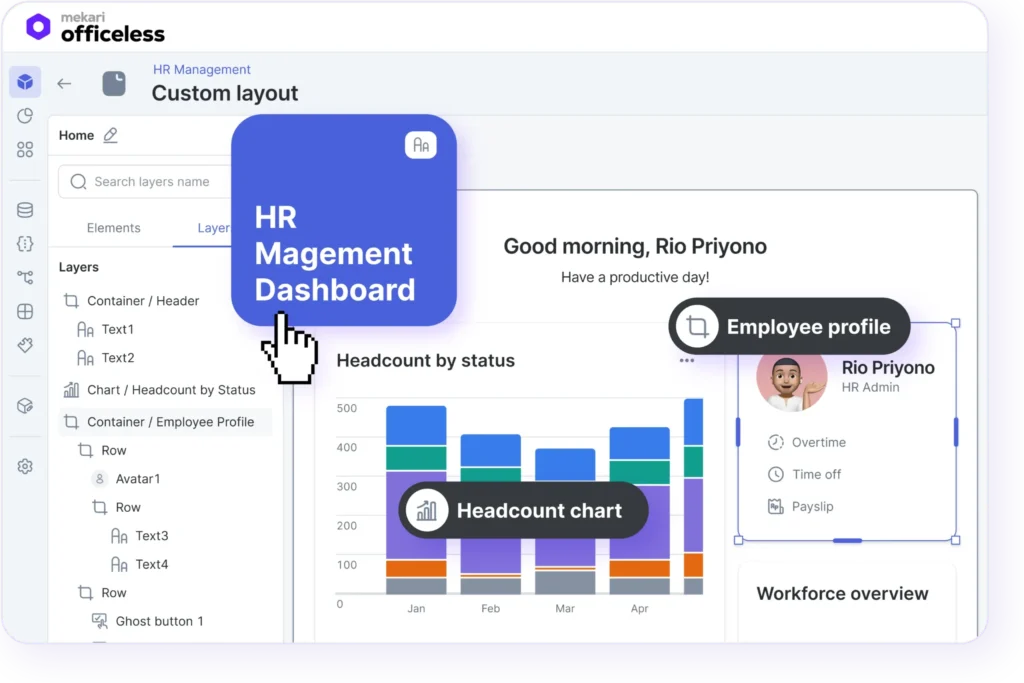
Mekari Officeless is an enterprise software development platform that accelerates business app creation, workflow automation, and analytics, all within the Mekari unified software ecosystem.
Designed specifically for mid-to-large businesses operating in Indonesia, it enables operations and IT teams to build custom business applications, automate complex multi-step processes, and generate analytics dashboards without deep coding expertise.
Best for: Indonesian enterprises that need to automate internal workflows, build departmental apps, manage approval processes, and gain real-time operational visibility, all in one platform connected to Mekari unified software ecosystem.
Key features
- No-code and low-code app builder with prebuilt templates for common enterprise use cases, such as HSE, e-procurement, facility management, and visitor management
- Visual workflow automation engine with multi-level approval routing
- Integrated analytics and data dashboard services for real-time operational insights
- Marketplace of prebuilt modules that can be deployed immediately
- Custom software and workflow services backed by Mekari’s expert team
- Seamless integration with Mekari unified software ecosystem and third-party systems via API
- Enterprise-grade security and Indonesian regulatory compliance
Why it’s better than Bubble for Indonesian enterprises: Unlike Bubble, which is designed for general SaaS and web app development, Mekari Officeless is purpose-built for enterprise operational needs, with local support, a familiar product ecosystem, and prebuilt solutions that accelerate deployment.
You get the business app creation speed of a no-code tool with the governance, scalability, and integration depth of enterprise software.
Limitations: Mekari Officeless is primarily targeted at business and enterprise operational use cases, not general consumer-facing SaaS products.
4. Microsoft Power Apps
Microsoft Power Apps is a low-code platform for building business apps within the Microsoft ecosystem. It connects easily with Dataverse, SharePoint, Microsoft 365, Dynamics 365, SQL, and Azure.
Best for: Mid-size and large companies already using Microsoft 365, Azure, or Dynamics 365.
Key features
- Built-in AI agents and AI Builder
- PowerFx for app logic and customization
- Hundreds of data connectors
- Integration with Teams, SharePoint, Power Automate, and Power BI
- Offline capability and enterprise governance
Limitations: Power Apps works best inside the Microsoft ecosystem. Advanced use cases may require additional tools, licensing, and technical configuration.
5. Retool
Retool is a low-code platform for building internal tools, dashboards, admin panels, and data-heavy business apps. It combines a drag-and-drop UI editor with code, APIs, and database integrations.
Best for: Engineering and IT teams that need to build internal tools quickly.
Key features
- 100+ UI components
- 40+ native database connectors
- SQL, REST API, GraphQL, and JavaScript support
- Workflow automation with webhooks, cron jobs, and app events
- Git sync, self-hosting, SSO, and enterprise security options
Limitations: Retool is not ideal for non-technical teams because it often requires knowledge of databases, APIs, and JavaScript.
6. Softr
Softr is a no-code platform for building business apps, client portals, internal tools, CRMs, dashboards, and forms. It works well with data sources like Airtable, Google Sheets, HubSpot, Notion, and SQL databases.
Best for: Teams that already use Airtable or Google Sheets and need to build portals or internal tools quickly.
Key features
- Real-time integrations with 15+ data sources
- Native database
- AI Co-Builder and custom interface tools
- User permissions, role-based access, and built-in authentication
- SOC 2 Type 2 certification
Limitations: Softr is web-only and does not publish native iOS or Android apps. It is also less suitable for complex workflows or full consumer-facing SaaS products.
7. WeWeb
WeWeb is a full-stack no-code platform for building web apps with exportable Vue.js code. It supports its own backend, WeWeb Tables, while also integrating with tools like Supabase, Xano, Airtable, Firebase, REST APIs, and GraphQL.
Best for: Teams building SaaS products, dashboards, CRMs, and client portals that need flexibility, code export, and less vendor lock-in.
Key features
- Full Vue.js source code export
- Self-hosting support
- Native backend with WeWeb Tables
- Integrations with Supabase, Xano, Firebase, Airtable, REST APIs, and GraphQL
- AI-powered component builder and GitHub sync
Limitations: WeWeb has a steeper learning curve than simpler drag-and-drop builders. It is also less ideal for SEO-heavy public websites because its apps are client-side rendered.
Why Mekari Officeless is the best Bubble.io alternative for Indonesian enterprises
Bubble.io is a strong general-purpose web app builder, especially for startups, indie developers, and teams that want to launch MVPs quickly. However, Indonesian enterprises often need more than a flexible visual builder.
Mekari Officeless is a platform that can support business app creation, operational workflow automation, analytics, and long-term scalability within a trusted software ecosystem.
Mekari Officeless is best for:
- Enterprises that want to build custom internal apps, from HSE management systems and e-procurement portals to visitor management and workplace operations tools, without spending months on custom development.
- Operations and IT teams that need to automate multi-step workflows across departments, including approval processes, task routing, and operational coordination.
- Finance and management teams that need real-time analytics dashboards to monitor operational KPIs and make faster business decisions.
- Companies already using Mekari products, such as Mekari Expense, Mekari HR, or Mekari Jurnal, that want a unified software ecosystem to support scalable growth.
Unlike Bubble, Mekari Officeless is not just a visual app builder. It is part of a broader enterprise software platform that includes custom software services, workflow services, and analytics services, supported by Mekari’s local expert team that understands Indonesian business needs and regulations.
Explore Mekari Officeless.
References and methodology
Methodology
Methodology
Articles published by Mekari Officeless are developed using trusted sources, including official data, company reports, academic research, and insights from industry practitioners. Whenever possible, we refer directly to primary sources before drawing conclusions. Our editorial team reviews and verifies the information to ensure accuracy and relevance. All references are listed so readers can trace each piece of information back to its original source.
Our editorial standards
Our editorial standards
- Primary source first: We consult official product documentation and pricing pages directly, not secondhand summaries or aggregator sites.
- Fact-checking: All product features, pricing, and claims are cross-verified against each platform’s official website at the time of writing.
- No paid placement: Tools are selected based on relevance and fit for Indonesian businesses, not commercial arrangements. Mekari Officeless is included as a first-party product and is transparently labeled as such.
- Regular review: Articles are periodically updated to reflect product changes or shifts in market relevance.
References
References
Bubble.io. ‘’No Code App Builder’’