


Each procurement platform offers different strengths depending on your company size, operational complexity, compliance needs, and procurement goals. Here are five standout platforms from the list:
- Mekari Officeless E-Procurement Prebuilt Software is the strongest choice for Indonesian enterprises that need end-to-end source-to-pay workflows, local compliance support, procurement governance, and integration with finance, tax, and operational systems.
- Coupa is ideal for enterprises focused on centralized spend management, procurement compliance, and real-time spending visibility across global teams.
- GEP SMART stands out for global organizations needing AI-powered source-to-pay capabilities, advanced sourcing workflows, and enterprise-scale procurement optimization.
- Kissflow Procurement Cloud is a strong option for SMEs and growing businesses looking for flexible no-code procurement workflows with faster deployment.
- Procurify works well for mid-market companies that prioritize mobile procurement adoption, real-time spend visibility, and easy-to-use purchasing workflows.
Modern procurement no longer needs to happen behind a desk. A mobile procurement platform allows businesses to manage purchasing workflows directly from a smartphone or tablet, helping teams stay productive wherever they are.
Mobile procurement typically includes features such as:
- Submitting and tracking purchase requisitions from a phone
- Approving or rejecting purchase orders with one tap
- Receiving real-time notifications for pending actions
- Scanning receipts and invoices using mobile OCR
- Monitoring live spend and budget utilization
- Communicating with vendors through supplier portals
While some platforms are truly mobile-first and designed for seamless on-the-go use, others simply adapt desktop systems into smaller screens. In this article, we’ve rounded up the top mobile procurement platforms to help simplify your workflow.
Disclaimer: This list is arranged alphabetically and does not indicate ranking or preference.
1. Basware
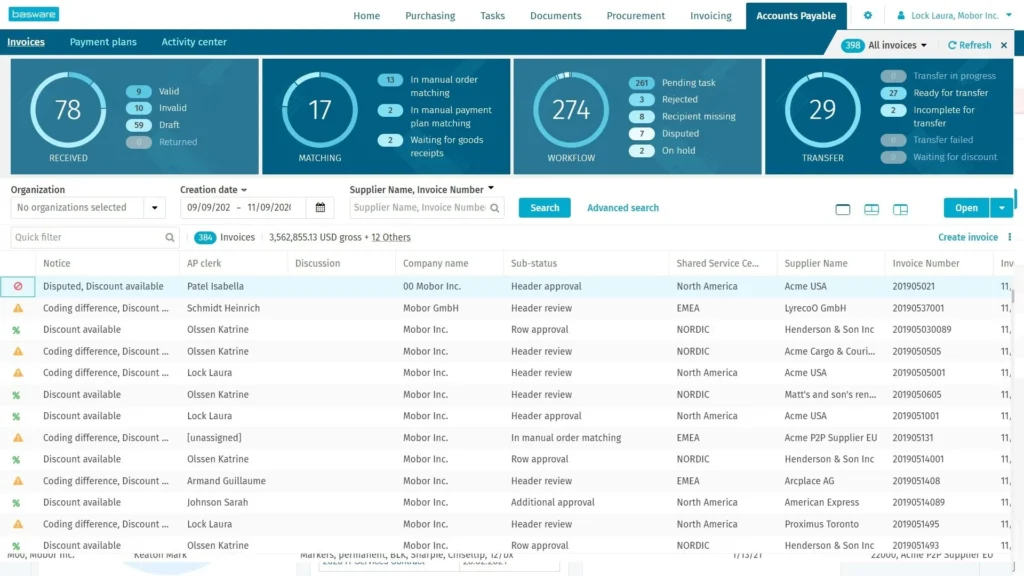
Basware is a procurement and accounts payable automation platform known for its strong e-invoicing and procure-to-pay capabilities. The platform is widely used by multinational companies that need to manage complex cross-border invoice compliance requirements.
Best for: Large enterprises with high invoice volumes, complex AP automation needs, and global procurement operations.
Key features:
- Mobile invoice approval and purchase order tracking
- Expense management directly from mobile devices
- Strong global e-invoicing compliance support
- Procure-to-pay workflow automation
- Enterprise-grade AP management capabilities
Limitations:
- Better suited for large enterprises than SMBs
- Can feel complex for teams with simpler procurement needs
2. Coupa
Coupa is a cloud-based Business Spend Management (BSM) platform that combines procurement, invoicing, expense management, and supplier management into a unified system.
Best for: Mid-to-large enterprises prioritizing spend visibility, compliance, and centralized procurement management.
Key features:
- Mobile requisition and PO approval workflows
- Receipt capture from mobile devices
- Real-time spend dashboards and analytics
- Supplier collaboration and vendor communication tools
- Policy-compliant purchasing guidance
Limitations:
- Can be expensive for smaller businesses
- Initial implementation may require significant onboarding
3. Fraxion
Fraxion is a mobile-first procurement platform focused on real-time budget control and purchasing governance without the complexity of traditional enterprise systems.
Best for: Mid-market companies looking for strong spend controls with faster implementation.
Key features:
- Mobile-first approval workflows
- Real-time budget validation during approvals
- Mobile purchase order management
- Integration with over 50 ERP and accounting systems
- Spend visibility and procurement governance tools
Limitations:
- Less suitable for highly complex enterprise procurement ecosystems
- Smaller ecosystem compared to larger procurement vendors
4. GEP SMART
GEP SMART is an AI-powered source-to-pay platform built on Microsoft Azure that supports procurement workflows from sourcing through payment.
Best for: Global enterprises requiring end-to-end source-to-pay management with AI-driven procurement optimization.
Key features:
- Full source-to-pay functionality on iOS and Android
- Mobile sourcing event and RFQ participation
- Supplier management and collaboration tools
- AI-powered spend analytics and cost-saving insights
- Cloud-native procurement infrastructure
Limitations:
- Better suited for large enterprises than smaller teams
- Advanced functionality may require longer implementation cycles
5. Ivalua
Ivalua is an enterprise-grade source-to-pay suite covering sourcing, contracts, supplier management, and AP automation with AI-powered procurement capabilities.
Best for: Enterprises with global procurement operations and complex sourcing requirements.
Key features:
- Mobile requisition and approval management
- Supplier collaboration and document exchange
- Mobile contract review and renewal tracking
- AI-powered sourcing and contract assistance
- End-to-end procurement lifecycle management
Limitations:
- Enterprise-focused pricing and implementation complexity
- May be excessive for smaller procurement teams
6. JAGGAER
JAGGAER is an enterprise procurement platform known for its strong sourcing and supplier management capabilities, especially in regulated industries.
Best for: Enterprises in healthcare, education, manufacturing, and public sector procurement.
Key features:
- Mobile requisition and approval workflows
- Supplier management and qualification tracking
- Mobile sourcing event access
- Procurement compliance tools
- Strong direct and indirect spend management
Limitations:
- Better suited for enterprise procurement environments
- Setup and customization may require dedicated support
7. Kissflow Procurement Cloud
Kissflow Procurement Cloud is a low-code procurement platform focused on customizable workflows and fast deployment without requiring extensive developer involvement.
Best for: SMEs and growing businesses looking for flexible procurement workflows with minimal IT dependency.
Key features:
- Mobile PO approvals and requisition submission
- Vendor onboarding workflows
- No-code configurable approval processes
- Drag-and-drop workflow builder
- Flexible procurement automation setup
Limitations:
- Less suited for highly complex enterprise procurement ecosystems
- Advanced customizations may still require technical expertise
8. Mekari Officeless E-Procurement
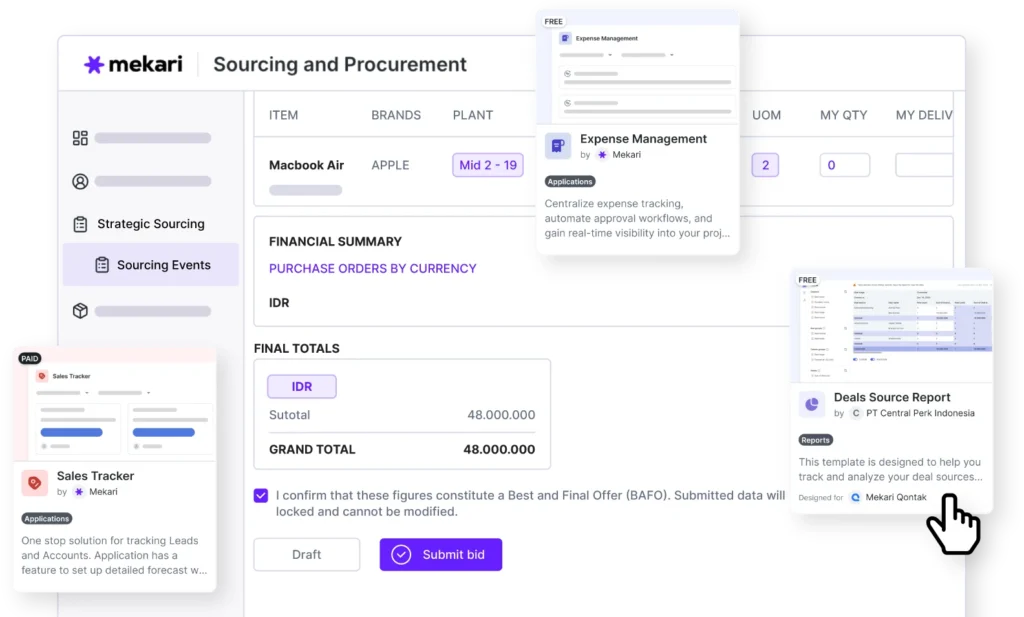
Mekari Officeless E-Procurement Prebuilt Software is an enterprise-grade source-to-pay (S2P) platform designed to help Indonesian businesses manage procurement, vendor governance, sourcing, contracts, purchasing, and spend analysis within a single ecosystem.
Best for: Indonesian mid-to-large enterprises that need scalable procurement governance, workflow automation, and compliance-ready procurement operations.
Key features:
- Vendor lifecycle management including onboarding, compliance monitoring, risk assessment, and performance evaluation
- End-to-end sourcing and contract management covering RFx events, vendor evaluation, contract drafting, and clause libraries
- Full procure-to-pay workflows from purchase requisition, PO management, goods receipt, and invoice handling to automated 3-way matching
- Real-time spend analytics for procurement visibility, savings analysis, and maverick spend detection
- Flexible master data and organizational configuration with integration into the broader Mekari ecosystem
Why it stands out for Indonesian companies:
Unlike lightweight procurement tools focused only on approvals and purchasing, Mekari Officeless provides a complete procurement infrastructure built for enterprise governance, operational control, and Indonesian business requirements.
Limitations: Better suited for structured enterprise procurement than lightweight SMB purchasing workflows
9. Precoro
Precoro is a cloud procurement platform designed for mid-market businesses that want simple deployment and an intuitive purchasing experience.
Best for: Mid-market companies looking for easy-to-use procurement software with fast onboarding.
Key features:
- Mobile requisitions and invoice tracking
- Configurable multi-level approval workflows
- Vendor management tools
- User-friendly procurement interface
- Fast implementation process
Limitations:
- Less suitable for highly customized enterprise procurement operations
- Advanced sourcing capabilities are relatively limited
10. ProcureDesk
ProcureDesk is a cloud procurement platform offering PO management, invoice automation, and spend reporting for mid-sized businesses.
Best for: Mid-market companies seeking enterprise-style procure-to-pay functionality without complex implementation.
Key features:
- Mobile PO creation and approval
- Goods receipt confirmation via mobile
- Budget tracking and invoice management
- Spend reporting and procurement visibility
- Responsive customer support
Limitations:
- Less suitable for global enterprise procurement complexity
- Limited advanced sourcing functionality
11. Procurify
Procurify is a procure-to-pay platform focused on real-time spend visibility and intuitive purchasing workflows.
Best for: Growing companies that need better spend visibility and easy procurement adoption across teams.
Key features:
- Mobile purchase requests with product catalogs
- Mobile approvals and delivery confirmation
- Real-time committed spend visibility
- Contract and vendor management tools
- User-friendly interface for non-procurement teams
Limitations:
- More focused on spend visibility than complex sourcing operations
- Enterprise customization options are more limited compared to larger platforms
12. Tradogram
Tradogram is a cloud-based procurement platform designed for SMBs transitioning from spreadsheet-based procurement processes.
Best for: Small and mid-sized businesses looking for affordable procurement software with straightforward functionality.
Key features:
- Mobile PO management and RFQ creation
- Supplier collaboration tools
- Mobile spend tracking dashboards
- Easy-to-use procurement workflows
- Cost-effective deployment
Limitations:
- Less suitable for enterprise-scale procurement complexity
- Limited advanced automation capabilities
13. Vroozi
Vroozi is a mobile-first procurement platform designed to simplify compliant purchasing through a consumer-style buying experience.
Best for: Mid-market and enterprise organizations looking to reduce maverick spending and improve procurement adoption.
Key features:
- Marketplace-style mobile catalog browsing
- Mobile purchase requests and order tracking
- Mobile approvals with ERP integration
- Supplier collaboration features
- Consumer-style procurement experience
Limitations:
- Better optimized for purchasing experience than deep sourcing functionality
- May require ERP integration for full operational visibility
Why mobile access is now essential for procurement teams
Mobile procurement is now essential for businesses that need faster approvals, better spend visibility, and smoother operations across multiple locations.
- Faster approvals: Mobile access allows managers to approve purchase requests instantly without waiting to return to their desks, reducing approval delays significantly.
- Better support for field operations: Warehouse teams, site engineers, and regional offices can submit requests, upload photos, change image sizes, and check inventory directly from mobile devices.
- Real-time spend visibility: Finance and procurement teams can monitor spending through mobile dashboards and notifications, helping prevent budget overruns earlier.
- Quicker supplier communication: Teams can resolve delivery issues, order changes, and invoice questions faster through centralized mobile communication.
- Higher user adoption: Easy mobile workflows encourage employees to follow procurement processes instead of relying on emails, chats, or manual requests.
How to choose the right mobile procurement platform for your business
Choosing the right procurement platform depends on more than just features. Businesses should evaluate how well the platform fits their operational structure, approval complexity, and long-term procurement goals.
Step 1. Define your primary procurement challenge
Start by identifying your main operational problem.
- If approval delays are the biggest issue, prioritize strong mobile approval workflows
- If field operations are your focus, look for mobile requisition and inventory features
- If spend visibility is the priority, evaluate analytics dashboards and reporting capabilities
Your main procurement bottleneck should guide your platform selection.
Step 2. Match the platform to your company size
Different procurement platforms are built for different levels of operational complexity.
- Large enterprises may need platforms like Coupa or GEP SMART for complex sourcing and multi-entity approvals
- Mid-market businesses often find strong value in tools like Procurify, Precoro, or ProcureDesk
- SMBs may prefer simpler and faster-to-deploy solutions like Kissflow or Tradogram
Step 3. Verify Indonesian regulatory compatibility
For Indonesian businesses, local compliance support is critical.
Evaluate whether the platform supports:
- NPWP-based vendor verification
- e-Faktur integration
- e-Meterai support for digital agreements
- Local payment and tax workflows
Step 4. Confirm ERP and accounting integrations
Your procurement platform should integrate directly with your financial systems, not operate in isolation.
Check whether the platform supports bidirectional integration with other systems. Strong integrations reduce duplicate data entry and improve financial visibility across procurement operations.
Step 5. Test the actual mobile experience
Before making a decision, request a mobile-specific product demo instead of only reviewing the desktop interface.
Ask vendors to demonstrate:
- Approval flows from a manager’s smartphone
- Purchase request submission from field devices
- Spend dashboards from tablets or mobile apps
If the mobile experience feels secondary, user adoption may become a problem later.
Step 6. Evaluate security and audit capabilities
Procurement systems handle sensitive operational and financial data, so security and traceability are essential.
Look for platforms that support:
- Multi-factor authentication
- Role-based access control
- Full digital audit trails
- Approval history tracking
- Enterprise-grade security certifications
These capabilities help businesses maintain procurement governance and simplify audit processes.
Why Mekari Officeless is the best mobile procurement platform for Indonesian companies
For Indonesian businesses, many global procurement platforms require additional customization to support local compliance, operational structures, and business workflows.
Mekari Officeless is built specifically for this environment, combining mobile procurement platform capabilities with Indonesia-focused business integrations and enterprise workflow management.
Key advantages include:
- Local compliance support including NPWP-based vendor verification, e-Faktur integration via Mekari Klikpajak, and e-Meterai digital contracts through Mekari Sign
- Native integration with the Mekari ecosystem including Mekari Jurnal, Mekari Expense, Mekari Sign, and Mekari Klikpajak
- No-code and low-code workflow configuration for approvals, vendor management, and procurement processes without heavy developer dependency
- Multi-entity support for managing branches, subsidiaries, and centralized procurement visibility
- ISO 27001-certified security and local implementation support for Indonesian procurement operations
For companies looking to modernize procurement beyond basic approval workflows, Mekari Officeless provides a more complete and locally optimized solution for mobile procurement management.
Ready to explore how Mekari Officeless E-Procurement Prebuilt Software fits your procurement workflow?
References and methodology
Methodology
Methodology
Articles published by Mekari Officeless are developed using trusted sources, including official data, company reports, academic research, and insights from industry practitioners. Whenever possible, we refer directly to primary sources before drawing conclusions. Our editorial team reviews and verifies the information to ensure accuracy and relevance. All references are listed so readers can trace each piece of information back to its original source.
Our editorial standards
Our editorial standards
- Primary source first: We consult official product documentation and pricing pages directly, not secondhand summaries or aggregator sites.
- Fact-checking: All product features, pricing, and claims are cross-verified against each platform’s official website at the time of writing.
- No paid placement: Tools are selected based on relevance and fit for Indonesian businesses, not commercial arrangements. Mekari Officeless is included as a first-party product and is transparently labeled as such.
- Regular review: Articles are periodically updated to reflect product changes or shifts in market relevance.
References
References
Vroozi. ‘’Best Procurement Software for 2024’’