


- Physical asset management is the strategic discipline of maximizing the operational value and financial return of every tangible asset an organization owns, from the moment of acquisition through final disposal.
- Physical assets include any tangible resource an organization owns and depends on to operate, from machinery and vehicles to buildings, IT hardware, and infrastructure.
- Mekari Officeless enables enterprises to build a custom physical asset management system tailored to their actual workflows and asset types.
Poor asset visibility is expensive, and most organizations only discover how expensive when something breaks down or an audit surfaces the gap.
McKinsey finds that maintenance-related tasks can represent 20 to 60 percent of total operational expenditure, depending on industry and asset type.
Physical asset management is the discipline that closes that gap. This framework gives enterprises a systematic way to track, maintain, and make decisions about every tangible asset they own, across its full lifecycle.
This article covers the fundamentals, common failure points, and what it takes to get asset management right at scale.
What Is Physical Asset Management?
Physical asset management is the systematic process of overseeing an organization’s tangible assets across their entire lifecycle, from acquisition to disposal.
The goal is to maximize the value each asset delivers while keeping the costs and risks of ownership under control.
This discipline spans the full range of any physical resources an organization depends on to operate, such as machinery, equipment, vehicles, buildings, infrastructure.
Managing them well goes beyond scheduling maintenance. It requires visibility, structure, and a consistent approach across every stage of an asset’s working life.
It is also worth distinguishing physical asset management from two disciplines it is often confused with:
| Aspect | Physical Asset Management | Financial Asset Management | Inventory Management |
|---|---|---|---|
| Focus | Performance and longevity of tangible assets | Portfolios, investments, and capital returns | Stock levels and goods movement |
| Primary concern | Reliability, maintenance, and lifecycle value | Returns, risk, and capital allocation | Availability and turnover of goods |
| Typical users | Operations, maintenance, and facilities teams | Finance and investment teams | Supply chain and warehouse teams |
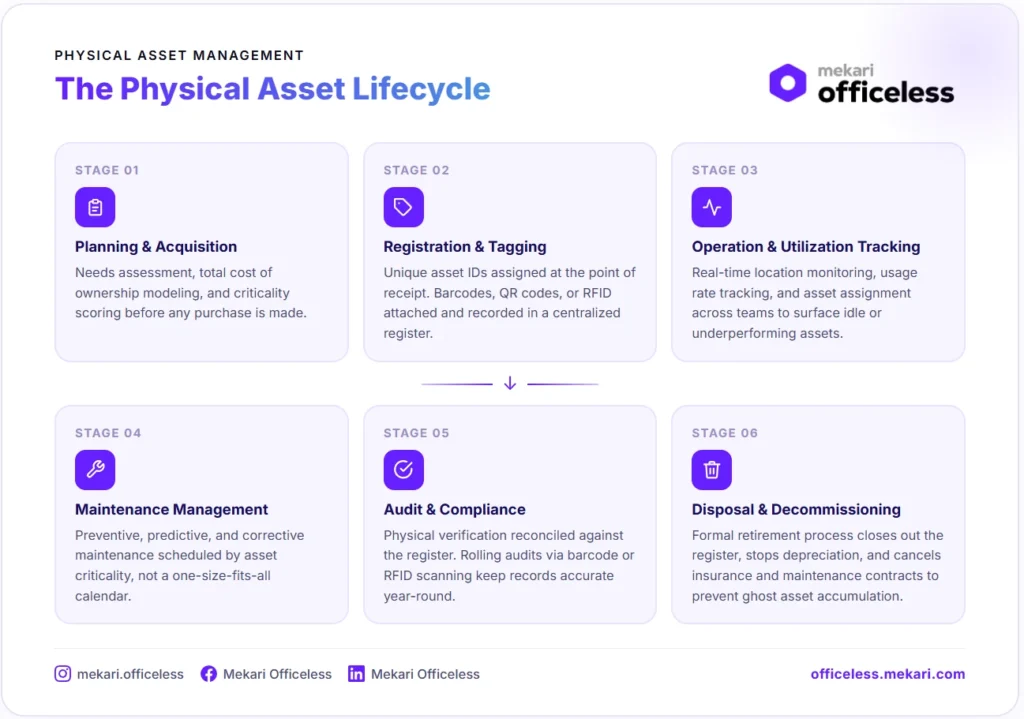
In practice, physical asset management spans six connected stages:
- Planning and acquisition: Needs assessment, total cost of ownership modeling, and procurement decisions.
- Registration and tagging: Assigning unique asset IDs, barcodes or RFID labels, and building a centralized register from day one.
- Operation and utilization tracking: Monitoring real-time location, usage rates, and asset assignment across teams.
- Maintenance management: Scheduling and executing preventive, predictive, and corrective maintenance.
- Audit and compliance: Physical verification, reconciliation against the register, and regulatory reporting.
- Disposal and decommissioning: Formally retiring assets to prevent ghost asset accumulation.
Each stage feeds into the next. Gaps in registration create visibility problems that compound into compliance failures later on.
The governing framework for this discipline is ISO 55000, the international standard that defines the principles and requirements organizations should follow when managing assets across their full lifecycle.
Why Physical Asset Management Breaks Down in Practice
Most enterprises invest in asset management processes at some point. The problem is rarely the intention.
It is the execution gap between what organizations think they know about their assets and what is actually true.
Three structural failures drive most of this gap, including:
1. Asset Data Lives in Silos
Procurement records sit in one system, maintenance logs in another, and finance tracks depreciation separately. No single team has a complete picture.
When data does not flow between systems, the consequences compound quietly:
- Duplicate purchases: Teams buy equipment that already exists somewhere in the organization because no one can see what is already owned.
- Missed maintenance: Assets fall off maintenance schedules when they are not visible in the right system at the right time.
- Inaccurate financial reporting: Depreciation records drift out of sync with operational reality, creating discrepancies that surface only at audit.
The result is an organization that is managing several partial views of its asset base rather than one accurate picture.
2. Ghost Assets Drain Resources Without Anyone Noticing
A ghost asset is any item still listed as active on the fixed asset register that no longer physically exists. It has been lost, stolen, scrapped, or decommissioned without anyone updating the record.
According to Kroll Advisory, between 10 and 30 percent of the average company’s fixed asset register consists of ghost assets. These assets continue to:
- Depreciate on the books, overstating asset value and distorting financial statements
- Accumulate insurance premiums based on declared asset values that no longer reflect reality
- Remain on active maintenance contracts, generating cost with zero operational return
- Inflate tax liabilities on assets the organization no longer owns
The problem compounds over time. Ghost assets typically remain on a company’s ledger for years before anyone discovers them, and by then the financial write-off hits all at once.
3. Reactive Maintenance Compounds the Cost
When organizations lack visibility into asset conditions, they default to fixing things after they break.
McKinsey research shows that only 51% of maintenance activities are preventive at surveyed organizations, leaving nearly half as reactive response.
That imbalance is expensive. Reactive maintenance consistently costs more than planned intervention because it adds:
- Emergency labor at overtime rates
- Expedited parts procurement at premium pricing
- Unplanned production downtime with cascading operational impact
- Collateral damage from failures that could have been caught earlier
The deeper issue connecting all three failures is a data problem, not a maintenance problem.
Organizations lose control of their assets because the systems meant to track and manage them were not built to connect, and the data inside them was never treated as a strategic resource.
The Physical Asset Lifecycle: What Good Management Looks Like at Each Stage
Effective physical asset management is not a single process. It is a chain of decisions and actions that starts before an asset is purchased and ends only after it is formally retired.
Each stage feeds into the next, and gaps at any point create problems that are harder and more expensive to fix later.
1. Planning and Acquisition
Good asset management begins before the purchase order is raised.
Organizations that skip this stage often end up with assets that are mismatched to operational needs, over-specified, or duplicative of what already exists elsewhere.
Key decisions at this stage include:
- Needs assessment: Defining what the asset needs to do, for how long, and under what conditions before evaluating options.
- Total cost of ownership modeling: Looking beyond the purchase price to factor in installation, training, maintenance, and eventual disposal costs.
- Asset criticality scoring: Ranking the asset by its operational importance, so maintenance and replacement decisions later on are proportionate to the risk of failure.
2. Registration and Tagging
The moment an asset enters the organization, it needs a unique identity.
This is where most ghost asset problems begin: assets that are received but never properly registered drift out of the record almost immediately.
Best practice at this stage means:
- Assigning a unique asset ID at the point of receipt, not weeks later
- Attaching a physical tag such as a barcode, QR code, or RFID label
- Recording the asset in a centralized register with location, owner, condition, and purchase details
A register that starts incomplete never catches up.
3. Operation and Utilization Tracking
Once an asset is in use, the question shifts from what it is to how it is performing.
Utilization tracking answers whether assets are being used, by whom, and whether they are delivering the value the organization expected.
This matters for two reasons. Underutilized assets lock up capital that could be deployed elsewhere.
Another reason is that assets with no assigned owner tend to disappear from records entirely, which is how zombie assets form alongside ghost ones.
4. Maintenance Management
Maintenance strategy should follow asset criticality, not a one-size-fits-all schedule. The three approaches each serve a different purpose:
- Preventive maintenance: Scheduled interventions based on time or usage intervals. Reliable and cost-effective for most assets.
- Predictive maintenance: Condition-based monitoring that triggers maintenance only when data indicates degradation, rather than on a fixed schedule.
- Reactive maintenance: Appropriate only for low-criticality assets where run-to-failure is the most economical choice, not as a default for the entire asset base.
According to McKinsey, organizations that shift to digital maintenance approaches can increase asset availability by 5 to 15 percent and reduce maintenance costs by 18 to 25 percent.
The gap between a reactive and a predictive approach is not just operational. It is financial.
Organizations that default to reactive maintenance consistently spend more per repair, face longer downtime windows, and carry higher risk of cascading failures across dependent systems.
5. Audit and Compliance
A physical audit reconciles what the register says against what actually exists on the ground.
Most organizations do this annually at best, which means the register can drift for months before discrepancies are caught.
More mature programs run continuous or rolling audits using barcode scanning or RFID to update records in real time rather than waiting for a scheduled count.
6. Disposal and Decommissioning
An asset’s retirement is as important as its registration. When assets are scrapped, sold, or transferred without a corresponding update to the register, they become ghost assets immediately.
A formal decommissioning process closes the loop: the register is updated, depreciation stops, insurance is adjusted, and maintenance contracts are cancelled.
This stage is where most organizations lose discipline, and where ghost asset accumulation quietly begins again.
Key Strategies for Effective Physical Asset Management
The most effective asset management programs share one underlying principle. They treat asset data as a strategic resource, not an administrative byproduct.
Organizations that get this right do not necessarily have more assets, bigger budgets, or larger maintenance teams.
They have better information, and they have built systems that make that information reliable, accessible, and actionable.
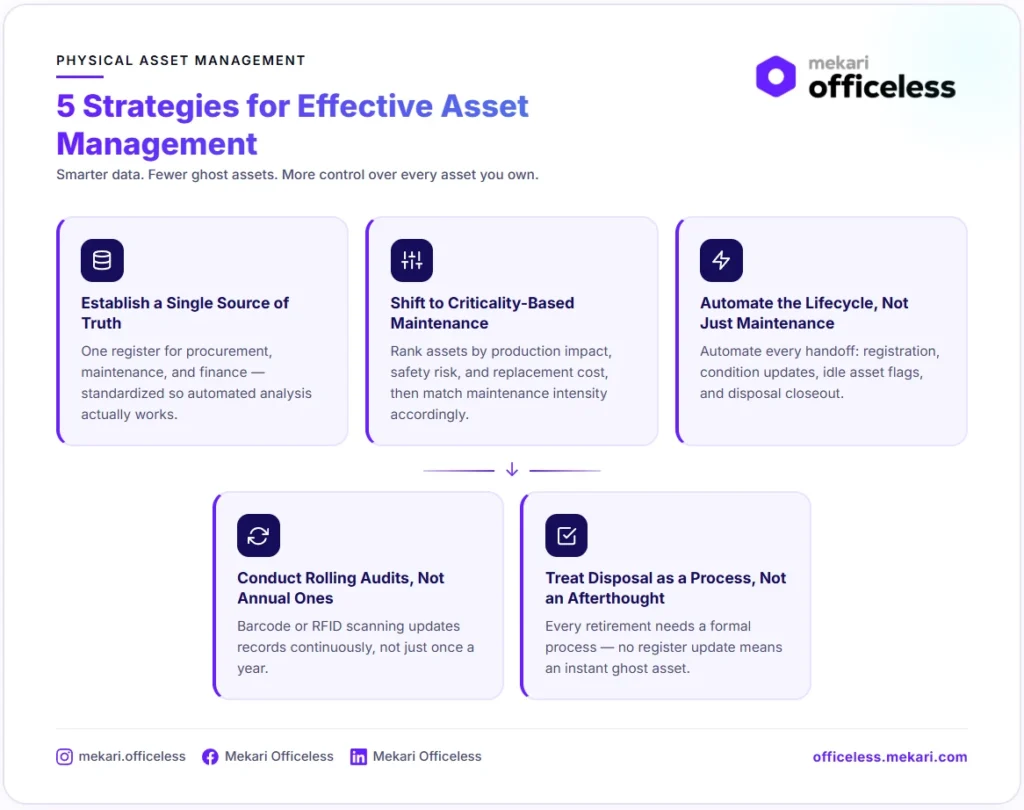
1. Establish a Single Source of Truth
Most asset lifecycle management problems trace back to one root cause where no one has a complete, accurate view of what is owned, where it is, and what condition it is in.
Procurement sees one version, finance sees another, and operations works from a third.
A centralized asset register that pulls from all departments eliminates this reconciliation burden.
Standardizing how assets are named and categorized matters just as much, since inconsistent records undermine analysis even when the data exists.
2. Shift from Time-Based to Criticality-Based Maintenance
Most organizations apply maintenance schedules uniformly, treating a critical production line the same as a low-value piece of office equipment.
A criticality-based approach ranks every asset by what actually matters:
- Production impact: How significantly does failure affect output or service delivery?
- Safety and compliance risk: Could failure create regulatory exposure or endanger people?
- Replacement cost and lead time: How long and how expensive is recovery if the asset fails?
Assets in the highest criticality tier justify predictive monitoring and proactive investment.
Assets in the lowest tier can often run to failure without meaningful consequence.
3. Automate the Lifecycle, Not Just the Maintenance
Most automation efforts focus narrowly on maintenance scheduling. The larger opportunity is automating the handoffs between lifecycle stages:
- Asset received triggers registration in the centralized system
- Maintenance event automatically updates condition record
- Utilization falling below threshold flags the asset for review or redeployment
- Disposal decision closes out depreciation, insurance, and maintenance contracts
Organizations that automate these transitions reduce the manual intervention points where data goes stale and ghost assets accumulate.
This requires a system flexible enough to reflect the organization’s actual processes, not a generic workflow that forces teams to work around it.
4. Conduct Rolling Audits, Not Annual Ones
Annual audits create a structural problem where the register can be wrong for up to twelve months before anyone checks.
Rolling audits supported by barcode scanning or RFID close this gap, updating records continuously rather than in a single annual event.
5. Treat Disposal as a Process, Not an Afterthought
Equipment gets scrapped, sold, or transferred informally all the time, with no update to the register, insurance policy, or depreciation schedule.
A formal decommissioning process with defined steps and assigned ownership directly prevents the ghost asset accumulation that undermines everything upstream.
It costs almost nothing to implement and delivers outsized returns on data quality.
When Generic Asset Management Tools Are No Longer Enough
Most enterprises start with spreadsheets or a basic Computerized Maintenance Management System (CMMS).
For a while, it works. The problems surface as the organization grows.
Off-the-shelf Enterprise Asset Management (EAM) Software and CMMS platforms handle standard workflows well. They break down when:
- Asset types across departments are too heterogeneous for a single default configuration
- Maintenance workflows do not match what the system assumes as standard
- Integration with existing ERP and finance systems requires more than a prebuilt connector can offer
- Teams build workarounds, data drifts back into spreadsheets, and the system becomes something people report into rather than something that runs the process
What organizations need at this stage is not a better off-the-shelf tool. They need a system built around their actual asset types, workflows, and data structure — one that can extend as operational needs evolve.
Build Your Physical Asset Management System with Mekari Officeless
Mekari Officeless is an enterprise software development platform that enables organizations to build, automate, and integrate internal applications tailored to their unique operational needs.
Rather than adapting processes to fit a vendor’s assumptions, enterprises can develop systems that reflect how they actually work.
For physical asset management, this means building exactly what the asset lifecycle requires. Mekari Officeless supports this through two paths:
- Custom software development service: Mekari Officeless’s expert team builds tailored enterprise software end-to-end, from asset registration and maintenance workflows to audit automation and disposal tracking, without the organization needing to manage the technical complexity.
- Platform as a Service: For teams that want to build and iterate independently, the low-code platform enables both technical and non-technical users to develop, automate, and integrate internal applications rapidly.
Both paths deliver the same outcome: a physical asset management system built around the organization’s actual asset types, workflows, and data structure, not a generic template that requires constant workarounds.
Explore Mekari Officeless’s custom enterprise software development to see how enterprises are building asset management systems that actually keep up with their operations.
References and methodology
Methodology
Methodology
Articles published by Mekari Officeless are developed using trusted sources, including official data, company reports, academic research, and insights from industry practitioners. Whenever possible, we refer directly to primary sources before drawing conclusions. Our editorial team reviews and verifies the information to ensure accuracy and relevance. All references are listed so readers can trace each piece of information back to its original source.
Our editorial standards
Our editorial standards
- Primary source first: We consult official product documentation and pricing pages directly, not secondhand summaries or aggregator sites.
- Fact-checking: All product features, pricing, and claims are cross-verified against each platform’s official website at the time of writing.
- No paid placement: Tools are selected based on relevance and fit for Indonesian businesses, not commercial arrangements. Mekari Officeless is included as a first-party product and is transparently labeled as such.
- Regular review: Articles are periodically updated to reflect product changes or shifts in market relevance.
References
References
Siemens. “Physical asset management”
McKinsey. “The future of maintenance for distributed fixed assets”
McKinsey. “Maintenance and operations: Is asset productivity broken?”
Kroll Advisory. “Invisible Risks, Measurable Returns: The New Case for a Strong Fixed Asset Register”